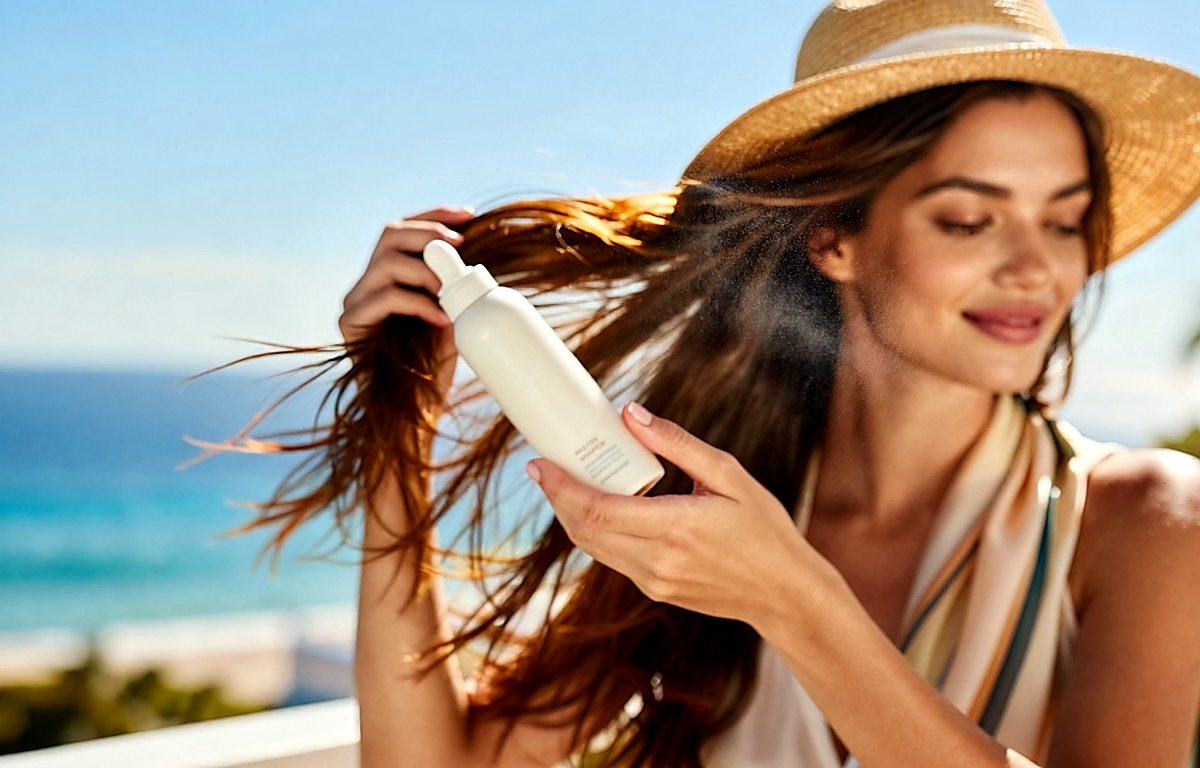
If you want the short, useful answer right away, here it is: a spray is usually more convenient for fine, normal, and easily flattened hair, as well as for quick blow-drying and light everyday styling. A cream usually works better on thick, dry, porous, curly, and damaged hair that needs more than a light watery product and benefits from extra frizz control. Milk is the most versatile in-between format: lighter than a cream, but noticeably more caring than a spray, which makes it especially good for medium-density hair, blowouts, and smooth styles without heaviness.
The main mistake when choosing a heat protectant is looking only at the phrase “protection up to high temperatures” and not taking your own hair length, density, porosity, and styling routine into account. The same product can seem wonderful on straight, thick hair and completely useless on fine, soft strands or, on the contrary, too heavy when you want root volume. So it makes more sense to choose not the “best heat protectant overall,” but the format that fits your usual technique: a blow dryer, round-brush blowout, flat iron, curling iron, diffuser, or simply drying without strong tension.
Why hair needs heat protectant and what it can realistically do
Heat protectant does not make hair invulnerable or turn hot styling into a completely safe procedure. But it can noticeably reduce mechanical and heat stress: it helps distribute heat more evenly, reduces overdrying through the lengths, improves the glide of a brush or flat iron, supports smoothness and shine, and sometimes even shortens drying time. That is its practical value.
It is also important to understand the limits. If you regularly run a flat iron over the same section many times, set the temperature to the maximum without a real need, or start straightening hair that is still damp, no heat protectant will make up for that kind of routine. It works best as part of careful styling: moderate heat, good product distribution, small sections, and as few extra passes as possible.
It is worth judging not only by what the packaging promises, but by how your hair behaves after styling. A well-chosen heat protectant leaves the hair looking more polished, causes less tangling through the lengths, does not leave stickiness, does not turn the ends into dry straw, and does not eat up root volume where you need it.
Spray, cream, and milk: what is the practical difference?
Although all three formats belong to the same category, they feel and behave differently.
Spray is the lightest and quickest format. It is the easiest to distribute through the full length, especially if your hair is fine, soft, or tends to get oily at the roots quickly. It rarely overloads the hair, is convenient for refreshing a style, and usually appeals to people who do not like feeling product in their hair. The downside is that very dry, porous, or highly frizz-prone hair may not get enough from a spray alone: the protection will be there, but the control and softness may fall short of what you want.
Cream is a richer format. It gives the lengths a more controlled, polished feel, smooths the cuticle more effectively, helps with round-brush blowouts and smoothing styles, and softens porous ends. But it is easy to overdo: if you use too much, hair can lose its lightness more quickly, look flat, or feel overloaded.
Milk is a compromise between the lightness of a spray and the care of a cream. It usually spreads more softly and evenly than a cream, while providing more smoothness than most lightweight sprays. If you are not sure where to start, milk is often the safest choice for real life: blow-drying, blowouts, occasional straightening, and fighting frizz without the feel of a heavy style.
There is also a fourth important point: the result depends not only on the format, but on the amount you use. A lightweight cream in a tiny amount may suit fine hair better than a spray applied too generously. So the format is a guideline, not a rigid rule.
What to choose for your hair type
The easiest way is to start with four factors: strand thickness, density, porosity, and tendency to frizz.
- Fine, soft, uncolored, or slightly damaged hair: in most cases, start with a spray. It is less likely to steal volume and does not make the lengths feel heavy. If the ends are dry, you can add literally a drop of a more nourishing product only to the lower third of the hair.
- Normal hair with medium density: usually does best with milk. It offers balance—protection, visual smoothness, and styling convenience.
- Thick, coarse, porous, lightened, curly, or very frizz-prone hair: usually benefits more from a cream or a richer milk. It needs not just a light protective layer, but extra control as well.
- A combination situation—oilier at the roots, drier through the lengths: apply a lightweight spray through the main body of the hair and a denser product only on the dry ends. This is often more effective than trying to find one product that does everything at once.
If your hair reacts strongly to humidity and starts frizzing quickly after styling, you may find it useful to read an additional piece on how to keep hair smooth and soft in damp air: frizz-free hair after humidity. It shows clearly that heat protection and moisture protection are not the same thing, even though these goals often overlap in styling.
How to match the format to a specific styling routine
The same person may use different formats depending on the tool. That is normal, and often more convenient than trying to solve everything with one bottle.
For blow-drying without complicated styling, a spray or a lightweight milk usually works best. What matters here is speed, easy distribution, and the absence of a sticky film. If your hair is fine, choose the lightest possible option. If it is somewhat dry and porous, a more caring milk may work better.
For a round-brush blowout, milk and cream work especially well. A blowout requires control through the lengths: the hair needs to follow the brush, lie smoothly, not fly away, and not frizz. A lightweight spray can also work, but it may not be enough if the length is coarse or porous.
For a flat iron, smoothness, slip, and moderation in the amount of product matter most. Often the best choice is milk in a small dose or a lightweight smoothing cream fully distributed through the lengths. Hair should be dry before using a flat iron. If a section still feels damp or sticky after the product, it is better not to start styling right away.
For a curling iron and curls, choose the format according to your hair type, but keep shape retention in mind. A cream that is too nourishing can sometimes make the curl softer and heavier. Fine hair usually does better with a spray; medium-density hair with milk; and thick, frizz-prone hair with a moderate amount of cream.
For the curly method with a diffuser, the heat protectant should not clash with your styling products. Milk or a lightweight cream under a curl gel or curl cream is often more comfortable than a watery spray, which may not give enough control to porous lengths.
What to look for in the formula and description, and what not to overvalue
There is no need to be intimidated by long ingredient lists: heat protectants are almost always built around a combination of conditioning, film-forming, and smoothing components. In practice, it is more useful to look not for one “magic” ingredient, but at the overall character of the formula.
- Silicones often provide that slip, shine, and visual smoothness. In many formats, they are a normal and functional part of the formula, not a reason to reject the product automatically.
- Hydrating and softening ingredients help dry lengths feel better after blow-drying and round-brush styling.
- Proteins, amino acids, and plant extracts can be a pleasant addition, but on their own they do not guarantee that styling will turn out well.
- Claims such as anti-frizz, smoothing, and detangling are usually genuinely useful if what you need is smoothness and frizz control.
- Overly loud promises such as “complete repair from high temperatures” are best taken calmly: styling is always a compromise, not a miracle.
If your scalp is sensitive, also pay attention to fragrance: sometimes it is the strong scent, not the format, that makes a product uncomfortable for everyday use. If you experience persistent burning, pain, scalp swelling, significant hair shedding, or suspect a dermatological condition, stop using the product and consult a doctor. During pregnancy, with skin conditions, and when using topical retinoids actively, it is best to introduce any new scalp products with extra caution and discuss them with a doctor if you have doubts.
How to apply heat protectant correctly so it works
Even a good product is easy to ruin with the wrong application. The most common mistakes are using too little on long, thick hair, too much on fine hair, applying it only on top for appearance’s sake, and trying to heat a wet section right away.
- Prep the hair: gently squeeze it with a towel or soft fabric. Water should not be dripping from it.
- Divide the lengths into sections: especially if your hair is thick. This helps the product reach more than just the top layer.
- Apply with the lengths and ends in mind: the roots usually do not need the same amount of product as the drier parts of the hair.
- Distribute it with your hands or a comb: this matters for spray, milk, and cream alike. Uneven application reduces both protection and styling quality.
- Wait a little before using a hot tool: especially if you used a richer format. The product needs a moment to settle on the hair.
- Set a reasonable temperature: the finer and more damaged the hair, the lower the heat should be and the fewer passes you should make.
If you blow-dry your hair almost every day but use a flat iron rarely, focus not on the product’s maximum “strength,” but on comfort in regular use. A product that sits on the shelf because it feels heavy or sticky is less useful than a lighter one that you genuinely like and use consistently.
Common mistakes: why the product “doesn’t work”
The complaint “this heat protectant did not suit me” often means not that the whole category failed, but that the format and the task did not match.
- The spray did not reduce frizz: your hair may simply need a denser format—milk or cream.
- The cream weighed the hair down: you are probably using too much, or it is not the right fit for fine hair and root volume.
- Hair gets dirty faster after the product: it was applied too close to the roots, or the format is too nourishing.
- The flat iron makes sections feel sticky: the product did not have time to distribute properly, or you started working on hair that was not fully dry.
- There is no feeling of protection: in reality, a heat protectant does not have to feel like a film. Sometimes a good result simply means less breakage, fewer sticking-out ends, and a smoother finish after styling.
Another common issue is layering too many leave-in products at once. A light conditioner, then oil, then cream, then spray, with styling on top—and in the end the hair does not shine, it just looks overloaded. The more layers you add, the higher the risk of losing lightness and ending up with an effect different from the one you wanted.
How to build your own working routine without unnecessary purchases
If you do not want to turn hair care into a complicated system, start with simple logic.
Scenario 1: hair is fine or medium, and styling is mostly with a blow dryer. Choose a spray or a lightweight milk. See whether the volume stays and whether the ends remain free of frizz. If the volume drops, the product is too heavy. If there is not enough smoothness, move from a spray to milk.
Scenario 2: hair is porous, dry, lightened, and you often do blowouts or use a flat iron. Start with milk or cream. Evaluate softness, shine, strand manageability, and the condition of the ends over several styling sessions in a row.
Scenario 3: roots lose freshness quickly, but the lengths are dry. Use a zoned approach: a lighter product on the main body of the hair and a very small amount of a richer one only on the lower part of the lengths.
Scenario 4: styling is infrequent, but you want one universal option. In this case, milk is usually the most sensible place to start.
Overall, the principle is similar to basic care in other beauty categories: it is better to build a clear routine that works than to swing between extremes. In that sense, the logic of choosing products is similar to the way a regular skincare routine is usually built—around needs, not random promises on packaging. If that approach resonates with you, you can read the piece on how to build a basic skincare routine: the logic of sensible selection there is very recognizable.
For hair, that means one simple thing: if you blow-dry almost every day, prioritize a comfortable everyday product. If you do less frequent but hotter styling, the priority is to avoid overheating the hair and choose the format that gives the best control for your specific tool.
Bottom line: what should you choose?
If we keep it very short, a spray is the best candidate for lightness, speed, and fine hair; a cream is for thick, dry, porous hair that needs control; and milk is for those who want the golden mean and versatility for blow-drying, blowouts, and occasional straightening. Choose not by how loud the promises are, but by how your hair looks and feels after several styling sessions in a row: whether the volume stays, whether there is less frizz, whether the ends feel less dry, whether the brush moves through more easily, and whether any heaviness appears.
A good heat protectant is neither a myth nor a marketing formality, but a practical working tool. But it truly shows its value only when paired with gentle technique: moderate heat, sufficient drying, correct dosage, and an honest assessment of your hair’s needs. Then the choice between spray, cream, and milk becomes not a difficult problem, but a simple way to tailor styling to yourself.