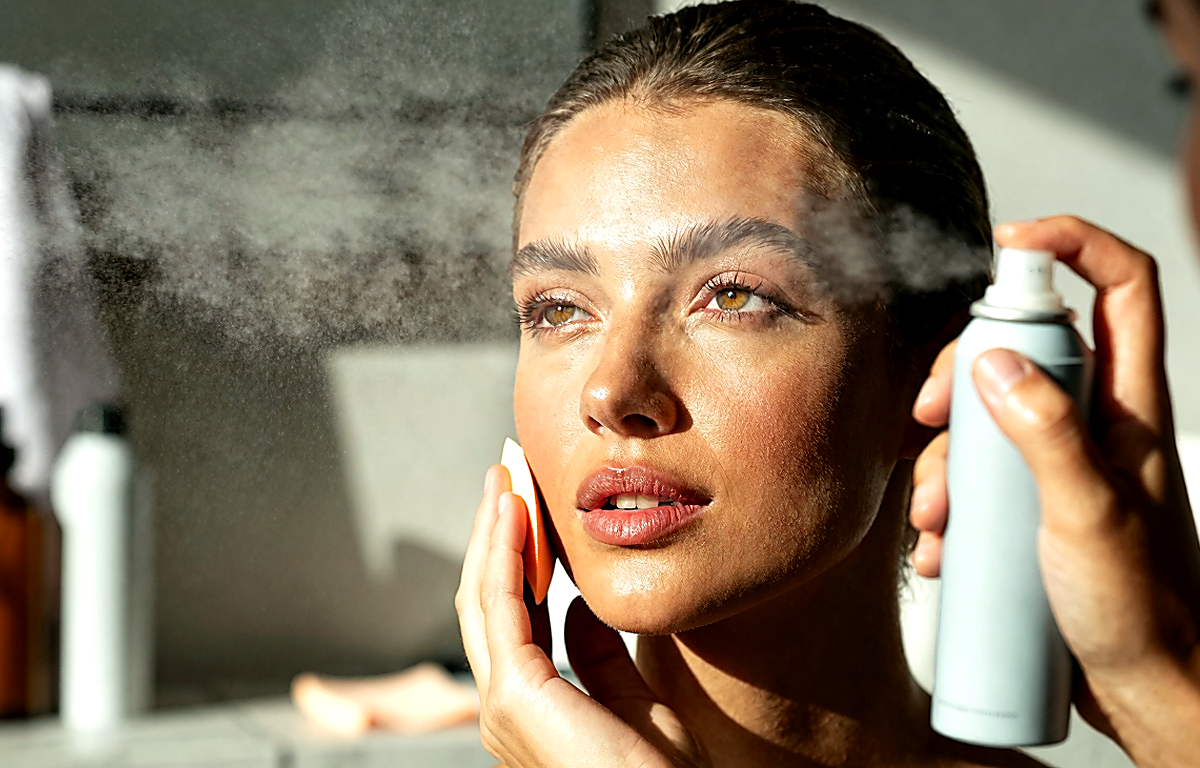
Setting spray for makeup is not necessary for everyone or every day. But in hot weather, at long events, with very expressive facial movement, fuller-coverage foundation, or makeup that tends to slip, it really can help: it binds makeup layers together, makes the finish look more seamless, and often keeps the face looking tidy for a few extra hours. The main mistake is expecting it to work miracles when the real issue is unsuitable skincare, a foundation layer that is too thick, or clashing textures. In that case, instead of a fresh finish, you can easily end up with stickiness, patchiness, and a film-like feel.
If you need the quick answer, here it is: setting spray is useful when your makeup needs to last longer than usual or when you want to take away that powdery look and make the layers melt into more natural-looking skin. To avoid a sticky finish, choose a formula for your skin type, do not spray too close, do not apply it over wet cream, and do not try to soak the face in hopes of extreme wear time. A good spray works as a finishing touch, not as a product that is supposed to fix every mistake in skin prep.
These days, setting sprays are often confused with hydrating mists, thermal water, and refreshing face sprays. They may look similar, but they do different jobs. A mist may simply refresh and lightly hydrate, while a setting spray is usually focused specifically on how makeup behaves: how it looks after 4–8 hours, whether it transfers less, whether it breaks apart into separate patches, and whether the complexion stays even around the nose, chin, and forehead.
Below, we will break down when this kind of spray is truly worth it, how to tell which formula suits you, and what to do if your face feels sticky, heavy, or too shiny after spraying.
When a setting spray is actually worth it
In everyday life, you can easily skip it if your skincare feels comfortable, your base is light, and your makeup already wears well on its own. But there are situations where a spray is especially useful.
- Heat and humidity. In these conditions, foundation tends to move faster, shine shows up more quickly, and powder or concealer can look more obvious. A setting spray helps makeup look more pulled together.
- A long day away from home. If you have work, meetings, and an evening event ahead, a spray can reduce how many touch-ups you need.
- Photo and video shoots. It often removes a dry, powdery look and makes textures on the skin appear more even.
- Full or layered makeup. When you are wearing primer, foundation, concealer, cream contour, blush, and powder, a spray helps bring the layers together.
- Expressive facial movement. It will not freeze your face, but it may reduce the feeling that makeup quickly breaks up in mobile areas.
- Special occasions. A wedding, graduation, concert, trip, or performance—those moments when you want to think less about touch-ups.
At the same time, it is important to remember this: if your foundation sinks into pores, gathers around the nose, or turns patchy within the first 20–30 minutes, the problem is not necessarily the lack of setting spray. Often the reason is that your skincare is too rich, has not had time to absorb, or does not work well with your makeup products. It is often more helpful to review the base first. For example, if your skin feels overloaded, it may help to return to a simpler, clearer routine; you can read more about that in our article on how to build a basic skincare routine for the face.
What a setting spray really does—and what it cannot do
The best way to avoid disappointment is to understand the product’s real role. A setting spray is not supposed to turn any makeup look into an immovable mask. Its job is usually more modest, but also more useful.
What it can do:
- reduce that dry, over-powdered feeling after powder;
- make transitions between products look softer;
- slightly improve the wear of foundation, blush, and bronzer;
- help makeup look fresh for longer;
- make excess powderiness less visible.
What it usually cannot do:
- save a foundation formula that does not suit you;
- neutralize strong oiliness all day without blotting papers;
- replace a primer if you have a specific concern about texture or pores;
- fix a makeup layer that is too thick;
- keep skin comfortable if it is already irritated or dehydrated.
In essence, a good spray works best as part of an already successful makeup routine. If your foundation, concealer, and powder are chosen well from the start, it can give you that polished, cohesive result. But if the skin is overloaded with cream, SPF, and several dense layers of makeup, the spray will only highlight the problem. By the way, one of the most common summer issues is the combination of sunscreen and makeup. If you notice patchiness from powder over SPF, it is worth reading how to apply powder over SPF without patchiness.
Why stickiness happens: the most common reasons
Stickiness after setting spray is not always a sign of a bad product. Much more often, it is the result of the wrong application scenario. Here are the main reasons a face can start to feel unpleasant.
- Too much product. This is the most common mistake. It seems logical: the more you spray, the better the hold. In practice, the skin takes longer to dry, the layers begin to move, and the finish becomes sticky and heavy.
- Spraying too close. If you hold the bottle almost against the face, you get large droplets instead of a fine mist. They wet certain areas, disturb powder, and create patchy shine.
- Skincare or SPF has not dried down. If there is still moisture under your makeup and you add spray on top, you end up with layered dampness. The face feels tacky, and makeup may start to slide.
- Clashing textures. A very nourishing cream, a rich glowy foundation, cream products, and then a heavy-duty setting spray can create not longer wear, but drag and stickiness.
- The formula does not suit your skin type. Dry skin may dislike mattifying sprays with a more noticeable film, while oily skin may struggle with very hydrating mists that leave a wet finish.
- Too much powder before the spray. It can seem like a good idea to powder thoroughly first and then bring the face back to life with spray. But when there is too much powder, the spray can make the finish look doughy rather than natural.
Climate matters too. In humid weather, even a good spray can feel more noticeable than it does in winter or in air-conditioned rooms. If you generally dislike sticky textures in skincare, you will likely prefer thinner, fast-drying formulas and a moderate amount of product. The same logic applies in body care: in hot weather, lightweight textures without a film are especially appreciated, as we discussed in our article about lightweight body cream for summer without stickiness.
How to choose a setting spray for your skin type and goal
Buying the first spray you see just because it is popular is not the best idea. It makes more sense to look at your goal: do you want a more matte result, a more natural fusion of layers, comfort for dry skin, or longer wear in hot weather?
If your skin is oily or combination. Look for formulas that promise shine control, light fixation, and quick drying. They are usually more comfortable in warm weather and less likely to create that sticky-mask feeling. But do not expect your face to stay completely matte until night; blotting papers may still be necessary.
If your skin is dry or dehydrated. Sprays that do not emphasize tightness and help reduce powderiness are usually more helpful. It is important that they do not feel too alcohol-heavy. But there is a trap here too: overly wet formulas can look beautiful at first and then turn into an uncomfortable sticky finish an hour later.
If your skin is sensitive. The shorter and clearer the ingredient list is for your personal triggers, the better. Fragrance, active extracts, and strong stinging after spraying are not things you should tolerate. A brief cooling sensation can be acceptable, but persistent burning, pain, redness, swelling, or watery eyes are reasons to stop using the product. If irritation does not go away, if your skin is markedly sensitive, if you have skin conditions, or if you are pregnant, it is better to discuss product choices with a doctor. This is especially important if you use retinoids or other actives that make the skin more reactive.
If you need makeup for an event. You can choose a more fixing formula, but test it at home in advance. On the day of an important event, it is better not to combine a new skincare product, new SPF, new foundation, and a new spray for the first time.
Another detail is the finish. A matte spray does not always look drier, and a glowy one is not always the same as sticky. Pay attention not only to brand promises, but to how the product behaves in your actual routine: with your cream, sunscreen, foundation, and powder.
How to apply setting spray so makeup looks better, not heavier
Technique matters more here than it seems. Even a good formula can disappoint if you use it the wrong way.
- Let skincare settle completely. After cream and SPF, wait until the skin no longer feels wet to the touch. It can still feel comfortable and slightly supple, but not damp.
- Do not overload the base. Setting spray works better over thin to medium layers. If the makeup already looks heavy, it rarely saves the situation.
- Powder only where you need it. Usually the T-zone or the areas where makeup moves faster are enough.
- Keep the bottle at a distance. The goal is a fine cloud, not big droplets on the cheeks and forehead.
- A few sprays are enough. There is no need to circle the entire face ten times. Less, but even, is better.
- Do not touch your face while the product is setting. Otherwise, you can disturb the top layer of makeup.
- If needed, gently blot the excess. If you accidentally sprayed too much and can see droplets, do not rub them in. It is better to lightly press a clean tissue onto the skin.
Some makeup artists use setting spray not only at the end, but also between layers: after cream products or after a light layer of powder. This can work, but at home it is better to be careful with this approach. Layered spraying increases the risk of overdoing it, and with that, the risk of stickiness.
If you want a more natural finish without extra weight, start with the most minimal version: foundation, local powder where needed, 2–4 sprays from a distance, then do not touch anything for a few seconds. That is often enough to make the face look less powdery and more seamless.
What to do if the spray has already left a sticky or overly wet finish
The good news is that you can often fix the situation without washing everything off and redoing your makeup.
- Wait 30–60 seconds. Some formulas feel wet at first and then calm down noticeably.
- Gently blot the excess. A clean paper tissue, used without rubbing, often removes extra moisture and gives the face a calmer appearance again.
- Go over the sticky areas with a light veil of powder. There is no need to repowder the entire face. The areas where the stickiness bothers you most are enough.
- Use a cool stream of air. A fan or the cool setting of a hair dryer from a distance can sometimes help the finish settle faster. The key is to avoid strong airflow.
- Next time, use less product. If the spray itself is not bad but feels heavy, using half as much is often enough.
If the stickiness happens every time despite careful technique, the problem is probably not your application but a mismatch between the formula and your skin or overall makeup routine. In that case, it is easier to switch to a different kind of spray than to keep trying to make a consistently uncomfortable product work.
If you develop persistent burning, itching, sore eyes, pronounced redness, or swelling after use, do not dismiss it as normal setting power. Stop using the product and, if symptoms continue, see a doctor. This is especially important with sensitive skin, rosacea, dermatological conditions, and periods when the skin is weakened by active skincare.
How setting spray differs from a mist, thermal water, and primer
Confusion between similar formats is one of the reasons people make disappointing purchases. In stores or on social media, all of these can easily be mixed into one general category of “spray-on face product,” but there is a difference.
Setting spray is a finishing product for makeup. Its main job is to affect how makeup looks and wears after application.
Hydrating mist is usually more about skin comfort and freshness. It can feel pleasant during the day, but it does not always improve makeup wear. Sometimes it does the opposite—especially if you use it over an already unstable base.
Thermal water is usually treated as a soothing and refreshing step. It is not the same as setting makeup, although in some cases a light spray can visually soften powderiness.
Primer is a base product used before makeup. It works at the beginning: smoothing texture, adding grip, mattifying, or, on the contrary, adding glow. A setting spray is the finishing touch.
The simplest way to think about it is this: if your problem starts before foundation goes on—for example, makeup immediately emphasizes texture or does not apply well—you probably need to review your skincare or primer. If everything looks good at first but after a few hours the face loses freshness, separates into layers, or becomes too powdery, then a setting spray makes more sense.
Practical mistakes that most often ruin the result
Even with a good product, there are several common mistakes that can make makeup look worse than it could.
- Applying the spray from too close a distance. That almost guarantees droplets instead of a fine mist.
- Trying to use it instead of proper skin prep. If the base is not working, a spray rarely fixes the issue.
- Mixing too many wet textures. Heavy SPF, a rich cream, a glowy foundation, cream highlighter, and a generous layer of spray are a common recipe for stickiness.
- Using it as a refreshing mist throughout the day when there is no real need. Some setting products are not meant to be reapplied again and again over already tired makeup.
- Ignoring the season. In summer and in humid climates, the same formula can feel completely different than it does in winter.
- Ignoring your skin’s reaction. If a product causes discomfort every single time, it is better not to convince yourself that “this is just how it should be.”
There is also a less obvious mistake: aiming for absolute immobility in makeup. Skin is not paper; the face moves, produces sebum, and comes into contact with air and clothing. The goal is not to freeze everything in place, but to still look polished and natural a few hours later. Sometimes that takes not a new spray, but a lighter foundation, a more moderate amount of powder, and sensible skincare.
By the way, the logic of managing excess moisture and frizz is not limited to makeup. In humid weather, hair often loses its shape for the same reason—too much moisture in the air—and the right finishing products matter there as well. If that topic is relevant to you, take a look at our article about hair without frizz after humidity.
Bottom line: do you need a setting spray?
Setting spray is a useful product, but not an essential one. It is especially good when you want makeup to keep a neat appearance longer, reduce excess powderiness, and make the finish look more unified. But it does not replace proper skin prep and should not leave behind lasting stickiness. If your face feels unpleasantly tacky after using it, the answer is usually not to endure it, but to reconsider the amount of product, your spraying technique, and whether the formula works with your skincare and makeup.
Put very simply, setting spray is worth trying if your makeup often loses freshness by the middle of the day or looks too dry after powder. To get a beautiful result, apply it moderately, over a dry base, and with a clear purpose. Then instead of a sticky film, you will most likely get exactly what this format is meant to deliver: makeup that looks more alive, more polished, and longer-lasting.