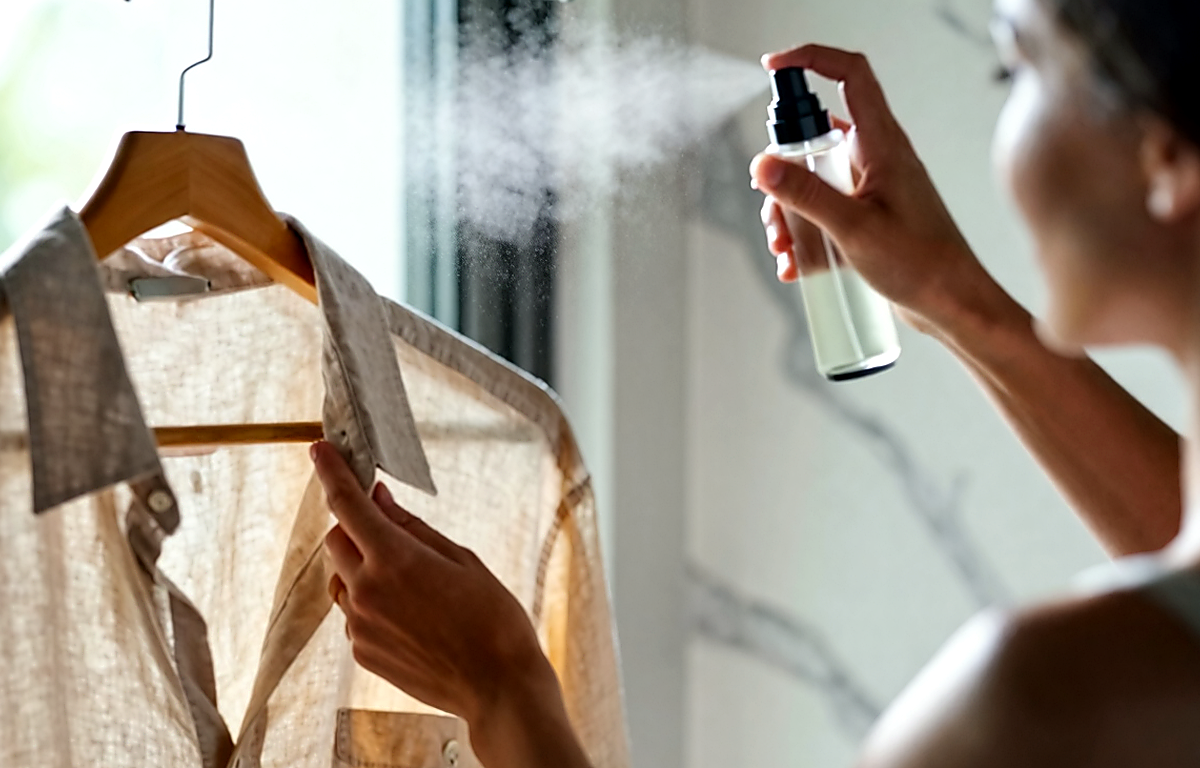
In summer, many people apply fragrance not only to their skin but also to their clothes: the scent feels softer, lasts longer, and does not mix with sweat, SPF, and rich creams. But this habit has a downside: alcohol, colorants, oils, and resins in the formula can leave marks, alter the fabric’s color, or even damage delicate fibers. The good news is that you can wear perfume on clothing safely if you take the material, fragrance format, and application point into account.
The main rule is simple: in summer, spray fragrance not onto the front of the fabric, but onto inner layers, lining, seams, the hem from the inside, or separate textile accessories that are easier to replace and wash. For silk, satin, viscose, and fine linen, it is especially important to test first on an inconspicuous area. The hotter the day and the lighter the clothing, the more careful the dosage should be: 1-2 light sprays from a distance of 20-30 cm are better than one dense wet cloud in a single spot.
Why Fragrance Behaves Differently on Clothes in Summer
In hot weather, perfume evaporates faster. This is especially noticeable on skin: body temperature is higher, the sun increases the volatility of the top notes, and sweat and skincare products can change how the composition smells. That is why clothing seems like a convenient alternative: fabric does not heat up the way skin does, and the scent often lasts longer and more evenly. But summer is also when the risk of mistakes goes up.
There are several reasons fabric suffers more often in the warm season:
- we wear thinner and lighter materials, where stains show up more quickly;
- summer clothes are more often made from delicate fibers such as silk, viscose, linen, and blended fabrics;
- high temperatures speed up alcohol evaporation, which can also change how aromatic oils are distributed through the fabric;
- clothing comes into contact with sweat, SPF, deodorant, and body cream more often, which increases the risk of marks.
If you actively use body care in summer, especially light lotions and creams, it is better to wait until they are fully absorbed before applying fragrance to your clothes. Otherwise, a stain may appear not only because of the perfume, but because of the mix of cosmetics and fabric. In that sense, it helps to build a summer body-care routine around products that do not leave a sticky film; we have already written about that in our article about a lightweight body cream for summer without stickiness.
Which Fabrics Can Be Scented and Which Are Better Left Alone
The safest approach is not to treat all clothing the same way. The same fragrance behaves very differently on a white cotton shirt and on a silk top. Before applying it, assess not only the item’s color, but also the fabric composition, weight, and finish.
Usually more tolerant of careful spraying:
- heavy cotton;
- denim;
- tailored wool with lining;
- blended fabrics without a pronounced sheen;
- lining fabrics, as long as they are not too thin.
Require caution:
- linen, especially bleached or very fine linen;
- viscose;
- light-colored knitwear;
- satin and fabrics with a smooth surface where any halo is visible.
Better not sprayed directly at all:
- silk;
- satin;
- velvet;
- suede and leather;
- items with sequins, glued-on embellishments, prints, or metallic-thread embroidery;
- vintage and especially fragile garments.
Why such a wide range? Delicate fabrics have thinner fibers that are more sensitive to alcohol, colorants, and oily components. On a smooth surface, almost any trace will show. And garments with special finishes, for example water-repellent or glossy ones, can change texture locally.
If you are unsure about the composition, follow a simple rule: the more expensive, thinner, lighter, and more high-maintenance the fabric is, the less likely direct spraying is to be a good idea.
Which Fragrances and Formats Are Safer for Clothing
For fabric, not only the act of spraying matters, but also the type of fragrance product. The more colorants, resins, and oily components there are in the formula, the higher the risk of marks. It is especially wise to be cautious with rich oriental, gourmand, amber, and oud compositions: they are excellent for longevity, but they can leave a visible trace on light-colored clothing.
Usually safer for summer clothing:
- light citrus, green, aquatic, and tea compositions;
- colognes and light eau de toilette formulas with a transparent trail;
- hair sprays and special textile mists, if the manufacturer specifically indicates this method of use.
Require extra attention:
- oil-based perfumes;
- perfume extracts;
- dark-colored liquids;
- fragrances with a strong vanilla, resinous, or balsamic base;
- sprays with shimmer or conditioning additives.
If you really want to wear a rich evening fragrance in summer, do not spray it onto the visible part of your clothing. It is better to choose one of the workarounds: apply it to the inner seam of a blazer, to a scarf, to a removable collar, to a ribbon in your hair, or to a bag lining. This way the trail stays, while the risk to the fabric is lower.
Hair is a separate issue. Many people try to replace clothing application by spraying fragrance onto their strands, but regular perfume can dry out the lengths because of its alcohol content. If you want the scent to stay with you all day, it is safer to choose dedicated hair mist formulas and keep an eye on how your hair behaves in summer humidity. Our article about keeping hair frizz-free after humidity may also be useful.
Where to Spray Fragrance So It Does Not Leave Stains
The most common mistake is spraying fragrance onto the center of the chest, the shirt collar, or directly onto the shoulder of a blouse. These are exactly the areas that are most visible, rub against the skin most often, and collect traces of skincare the fastest. It makes much more sense to choose spots where the fragrance works like a soft trail rather than a visible wet patch.
Best areas for applying fragrance to clothes in summer:
- the inside of the hem of a dress or skirt;
- the inside of a shirt at side-seam level;
- the inner side of a blazer lapel;
- the lining of a jacket or lightweight trench;
- the inside of a scarf, kerchief, or dense-cotton bucket hat;
- a fabric scrunchie, ribbon, scarf, or another removable accessory.
Areas best avoided:
- the underarm area;
- the neckline and collar, especially on light-colored fabric;
- cuffs;
- silk belts, bows, and decorative details;
- places where the fabric sits close to skin covered with SPF, deodorant, or cream.
If you are wearing a white shirt, a linen sundress, or a light-colored top, the safest option is to spray the fragrance into the air in front of you and walk through the cloud, but only if the fabric is not delicate and you do not overdo it. This method is not ideal for longevity, but it reduces the risk of a local wet stain. For silk and satin, even that may be too bold.
Step-by-Step Application Technique: Short and Mistake-Free
If you want a simple, practical routine that works for most summer clothes, use this order. It is especially convenient in the morning, when there is no time for experiments.
- Check the fabric. Look at the composition on the label and assess the color, density, sheen, and any embellishment.
- Do a test. One micro-spray on an inconspicuous area from the inside. Wait until the spot is fully dry.
- Choose the right distance. Ideally 20-30 cm. Too close creates a wet patch; too far means half the fragrance settles somewhere else.
- Do not spray one spot for too long. 1-2 sprays are enough. In summer, less is almost always better than more.
- Let the fabric dry. Do not put the item on immediately if the area is still damp.
- Do not rub. It is bad for both the fabric and the way the fragrance develops.
If you are heading out into heat, onto public transport, or to a daytime event, limit yourself to one light layer. Overapplying fragrance to fabric in summer rarely smells “luxurious” — more often, it makes the trail feel heavy and intrusive, especially in stuffy rooms.
Another useful principle is to combine skin and clothing rather than trying to replace one with the other. For example, one micro-spray on clean, dry skin in an area covered by clothing, and one on the inner layer of fabric. This gives the fragrance more dimension while reducing the load on the material.
What Not to Do: Mistakes That Leave Marks Behind
Most ruined garments suffer not from the fragrance itself, but from the wrong habit of using it in a rush. In summer, the price of that haste is higher because fabrics are thinner and there are more skincare products on the skin.
The most typical mistakes:
- applying fragrance to clothing right after cream, body oil, SPF, or deodorant;
- spraying a dark or formula-heavy perfume onto white and pastel fabrics;
- using oil perfumes on clothes instead of skin;
- drenching the chest and neck area so it “definitely lasts”;
- spraying silk and satin without testing first;
- trying to overpower the smell of heat with extra layers of fragrance;
- putting the item away or wearing it before it is fully dry.
A sunny day deserves a separate note. If part of the clothing remains exposed and the fragrance lands not only on the fabric but also on nearby skin, it is better to avoid unnecessary layering. Some fragrance and skincare ingredients can increase the skin’s sensitivity to the sun. If persistent burning, pain, pronounced redness, or swelling appears after application, it is best to stop using the product and consult a doctor. During pregnancy, with active skin conditions, and while using retinoids, it is especially important to be careful with any potentially irritating products.
What to Do If a Stain Has Already Appeared
The first rule is not to rub the stain aggressively or soak it with the first product you find in the bathroom. Fragrance stains are tricky because they may contain not only alcohol, which evaporates quickly, but also oils, resins, and colorants. The wrong cleaning method can sometimes make the mark more visible.
What to do:
- Immediately blot the area with a dry, clean tissue if the fabric is still damp.
- Check the care label: can the item be washed, is it dry-clean only, or does it require a delicate cycle?
- If the fabric is not demanding, try cool water and a mild product on an inconspicuous area.
- Do not use hot water: it can set the stain.
- For silk, wool, satin, velvet, and garments with complex construction, it is better to choose professional dry cleaning right away.
If the stain feels oily, the cause is most likely oily components in the fragrance. If there is a halo without obvious oiliness, the problem may be an alcohol mark on a delicate surface. In both cases, it is best to act gently and quickly. The longer the stain stays on the fabric, the harder it becomes to remove without a trace.
A useful habit is to keep your favorite summer fragrance in a small travel version and avoid refreshing it blindly on clothes during the day. Reapplying over a layer that has already settled is exactly what most often ends in a stain, because by then the fabric may already have absorbed sweat, dust, and skincare products.
How to Make the Scent Trail on Clothes Last, but Stay Delicate
Many people want their fragrance to stay on fabric from morning to evening, but without harshness. You do not need to increase the number of sprays to do that. It is much more effective to change your application strategy and choose the right scent carriers.
Practical ways to extend the trail without risk:
- apply fragrance to layered clothing, where the inner layer takes the main load;
- use textile accessories: a scarf, scrunchie, ribbon, or the inside of a bucket hat;
- choose light but long-lasting formulas instead of sweet and dense ones;
- refresh the fragrance not on clothing, but on a removable accessory;
- store the item in a ventilated place so old scents do not mix with new ones.
Sometimes the best summer option is not to spray fragrance onto the clothing itself at all, but to scent the space around you through accessories. For example, a light cotton scarf or the inside lining of a bag creates a soft background that is noticeable in motion but does not overwhelm either the fabric or the people around you.
If your summer look includes active makeup and SPF, try not to direct fragrance toward the face and décolletage area. This reduces the risk of irritation and does not clash with makeup products. By the way, if you reapply protection and makeup in layers during summer, our article about how to apply powder over SPF without patchiness may be useful: the logic of gentle layering there is very similar.
How to Adapt the Habit to Your Wardrobe
There is no universal “always fine” or “never okay” rule for perfume on clothing. It is much more useful to connect the habit to your actual wardrobe. If you wear linen, white shirts, and silk tops all summer, your safe routine will be one thing. If you prefer cotton T-shirts, denim, and blazers, it will be another.
If your wardrobe includes a lot of linen and light-colored cotton:
- do not spray the center of the garment;
- focus on the inside and the hem;
- choose transparent compositions without a dense sweet base.
If you often wear delicate fabrics:
- use only a test on an inconspicuous area;
- it is better to transfer the fragrance to accessories rather than the garment itself;
- consider a dedicated hair mist or textile mist.
If your style is T-shirts, oversized shirts, and denim:
- you have more freedom, but it is still worth respecting distance and dosage;
- do not apply it to areas that come into contact with deodorant and SPF;
- do not refresh the fragrance many times during the day in the exact same spot.
And finally, take the composition itself into account. In summer, fragrances that do not try to “shout” from the fabric work especially beautifully, staying in the background instead: clean musks, tea notes, transparent citruses, greens, and soft florals. The lighter the character of the fragrance, the more naturally it works on clothing in the heat — and the less tempting it is to overdo it.
Conclusion
You can apply fragrance to clothes in summer if you do it deliberately rather than automatically. The safest choices are inner areas of the fabric, moderate dosage, a test on an inconspicuous spot, and avoiding direct spraying on silk, satin, light linen, and garments with complex embellishment. If you want better longevity, it is better to work not through quantity, but through the right area and the right accessories. That way your clothes stay in good condition, and the fragrance feels light, clean, and appropriate even on a hot day.