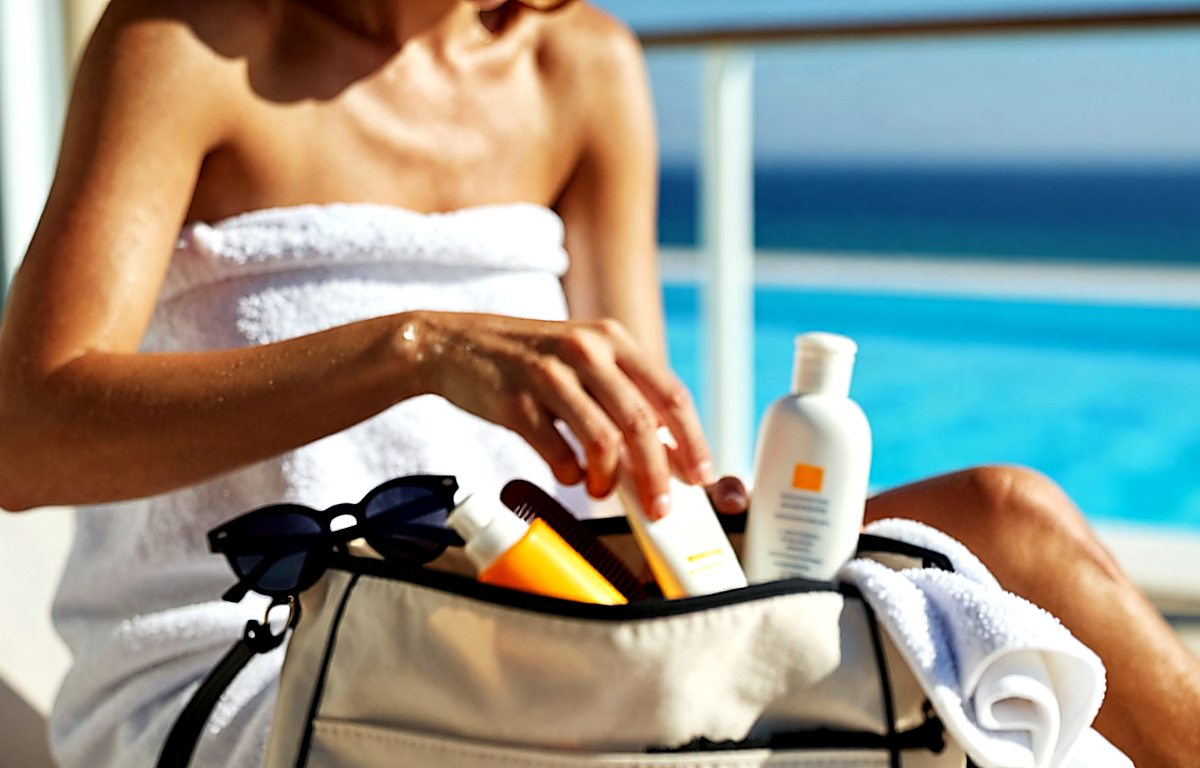
A beach beauty bag should not be big, but smart: by the water, you really need only a few categories of products – reliable SPF, lip protection, gentle cleansing after the beach, basic hydration, and a couple of things to keep your hair and body comfortable. Anything that does not handle heat, sun, sand, and salt water well is better left at home: full-coverage makeup, active acids, retinoids, heavy fragrances, and fragile glass bottles. The main principle is simple: at the beach, cosmetics should not look impressive, but protect, reapply quickly, and avoid irritating the skin.
If you pack your bag by that rule, отдых becomes easier. Instead of ten bottles, one good sunscreen for the face and body, an SPF stick for sensitive areas, an SPF lip balm, a gentle cleanser, a light cream or lotion for after the shower, a comb, a hair tie, and a hat are enough. That is sufficient to keep your skin from getting overly dry, without spending time on a layered routine that will slide off anyway in the heat and water. Below is a practical list of what to take to the water, and an equally important list of what is better left at home.
What you should always take to the water: the essentials you really need
In a beach beauty bag, the winners are not the prettiest bottles but the clearest, most convenient formats. A product should be easy to reapply, able to handle the heat, and not turn your face and body into a sticky film. It is better to test textures at home in advance, not for the first time on the beach.
- Face sunscreen SPF 30-50+. If you spend more than half an hour by the water, anything below SPF 30 has little practical value. For fair, sensitive, or easily flushed skin, SPF 50 is often the more comfortable choice.
- Body sunscreen. A separate body product is usually easier to spread in the amount you actually need. Milk, lotion, fluid, or spray formats can all work, but even sprays still need to be spread carefully with your hands.
- An SPF stick for sensitive areas. The nose, cheekbones, ears, shoulders, part line, moles, and tattoos often burn first. A stick is convenient for quick reapplication in the wind and on the go.
- SPF lip balm. Lips are what people forget most often, even though they dry out quickly in sun and wind. A simple protective format without strong menthol or irritating fragrance is the better choice.
- Gentle cleansing after the beach. A mild gel or foam cleanser is enough to wash off SPF, salt, sand, and sweat in the evening. Harsh cleansing until the skin squeaks is almost always unnecessary in summer.
- A moisturizing body product. After a shower, the skin usually needs not a rich body butter but a light cream or lotion that absorbs quickly. If that is the texture you prefer, you can use the advice in the article on a lightweight body cream for summer without stickiness.
- Thermal water or simply a bottle of clean water. The first can feel refreshing, but it does not replace cream or SPF. The second matters more: dehydration affects both how you feel and how comfortable your skin feels.
- A wide-tooth comb, a soft hair tie, or a clip. Hair gets tangled by the water faster than it seems, especially with humidity and wind.
If you do not want to overload your routine, build your beauty bag around one question: Will this help me handle sun, water, and heat without harming my skin? If not, it is almost certainly unnecessary.
How to choose beach SPF so it actually works instead of just sitting in your bag
Beach SPF has two jobs: to protect your skin and to be convenient enough that you apply enough of it and reapply on time. In real life, it is usually the second part that fails. The ideal sunscreen is the one you do not want to skip because of stickiness, a white cast, or an overly strong fragrance.
For the face, fluids, emulsions, cream-gels, and lightweight creams are convenient. For the body, lotions, milks, and sprays with an easy-to-understand texture work well. But format is not the only thing that matters. Pay attention to a few practical points:
- Broad-spectrum protection. Look on the packaging for UVA and UVB protection.
- Water resistance. This is helpful for the beach and the pool, but it does not mean the product never needs to be reapplied after swimming, toweling off, or spending a long time in the sun.
- A comfortable texture. If a product feels too greasy, you will want to apply a thinner layer, and that lowers the real level of protection.
- No personally irritating triggers. If your skin is sensitive, it is better to rule out a product in advance if its scent causes a reaction or if the texture stings your eyes.
Many people use one type of SPF in the city and another at the beach, and that is completely normal. By the water, skin has to deal with sweat, salt, sand, intense light, and the constant friction of a towel. That is why beach SPF should not be the most elegant option, but the most reliable and straightforward one. If you wear makeup over sunscreen and want to refresh the finish without patchiness, the article on how to apply powder over SPF may help, but at the beach it is still better to keep decorative layers to a minimum.
And one more important point: SPF is not a reason to stay in the sun longer. Even a very good sunscreen does not make midday hours safe and does not replace shade, a hat, sunglasses, and clothing.
What to take for your face if you want neither overload nor irritation
By the water, the face often suffers not from a lack of complicated skincare, but from too much of everything at once. Heat, salt water, wind, and sunscreen already create enough stress. That is why a beach beauty bag for the face should be almost ascetic.
Here is the practical minimum:
- Gentle cleansing for the evening. This is enough to remove SPF and impurities after the beach.
- A moisturizing cream or gel-cream. Without a heavy film and without lots of active ingredients.
- A soothing basic product. For example, a simple cream with a neutral formula if your skin tends to feel dry after sun and water.
- Sunscreen for reapplication. It is better to have a separate convenient format than to hope the morning layer will last all day.
What can you confidently cut back on? Multi-step routines that work well at home but only make life harder on vacation. Serums with strong actives, intensive acid toners, aggressive cleansers, and anything that requires perfect timing usually offer no extra benefits at the beach.
If you want to simplify your summer routine overall and keep only the functional basics, it helps to remember a simple framework: cleansing, hydration, protection. That approach is well explained in the article how to build a basic skincare routine for the face. At the beach, it is especially logical: the fewer irritating variables there are, the easier it is for the skin to stay calm.
Retinoids and active acids deserve a separate note. If you use them as part of a course, the point is not to urgently cancel everything across the board, but to be especially careful with sun exposure and not take those products to the beach as part of a familiar routine. During pregnancy, with active dermatological conditions, after procedures, or with marked sensitivity, it is better to discuss your skincare regimen with a doctor.
What to pack for the body: comfort matters more than complicated products
The same principle that works for the face works for the body in summer: protection plus restoring comfort. After sun, swimming, and a shower, the skin usually needs not a heavy butter with dense occlusion, but light hydration that you do not want to wash off immediately.
A practical body set can look like this:
- Body SPF in a sufficient amount if you spend the whole day by the water;
- a light cream, lotion, or milk for after the shower;
- a product for areas that chafe if you walk a lot in flip-flops, wear an open swimsuit, or move actively;
- deodorant in a familiar format that does not irritate your skin in the heat.
Scrubs, stiff brushes, and active acid products for the body before the beach and immediately after it usually do more harm than good. The skin is already dealing with many external stressors, and additional intensive exfoliation can increase sensitivity, dryness, and the feeling of tightness.
If you want your body to look more polished, it is better to rely on regular gentle hydration and careful SPF application than on trying to polish the skin on vacation. The smoothness created by gentle care usually looks more natural and feels more comfortable than the effect after an aggressive scrub.
If after sun exposure you have not just dryness but persistent burning, soreness, noticeable swelling, or blisters, you should not limit yourself to a home beauty bag: that is a reason to see a doctor. Cosmetics should not be used as a substitute for medical care in the case of a pronounced sunburn or a skin condition.
What to take for your hair by the water: the minimum that really helps
At the beach, hair suffers from three things at once: ultraviolet light, wind, and humidity. Add salt or chlorinated water, and dryness, frizz, and tangling show up even faster. But here too, you do not need a suitcase full of products.
In most cases, this is enough:
- a wide-tooth comb to detangle the length gently;
- soft hair ties or a claw clip to keep hair off the face and reduce friction;
- a hat that also protects the scalp, part line, and lengths from some direct sun;
- a light leave-in product if your hair tangles and dries out easily, but without a heavy oily film.
Not everyone needs dedicated beach haircare, but almost everyone benefits from touching wet lengths less, not ripping through tangled strands with a comb, and not tying the hair too tightly. If humidity quickly makes your hair frizzy and hard to manage, it helps to choose a more suitable routine in advance; there is useful guidance in the article how to reduce hair frizz after humidity.
What is better not to take? Styling that turns the hair into a stiff film, heavy oils in large amounts, and glass bottles with fragile dispensers. In heat, sand, and a beach bag they are inconvenient and often just get in the way. It is much wiser to focus on sun protection, gentle control, and careful detangling.
What to definitely leave at home: cosmetics that usually get in the way by the water
Sometimes the best way to pack a beach beauty bag is not to add something new, but to remove the excess. There are products that can be excellent at home but become useless or problematic by the water.
- Full-coverage foundation, complicated makeup, and layered coverage. They do not work well with heat, sweat, SPF, and frequent touching of the face.
- Heavy rich creams if your skin overheats quickly and feels sticky in summer.
- Acids, aggressive peels, and harsh scrubs. Before intense sun exposure and immediately after it, this is a questionable idea.
- Retinoids for use at the beach or in a chaotic vacation routine. These products require care and discipline, not spontaneous application between swimming and sunbathing.
- Strong fragrances. In the heat they can feel much more intense and simply get in the way.
- Fragile glass packaging. A beach bag is a poor place for a heavy bottle that overheats easily and can break.
- Products you have never tried before. The beach is not the best place for the first test of a new active or a heavily fragranced cream.
A separate category is everything you take just in case but cannot explain exactly why you will use it. If a product does not solve a clear task – protection, cleansing, hydration, comfort – it will probably just take up space.
A good check before leaving home: can you explain the role of every product in one short sentence? If not, the bag is already overloaded.
How to pack your beauty bag for the situation: sea, pool, or city beach
Although the basics are almost always the same, it is more convenient to pack your beauty bag for the exact type of outing. That helps you avoid carrying too much and forgetting something critical.
For the sea:
- SPF for the face and body;
- a stick for the nose, shoulders, ears, and part line;
- SPF lip balm;
- a bottle of water;
- a hair tie, a comb, and a hat;
- a light cream for after the evening shower.
For the pool:
- SPF is still essential, especially in open areas;
- it is useful to bring a gentle cleanser for the shower after chlorinated water;
- for hair, careful detangling and preventing excess dryness matter especially;
- it is better to skip full-coverage makeup.
For a city beach or a short trip to the water:
- a compact SPF;
- a stick for sensitive areas;
- lip balm;
- sunglasses and a hat;
- a small comb and a hair tie if you have long hair.
If you are going with children, the beauty bag usually gets bigger, but your personal set does not have to turn into a travel shelf from a store. Adult skin rarely needs a complicated ritual right on the beach. It is much more useful not to forget to reapply protection, find shade, and wash everything unnecessary off in the evening.
Common beach mistakes that make cosmetics stop working
Even a good beauty bag will not help if there are typical mistakes in how you use it. Many of them seem minor, but they are often exactly what ruins the skincare experience.
- Applying too little SPF. This is the most common mistake: you have the product, but the layer is so thin that the protection is much lower than expected.
- Not reapplying protection after swimming, using a towel, and spending several hours in the sun.
- Putting sunscreen only on the face and forgetting the ears, neck, chest, hands, feet, and part line.
- Trying to cover heat with heavy makeup. It usually looks worse and feels heavier than simply having cared-for skin with protection.
- Using irritating actives in the evening after intense sun exposure, when the skin is already uncomfortable.
- Storing cosmetics in direct sunlight. It is better to keep them in the shade, in a cosmetic bag, or in a tote rather than on a lounger in open sun.
- Ignoring your skin’s signals. If a product causes intense burning, persistent redness, or noticeable discomfort, you should not endure it just because you think that is normal.
The guideline is very simple: beach skincare should make the day easier, not harder. If a product takes too much effort, clashes with the heat, leaves stickiness, or irritates the skin, it is not suitable for this exact scenario.
Short conclusion: the ideal beach beauty bag is not a lot, but enough
A good beach beauty bag has no random bottles. It has sun protection, simple after-water care, basic hydration, and a few small things for the comfort of hair and lips. Everything else is optional. The stronger the sun and the longer the day by the water, the more important minimalism, clear textures, and familiar products you already know become.
In short, take face and body SPF to the water, an SPF lip balm, a convenient format for reapplying protection, a gentle evening cleanser, a light cream for the face or body, a comb, and hair accessories. Leave at home full-coverage makeup, aggressive acids, retinoids for chaotic use, heavy fragrances, and anything that cannot handle heat and sand. And if after sun exposure you develop severe pain, persistent burning, pronounced swelling, an unusual rash, or if you are pregnant, have an active skin condition, and are unsure about your routine, it is safer to discuss the situation with a doctor rather than experiment on the beach.