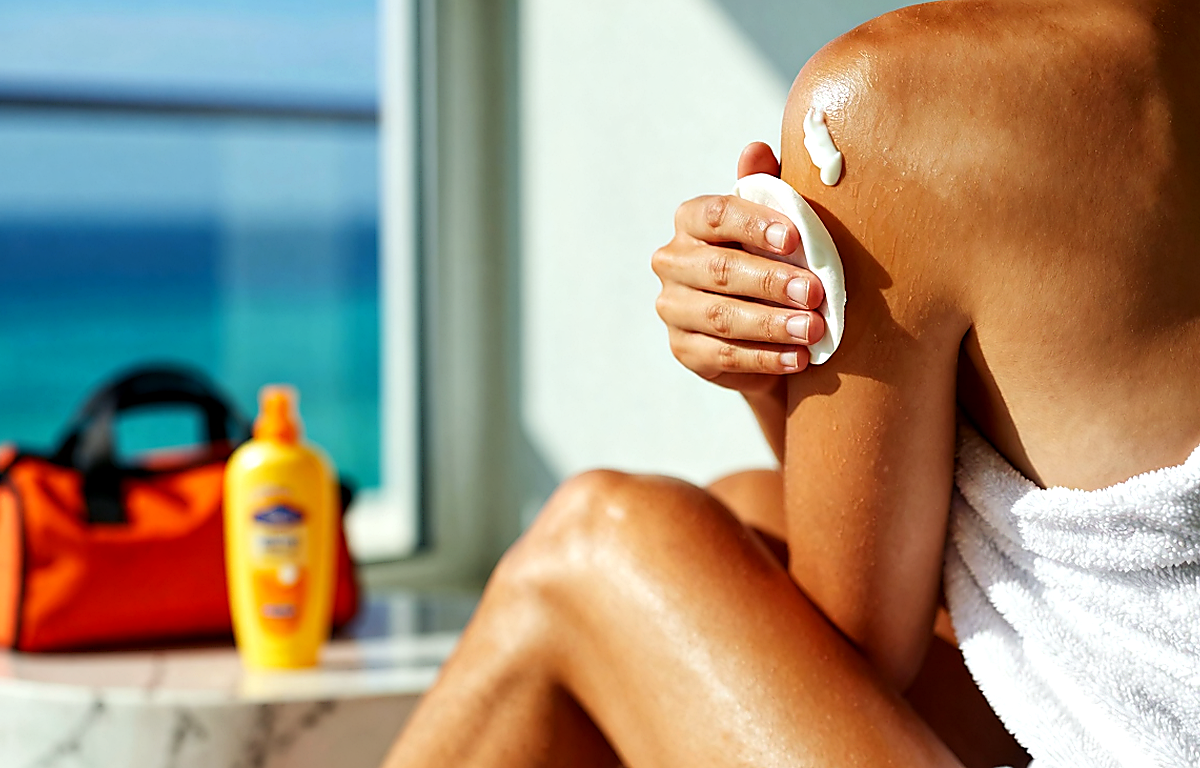
If you want the short answer, lotion is usually the most convenient option for the city: it spreads faster than a dense cream, usually does not leave such a heavy film, and still gives more predictable coverage than a spray. Cream works best for dry and sensitive skin, as well as when skin often feels dry from air conditioning, shaving, and hard water. Spray is great as the fastest on-the-go format, but only if you are ready to apply it generously, spread it carefully with your hand, and not mistake a light mist for full protection.
In summer, body SPF matters in the city too, not just at the beach. Bare arms, shoulders, the décolleté area, the neck, and legs below a skirt or shorts get UV exposure on the way to work, at a café terrace, while driving, during walks, and even in cloudy weather. That is why the main criterion here is not some abstract “best formula,” but what you will actually use in real life: quickly, without irritation, and without inner resistance caused by stickiness, white marks, or awkward packaging.
Why the format matters more in the city than it seems
With body sunscreen, most mistakes are linked not to the SPF number on the package, but to the fact that the product is simply inconvenient to use. One cream feels too thick for the heat, another takes too long to absorb before getting dressed, a spray drifts away from the skin, and a lotion stays at home because the bottle feels “too vacation-like.” As a result, protection is applied irregularly, in too thin a layer, or only on days when the sun looks especially intense.
In the rhythm of city life, a good body SPF should meet a few simple requirements: spread quickly, work well with clothing, not add to the feeling of overheating, not leave the skin sticky, and not require ten minutes to apply. If a product feels pleasant on the skin, you are more likely to reapply it before leaving the office. And consistency matters more here than one heroic attempt to apply the “strongest” product once and then avoid repeating it all day.
There is another nuance: in the city, we often protect not the whole body but specific areas. These are the forearms, hands, shins, shoulders, and sometimes the collarbones and upper back if clothing is open. So the texture needs to be convenient specifically for targeted use. A cream that is too rich can feel irritating in the heat, while a spray that is too dry can create a false sense of lightness while still giving insufficient coverage.
Spray: when it is truly convenient, and when it lets you down
People love spray for its speed. It is easy to toss into a bag, quick to reapply outdoors, and convenient for hard-to-reach areas. In the city, that sounds like the ideal scenario: a few seconds and you are protected. But sprays are exactly where the biggest gap often appears between how something feels and the real result.
The problem is that an aerosol or pump format is often applied too thinly. You see a light veil of moisture on the skin and assume that is enough. In reality, the product needs to be sprayed on generously and evenly and almost always spread further with your palm. Otherwise, part of it settles into the air, onto clothing, or simply remains in separate droplets instead of forming a continuous protective layer.
When spray is convenient:
- if it is important for you to reapply SPF on your hands and legs as quickly as possible before going outside;
- if you dislike dense textures and are more likely to use lightweight formats;
- if you need to apply sunscreen to your shoulders, the backs of your arms, or other awkward areas;
- if you are ready not just to spray it on, but to actually spread it over the skin.
When to be more careful with spray:
- in windy weather, when part of the product is literally carried away from the skin;
- in tight indoor spaces and elevators, where spraying is inconvenient and inconsiderate to people around you;
- if your skin is very dry and needs not only UV protection, but noticeable comfort as well;
- if you tend to apply just a token amount for appearances.
The finish is another separate issue. Many modern sprays make skin look smoother and feel pleasantly light, but some contain a lot of alcohol and can be drying. After shaving, on irritated skin, or when the barrier is compromised, this format may not feel the most comfortable. If after application you regularly feel burning, severe discomfort, or notice persistent redness, soreness, or swelling, it is best to stop using the product and discuss the situation with a doctor. During pregnancy, while using retinoids, or with skin conditions, it is also wise to choose active skincare products together with a specialist.
Lotion: the most versatile city option
Lotion is often the sweet spot between comfort, speed, and application quality. Its texture is usually lighter than a classic cream but denser than a watery spray, so it is easier to spread evenly. That is especially valuable in the city: you can quickly cover exposed areas without turning your morning routine into a long ritual.
Lotion has several practical advantages. First, it usually feels easier to wear in the heat: there is less of that armored feeling on the shoulders and arms. Second, many formulas work well with clothing once absorbed. Third, it is easier to control how much lotion you use: you can see how much you squeezed out and spread it more easily into an even layer.
Who lotion suits best:
- people who use SPF daily on their hands, neck, décolleté, and shins;
- those who need a balance between lightness and hydration;
- those who dislike greasy shine but want more reliable application than a spray usually gives;
- those looking for one format for the office, walks, and short trips around the city.
It does have limits. If your skin is very dry, flaky, reactive, or feels tight after a shower, some lotion formulas may seem too light. In that case, you may want a more nourishing effect. But for normal, combination, and simply summer-prone-to-sweating skin, this format often becomes the one used most often—and therefore the most useful.
If you generally like lightweight summer body care without stickiness, you may also want to read our piece on a lightweight body cream for summer without stickiness: the logic of choosing a texture there is very similar to choosing a comfortable everyday SPF.
Cream: the best choice for dry skin and lasting comfort
Cream loses on speed but wins on the feeling of protection and comfort for people whose skin loses moisture quickly. If your skin feels tight after a shower, your shins tend to get dry, or sun and air conditioning leave your skin rough, a richer format may be the smartest option. A good SPF cream can reduce the discomfort of dryness while also helping you avoid skipping areas simply because it feels pleasant to apply thoroughly.
In the city, cream is especially good for:
- dry hands and forearms;
- the décolleté area and shoulders if the skin there is sensitive;
- shins, which often become dry in summer;
- skin after shaving, if light alcohol-based formats cause stinging.
But there are nuances. In hot weather, a dense cream may feel more noticeable under clothing, absorb more slowly, and make you want to wash it off as soon as possible. Another issue is too much visible shine, especially on the shoulders and legs, if the formula is rich in oils. Some people find that beautiful, others find it tiring in daily life.
That is why cream is worth choosing not because it seems more “serious,” but because it genuinely makes your skin feel better. If it makes you more comfortable, helps you apply enough product more often, and keeps you from missing areas, then that is your successful city format.
What is most convenient specifically in the city: an honest comparison by scenario
To avoid debating formats in the abstract, it helps to compare them with everyday city scenarios.
If you leave home in the morning and apply SPF once to exposed areas.
Lotion usually wins. It spreads quickly, does not require special technique, and gives the feeling of a complete application.
If you are always on the move and reapply protection away from home.
Spray is more convenient in terms of speed and portability. But it is still best spread with your hand, especially on the hands, shoulders, and legs.
If your skin is dry, sensitive, or does not tolerate alcohol-heavy textures well.
Cream or a richer lotion will most likely feel more comfortable than a spray.
If you absolutely cannot stand stickiness.
It usually makes sense to begin with a lotion or modern lightweight sprays, but remember that “weightless” should not mean using too little product.
If you wear open clothing and worry about white marks.
A lot depends on the specific formula, but fluid textures are usually easier to spread thinly and evenly than a dense mineral body cream.
If you drive, walk a lot, sit by a window, or often eat outside.
Any format will work if you are ready to use it regularly on your hands, neck, décolleté, and legs. For most people, that again means lotion; for some, spray works best as a quick reapplication product.
The conclusion is simple: in the city, the most convenient format is not the trendiest one, but the one with the least friction. The one that does not annoy you with its texture, does not stain clothing, does not take too much time, and does not create the illusion of protection instead of proper application.
How to apply body SPF correctly so the format does not let you down
Even a good product works worse when it is applied too sparingly or too randomly. This is especially typical with body SPF, because exposed areas seem small and rushing encourages under-application. Here are the basic rules that make any format more effective.
- Apply the product to all exposed areas, not just the ones that “catch the most sun.”
- Do not forget the ears, the back of the neck, the tops of the feet, the hands, and the area along the edges of clothing.
- Spread spray with your hand, even if the packaging promises easy application.
- Give the product a little time to set before putting on tight clothing.
- Reapply protection after heavy sweating, a long walk, outdoor sports, and of course after water exposure.
- If you spend almost the whole day indoors but go outside regularly, keep a compact format on hand for reapplying at least to your hands, neck, and décolleté.
It is also useful to identify your “must-protect city zones” in advance. For many people, these are the forearms, hands, neck, collarbones, and shins. Psychologically, that is easier than thinking about covering the whole body every single day. If your clothing changes, your application map changes too.
For the face and body, it is better not to search for one perfect universal product just to save space in your bag. Facial skin usually has its own separate demands when it comes to finish, makeup compatibility, and comfort throughout the day. If the topic of combining sun protection with makeup matters to you, you may find our article on how to use powder over SPF without patchiness helpful.
What to look for in the formula and product description besides SPF
The SPF number matters, but how a product feels depends on other factors too. For city life, these are often even more critical than the difference between neighboring formats.
Broad-spectrum protection.
You need protection not only from UVB, which is associated with sunburn, but also from UVA, which contributes to photoaging. Packaging can describe this in different ways, but the principle itself always matters.
Texture and finish.
Look for descriptions such as “lightweight lotion,” “absorbs quickly,” “for sensitive skin,” or “non-sticky” if those are exactly the issues that keep you from using SPF regularly. But remember that marketing promises should be tested on your own skin rather than accepted as fact in advance.
Hydrating components.
Glycerin, emollients, and skin-softening ingredients make daily use more pleasant, especially if you do not like applying a separate body cream in the morning.
Fragrance.
A strong scent in body sunscreen can quickly become tiring, especially if you need to reapply during the day. Sensitive skin and people who do not tolerate bold fragrances well usually find neutral options easier to live with.
Packaging.
A large pump bottle may be convenient at home, while a compact lotion or spray is better for your bag. Sometimes the problem is not the texture itself, but the fact that the product is inconvenient to use outside the bathroom.
If both your face and body skin become especially temperamental in heat, strong sun, and layered summer skincare, it can be useful to review your whole basic routine rather than just your SPF. In that context, our article on how to build a basic facial skincare routine may also be helpful: the principle of sensible minimalism works very well for summer routines in general.
Common mistakes when choosing a format
There are several typical traps that can quickly send even a good product to the back of the shelf.
- Buying a spray if you are too lazy to spread it with your hand. Then the protection often ends up being too theoretical.
- Choosing a cream only because it seems more “serious.” If you hate dense textures, using it every day will be difficult.
- Expecting a lotion to feel completely absent on the skin. Any SPF is still a layer, and a minimal product presence is normal.
- Ignoring your own habits. For some people, a large bottle at home is ideal; for others, a mini format in the bag works best. Practicality matters more than beautiful theory.
- Not taking clothing and route into account. There is a big difference between a short dash to the car and daily walks around the city in an open top.
- Thinking one format must solve every problem. Sometimes the most convenient setup is lotion at home in the morning and spray for reapplication during the day.
Finally, there is no need to tolerate constant discomfort for the sake of discipline. If a product consistently causes persistent burning, soreness, pronounced redness, or itching, it is better to choose another option and consult a doctor if needed. This is especially relevant during pregnancy, while using retinoids, after aggressive procedures, and with chronic skin conditions.
How to choose your format without long experiments
The fastest way is to start not with trends, but with three questions.
1. What is your body skin like in summer?
If it is normal or slightly dry, start with a lotion. If it is very dry and sensitive, start with a cream. If you are always hot, everything feels irritatingly sticky, and you are willing to control application carefully, you can test a spray.
2. Where and how will you reapply SPF?
Only at home before going out—lotion or cream. In the office, in the car, or on a walk—a spray or a compact bottle of lotion will come in handy.
3. What annoys you most about sunscreen?
Stickiness—look for lightweight textures. Dryness—choose richer ones. White marks—go for more fluid, easier-to-spread formulas. Laziness and lack of time—prioritize convenient packaging and a quick format.
For many people, the most workable routine looks like this: apply lotion at home in the morning to all exposed areas, and keep a spray in your bag for quick reapplication on hands, shoulders, and legs. If your skin is dry, it makes more sense to consider a cream instead of lotion, but choose a more modern texture that is not too heavy.
This approach is realistic: it does not force you to do extra things, but it also does not leave protection at the level of a random ritual. And that is exactly what you need in the city, where the sun may seem “not that serious,” even though your skin receives it regularly and little by little every day.
In short, if you are choosing one format for most city scenarios, lotion usually wins. Spray is convenient as the fastest option and a good companion for reapplication, but it requires generous application and spreading with your hand. Cream is the best friend of dry and sensitive skin when not only SPF but also a clear feeling of comfort matters. Choose not by mythical universality, but by what you genuinely find easy to use every day—that is the SPF that will be most convenient in the city.