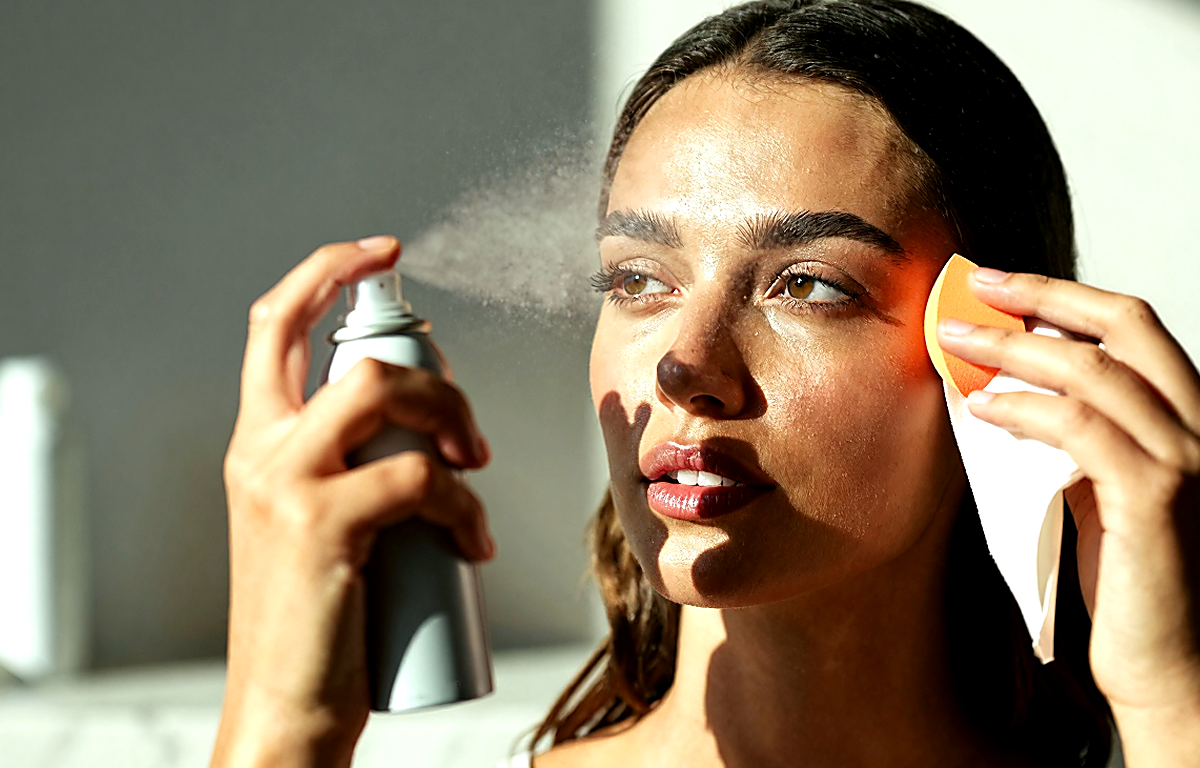
Setting spray is not for everyone and not for every day. If your makeup lasts until evening, does not melt in the heat, and does not settle into pores, you can do without it. But when foundation quickly turns dull, powder makes the face look dry, and makeup starts breaking apart after just a few hours, a spray is often the final step that pulls the layers of cosmetics together into a more cohesive, natural, and longer-lasting finish.
The main mistake is expecting every spray to do the same thing. Some formulas refresh and reduce powderiness, others genuinely extend wear, and others give a dewy glow that on oily skin can start to feel like stickiness and heaviness within an hour. To get a beautiful finish, it is important not just to spray something on at the end, but to choose the format according to your skin type, the textures in your makeup, and the weather. Then the spray works like a tool, not like a random extra layer.
What setting spray does and how it differs from a mist
Products with very different purposes are often sold under the name “makeup spray.” That is where disappointment comes from: a person expects longer wear and gets only a damp face. Broadly speaking, these products can be divided into three groups.
- Hydrating mist — refreshes the skin, slightly relieves dryness, and helps powder textures settle. But on its own, it does not always noticeably extend wear.
- Finishing spray — blends the layers of makeup together, makes the finish less chalky, and can give a matte, natural, or radiant finish.
- Setting spray in the narrow sense — contains film-forming ingredients that help makeup last longer, transfer less, and fade more slowly during the day.
In practice, many formulas combine these functions, but the emphasis is still different. If you want your foundation not to break down by lunchtime, look specifically for staying power. If the goal is to remove the “dry mask” effect after powder, a lighter finishing option will do. If your face feels tight and your makeup looks overdone, sometimes a gentle hydrating spray is enough rather than extra-strong setting.
A spray will not fix every base mistake. If your skin has too much heavy skincare, a rich SPF, several layers of primer, and full-coverage foundation, the problem may not be the lack of setting but overload. In that case, it helps to rethink skin prep first. For that, it is worth reviewing the basics of skincare too: how to build a basic skincare routine for your face.
When you really need a setting spray
There are several situations in which a setting spray is especially justified. In these cases, it does not just create the feeling of finished makeup — it genuinely improves the result.
- A long day away from home. Work, meetings, commuting, an event — when there is no chance to keep touching up foundation and blush.
- Heat, humidity, and lots of movement. In these conditions, makeup loses its shape faster, especially around the nose, mouth, and forehead.
- Layered makeup. Foundation, concealer, cream contour, blush, powder — the more layers you have, the higher the chance that the finish will look dry or disconnected.
- A tendency to transfer. For example, when foundation quickly ends up on your phone, glasses, collar, or mask.
- A powdery effect on the skin. A spray often helps make the finish look more alive and less obvious.
- A wedding, shoot, or evening event. In these situations, predictable wear matters, not just an instantly pretty finish.
But if you have light makeup on well-prepped skin, comfortable weather, and you wear it for only 4–5 hours, a spray may simply be an option rather than a necessity. Sometimes the best way to avoid stickiness is not to add an extra product where everything already works without it.
Why stickiness happens: the most common causes
A sticky finish does not always mean the product is bad. More often, it is a matter of mismatch between the formula, the amount, and the application technique. Here are the main reasons.
- Too much product. This is the most common mistake. Your face should not be wet as if it has been splashed with water. Too much spray takes longer to dry and leaves a tacky feeling.
- The wrong finish type. Radiant and very hydrating formulas on combination and oily skin are more likely to create the feeling of a damp film.
- Spraying from too short a distance. If you hold the bottle too close, the droplets land in large, uneven spots instead of a light veil.
- An overloaded base. A rich cream, greasy SPF, sticky primer, and heavy foundation already create many layers. The spray only intensifies that feeling.
- Applying it over unset cream products. If cream blush or concealer has not settled yet, the spray can make the surface shift around.
- The wrong expectation from the product. A mattifying setting spray and a glow mist feel different on the skin. Sometimes “stickiness” is simply not the effect you wanted.
- High humidity. Even a good formula can feel heavier than usual in muggy weather.
Sometimes the problem is not one product but the combination. For example, if you apply a lot of powder over SPF and then try to “bring it to life” with a spray, the result may become either more beautiful or, on the contrary, muddy and sticky — it all depends on how many layers there are. If you often wear makeup over sunscreen, this article may be useful: how to apply powder over SPF without patchiness.
How to choose a spray for your skin type and your goal
It is better to buy a setting spray not because it promises “16-hour wear,” but according to your real need. The same product can be excellent for dry skin and disappointing for oily skin.
For oily and combination skin, lightweight setting formulas with a natural or matte finish are usually more comfortable. They should dry quickly, leave no damp film, and not add extra shine to the T-zone. If your skin is already prone to oiliness, very radiant and oily textures are more likely to disappoint.
For normal skin, the easiest choice is a universal spray that gives a more pulled-together makeup look without pronounced glow and without harsh mattness. These give the most predictable result and work well for everyday use.
For dry and dehydrated skin, formulas that reduce powderiness and add visual comfort can be helpful. But here it is especially important not to overdo it: if skin is dry, there is a temptation to apply more, and excess is what most often leads to stickiness.
For sensitive skin, it is better to choose the calmest, least aggressive products possible and test them in advance on a small area. Fragrance, a high alcohol content, or active aromatic components can trigger discomfort. If you experience persistent burning, pain, noticeable redness, or swelling after application, wash the product off and do not use it again. If irritation continues, if you have skin conditions, or during pregnancy or when using products with retinoids and other actives, it is better to discuss the reaction with a doctor.
When choosing, it helps to ask yourself three questions:
- Do I need actual wear time, or just a fresher-looking finish?
- Do I want a matte, natural, or radiant result?
- Does my makeup usually break apart because of dryness, oiliness, or overload?
If you answer honestly, choosing becomes easier and the risk of stickiness drops noticeably.
How to apply setting spray so makeup lasts instead of feeling sticky
Technique matters here almost as much as the formula itself. Even a good product can be spoiled by spraying too generously. A practical method looks like this.
- Let your makeup settle. After cream and powder steps, wait 30–60 seconds. The surface should not feel wet or movable.
- Shake the bottle if the manufacturer says to. This is especially important for two-phase and finishing formulas.
- Hold the spray about a hand’s length away. Not right up against the face. The goal is a fine mist, not large droplets.
- Use 2–4 light sprays. That is usually enough for the whole face. More is not better.
- Do not touch your face immediately after applying it. Do not press in a sponge, rub with your hands, or check with your fingers whether it feels sticky. Let the product dry on its own.
- If needed, direct a flow of air toward the face. A fan or hand fan can sometimes help remove the damp feeling faster without disturbing the makeup.
There are also more advanced ways to use it. For example, on a very long day, some people apply a little setting spray not only at the end but also between layers: after foundation or after cream textures. This can improve wear, but at the same time it increases the risk of overload. That trick is better reserved for events rather than everyday office makeup.
Another nuance: do not try to “save” badly sitting foundation with spray. If the coverage has already pilled, separated around the nose, or emphasized dry patches, extra moisture will not always fix the situation. Sometimes it only makes flaws more visible. In that case, it is better first to gently remove the excess, touch up the foundation locally, and only then, if needed, add a very light veil of spray.
How to avoid stickiness: practical rules that almost always work
If you want a simple and reliable checklist, here is a set of rules that most often helps prevent an unpleasant finish.
- Reduce the number of layers under your makeup. In summer or in a stuffy room, overly rich skincare often gets in the way more than it helps.
- Choose the product by season. What feels pleasant in winter may feel heavy and damp in summer.
- Do not double up on similar effects. If you already have a radiant SPF, a glow primer, and a dewy foundation, a radiant spray may be unnecessary.
- Do not apply too much powder hoping to “revive” your face later. It is much easier to powder only the areas that actually need it from the start.
- Pay attention to the sprayer. If it releases large droplets, even a good formula will apply worse.
- Give every layer time. Fast, multi-layer application almost always feels heavier.
- Try different scenarios. One product may work for everyday wear, while another is better for heat and events.
The logic is simple: the fewer chaotic attempts you make to fix your makeup at the end, the higher the chance of getting a smooth and comfortable result. Setting spray is not a magic eraser, but a finishing tool that works best as part of a thoughtful routine.
Common mistakes when using setting spray
Even people who have worn makeup for years often repeat the same mistakes. They are not always obvious right away, but they are exactly what creates the feeling that “this spray just does not work for me.”
Mistake 1: using spray instead of preparing the skin. If the skin is dehydrated, flaky, or, on the contrary, gets oily quickly because of overly heavy skincare, spray will not solve the root cause.
Mistake 2: expecting mattness from a hydrating product. A product with a pronounced glow effect rarely behaves like a setting spray for a hot day.
Mistake 3: spraying on many more layers throughout the day. If you keep refreshing your face with a new layer every time, stickiness is almost inevitable. For daytime correction, it is often better to blot excess shine with a tissue and apply powder only where needed.
Mistake 4: applying it from too close a distance. Then separate wet spots appear on the face and can disrupt the makeup.
Mistake 5: judging the result instantly. Many formulas feel damp at first, but after 30–90 seconds they become much more comfortable.
Mistake 6: ignoring your skin’s reaction. A slight brief cooling sensation after spraying can be acceptable, but persistent burning, soreness, severe redness, or swelling is a reason to stop using it. If symptoms continue, it is worth seeing a doctor.
Who can skip setting spray, and who should keep it on hand
You do not have to turn setting spray into a permanent step. There are cases where it is more of a nice extra than a necessity.
You can easily do without it if:
- you wear very light makeup and it already looks natural;
- your skin is not prone to excess shine or pronounced dryness during the day;
- you wear makeup for a short time;
- you do not like the feeling of an extra layer on your face.
It is worth keeping on hand if:
- you often do full makeup with several different textures;
- powder looks noticeable on the skin and you want a more pulled-together result;
- you need your makeup to last many hours without the chance to touch it up;
- you often deal with heat, humidity, long trips, or shoots.
It is useful to remember that comfort matters no less than longevity. If a product truly extends the life of your makeup but feels like a sticky film all day, it is not your ideal option. A good spray should not constantly remind you that it is there.
By the way, the feeling of stickiness in a beauty routine is not limited to makeup. It is often connected to a general love of overly rich summer textures. Body care is a good example too: how to choose a lightweight body cream for summer without stickiness. The principle is the same: less overload, more seasonal compatibility, and more personal comfort.
Conclusion: do you need a setting spray?
Setting spray is useful when it has a specific job: extending wear, reducing powderiness, pulling makeup layers together, or helping it survive a long hot day. But if you buy it simply because “everyone does,” it is easy to end up with an extra layer, stickiness, and disappointment.
The most reliable approach is to choose the product not by loud promises but by your skin type, the weather, and your makeup style. Apply a small amount, spray from a distance, do not overload the base, and let the product dry on its own. Then a setting spray really works as a finishing touch: it makes makeup look neater, more natural, and more durable rather than heavier.