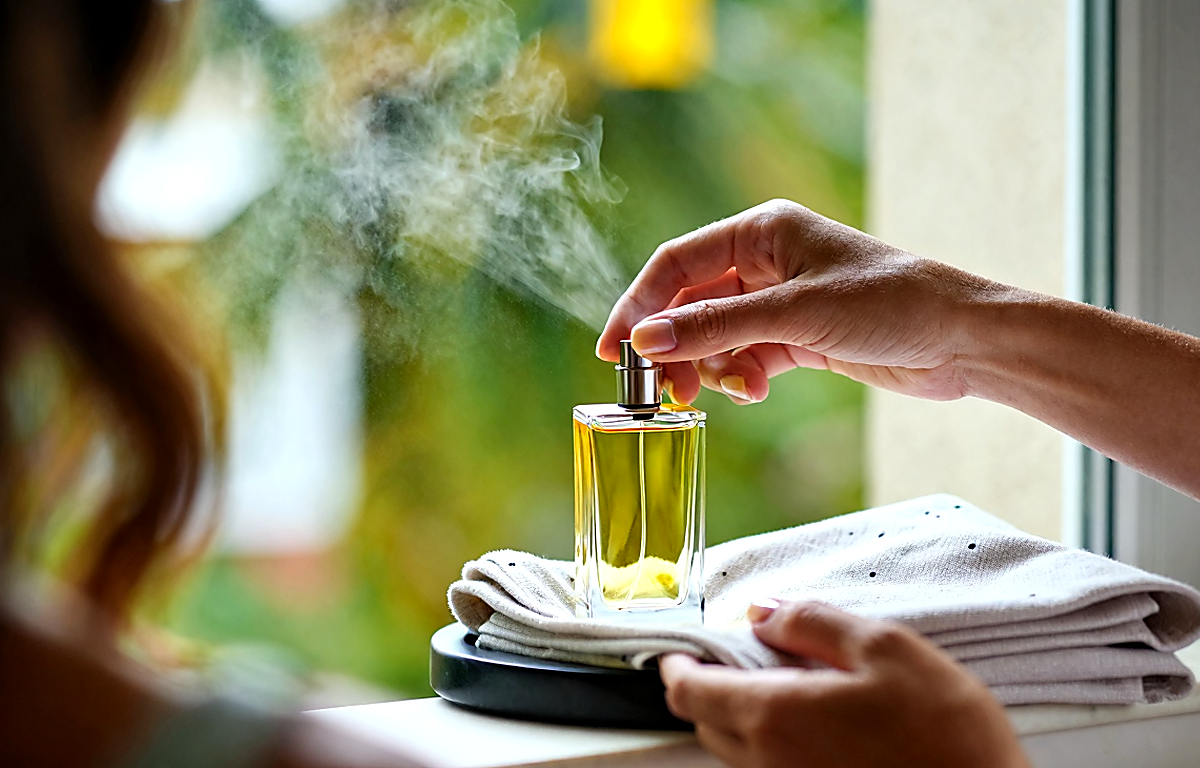
If you apply a Montale fragrance after a workout and notice marks on your T-shirt, top, or collar, the problem is usually not a “bad perfume” as such, but a combination of several factors at once: a highly concentrated composition, traces of sweat and deodorant left on the skin, overly generous spraying, and contact between damp fabric and the area where you applied the scent. The main practical idea is simple: do not spray fragrance onto skin that is still hot and damp, do not apply it where clothing fits closely right after the gym, and first check whether the stain is actually coming from deodorant, body cream, or laundry products.
Montale has many rich, long-lasting, and projecting fragrances, so after a workout they can behave especially actively: on warm skin the scent feels brighter, and the risk of transfer to fabric is higher. That does not mean you cannot wear these compositions after exercise. You can — if you change the technique. Below, we will look at what exactly is worth checking when clothing stains worry you, how to tell a perfume mark from a deodorant or sebum mark, where it is safer to apply fragrance, and which habits help preserve both freshness and your clothes.
Why stains appear specifically after a workout
After physical activity, the skin behaves differently than on a regular day. It is warmer, sometimes damp, and may still have sweat, salts, sebum, traces of sunscreen, deodorant, shower gel, body cream, or even hair conditioner on it if long hair touches the back and shoulders. When a long-lasting fragrance is sprayed over this “mix,” fabric can pick up both the perfume itself and everything that was already on the skin.
In practice, post-workout stains most often appear for one of four reasons:
- the fragrance was applied to damp skin or skin that had not fully cooled down;
- the perfume landed on areas that are immediately covered by tight clothing;
- the mark is actually caused not by the fragrance, but by deodorant-antiperspirant, especially in the underarm area and along side seams;
- the fabric already has a buildup of sweat, body products, and detergent residue, so it picks up oily or pigmented marks more easily.
It is also important to understand this: the denser and richer the composition, the more noticeable its behavior on fabric may be. This is not a defect and not a reason to give up a favorite fragrance right away. But it is a reason to pay closer attention to dosage and application points — especially after sports, when both skin and clothing become more sensitive to any residue.
What to check first: is the fragrance really to blame?
When streaks or darkened patches appear on clothing, the first impulse is to blame perfume. But in reality, the “culprit” is often something else. To avoid changing your habits for nothing, start with a quick check.
Look at where the stains appear:
- in the underarm area — suspicion more often falls on antiperspirant, sweat salts, and accumulated product residue;
- on the collar, near the collarbones, or on the chest — fragrance, cream, or SPF transferring from the skin is more likely;
- on the back and shoulders — contact with hair, leave-in care, or fragrance applied to the neck and nape is possible;
- on cuffs and wrists — the cause may be frequent rubbing against fabric or spraying too soon before getting dressed.
Then assess the character of the mark. A whitish or yellowish residue is more often linked to deodorant and sweat. A darker, slightly oily stain can sometimes come from a mix of skin sebum, cream, and the fragrance base. If the mark appears not immediately but after the item has sat before washing, it may be oxidation of the residue rather than an instant reaction to perfume.
A useful home test: once or twice after a workout, completely skip the fragrance but keep the same deodorant and the same clothes. Then do the opposite: switch deodorants but use your usual fragrance in a minimal amount. That makes it easier to understand what has the stronger effect. If you also use a rich body cream, try replacing it with a lighter option for a few days: sometimes that is exactly what increases transfer onto fabric. On the subject of textures and summer care, this article about a light body cream for summer without stickiness may be helpful.
Which Montale characteristics matter in this situation
Montale is often chosen for its longevity, noticeable trail, and rich character. For fans of expressive scents, that is a plus, but after a workout those same qualities require more careful handling. The more intense a composition feels on the skin, the more important dosage and a pause before contact with clothing become.
What is worth keeping in mind without myths or exaggeration:
- a long-lasting fragrance does not necessarily stain fabric on its own, but with excessive application the likelihood of transfer is higher;
- on hot skin, a composition often opens up more brightly than on cool skin, so a familiar “daytime” dosage may be too much after a workout;
- if you spray too close to fabric, part of the product settles not on the skin but directly onto the clothing;
- if there is a film of cream, oil, or rich sunscreen on the skin, the fragrance may stay on the surface longer and transfer more easily.
That is why in a sports scenario it is better to think not in terms of “does this brand suit me or not,” but in terms of “how exactly am I applying this fragrance in this context.” The same perfume can behave perfectly in the office and feel inconvenient after a workout if you apply it to a damp neck before putting on a fitted long-sleeve top.
There is also a psychological aspect: after a shower at the gym, it is tempting to quickly restore a sense of freshness, polish, and an “expensive” scent trail. But that very rush often leads to stains. With intense fragrances, the rule “less, but more precisely” works better than trying to cover up the smell of exercise with lots of sprays.
Where and how to apply fragrance after exercise to reduce the risk of stains
The most effective strategy is to first let the skin calm down, blot away moisture, shower if possible or at least thoroughly cleanse the areas where sweat and deodorant residue usually build up, and only then use fragrance. If time is short, it is better to do one spray on a safer area than several sprays all over the body.
After a workout, it is especially useful to follow these rules:
- Do not apply fragrance to damp skin. Even if it seems the sweat is gone, give the skin a couple of minutes to cool down and dry.
- Avoid areas where fabric fits closely: the center of the chest under a sports top, the neck under a collar, and the sides near the armhole.
- Do not spray fragrance in the underarm area. That is a place for deodorant, not perfume.
- Keep the bottle at a normal distance so you do not get large wet droplets.
- Before getting dressed, wait until the fragrance settles on the skin.
- If you know the fabric is delicate or light-colored, choose a minimal dosage.
Where is it safer to apply fragrance after the gym? The outer sides of the forearms often work better, as does the back of the neck provided the hair is dry and not coated with styling or care products, as well as the area below the collarbone line if clothing does not fit too tightly there. Some people prefer one spray into the air and then walking through the cloud, but that method is less controlled: the fragrance settles on hair, fabric, and accessories as well. In a situation where stains are the concern, targeted application is the more sensible choice.
If you use body care right after showering, let it absorb completely. A dense, sticky texture increases the risk of transfer. The same applies to facial care: if after a workout you refresh your basic routine, it helps not to overload the neck and upper chest with products that fragrance will then go over. In this context, this article on how to build a basic facial skincare routine may be useful if you want to rethink the overall order of product application.
Which fabrics and colors deserve special attention
Not all garments react the same way. Marks are more noticeable on light fabrics, especially white, cream, gray, and pastel shades. But dark clothing is not immune either: it may develop duller areas, streaks, or buildup that becomes visible over time.
These materials usually require more caution:
- thin cotton and cotton jersey, which absorb moisture quickly;
- viscose and modal, which tend to emphasize streaks;
- silky and smooth synthetic fabrics, where droplet marks are easy to see;
- sports materials that fit tightly to the body, because they actively contact the area where fragrance was applied;
- layered clothing, if fragrance is sprayed between layers on the go.
White T-shirts and tops are especially vulnerable because they show not only a fresh stain but also yellowing that appears later. If you suspect that your favorite workout clothes have already built up residues from various products, do not draw conclusions from one item alone: try testing the fragrance with other clothing that is newer or has been cleaned more thoroughly.
Hair length is also worth considering. If leave-in care, oil, or spray has been applied to the hair and it then rests on the shoulders and back after fragrance is sprayed onto the neck, the fabric may get double contact. If you have a habit of quickly styling your hair after the gym and throwing on clothes, check whether that is making the problem worse. On the subject of how hair behaves in humidity, this article about frizz-free hair after humidity may be of interest.
Step-by-step algorithm: what to do if you love the fragrance but do not want to risk your clothes
If you do not want to give up an expressive perfume, it is better not to rely on rigid bans but to build a clear routine. This is especially convenient on workout days, when time is short and mistakes are more common.
Try this approach:
- After your workout, cleanse the skin or take a shower. If there is no shower, at least blot away sweat thoroughly and change your T-shirt.
- Apply deodorant and let it dry. Do not combine this step with spraying fragrance.
- If you use body cream, choose a light texture and do not apply it heavily to the neck, chest, and shoulders.
- Wait a few minutes until the skin is dry and calm.
- Do one targeted spray on an area that will not immediately rub against fabric.
- Wait a little longer and only then put on your top layer of clothing.
- Assess the result over the course of a week, not after just one try: that is how you will see the real pattern.
If marks remain even with this routine, it is worth reducing the dosage even further or moving the fragrance to a later moment after you return home, when you have already changed into looser clothing. For some people, the best workout scenario is not a full fragrance application in the changing room, but a very light layer later, on dry skin and in a calmer setting.
Another practical trick is to separate all the “fragrant” and potentially mark-forming products in time. The more products are on the skin at once, the harder it is to understand which one is actually causing the problem. If you first establish a clean base and then test the fragrance separately, the solution appears faster.
How to care for clothes if stains have already appeared
Even the ideal application technique does not eliminate the need to care for your clothes. If a stain is already there, it is better to deal with it as early as possible. Old traces of sweat, deodorant, sebum, and cosmetics oxidize and set, and then it can seem as if the fragrance alone is to blame.
What usually helps in everyday garment care:
- do not postpone washing for too long, especially with sportswear;
- treat the problem area before the main wash with a gentle product suitable for the fabric;
- do not rub delicate materials aggressively;
- check the care label and the recommended water temperature;
- do not dry the item with high heat until you are sure the mark is completely gone.
If the stain appears regularly in the same spot, think not only about perfume but also about accumulated residue in the fabric. Sportswear is often washed gently to preserve elasticity, but because of that, product residue may not be rinsed out completely. Then even a small amount of fragrance starts to “cling” to an already soiled area.
It is also useful to periodically review the rest of the products that come into contact with both your body and your clothes: powders, SPF, creams. For example, if you have already dealt with cosmetic marks on fabric, the logic of this article about powder over SPF without stains may feel familiar: fewer layers, more texture compatibility, and a little more pause between steps.
When the issue is no longer about perfume, but about the skin
Sometimes the desire to freshen up quickly after a workout leads people to apply fragrance to irritated skin: after shaving, active friction, sun exposure, acid-based care, retinoids, or simply onto areas with redness and sensitivity. In that case, the issue is no longer just stains on clothing, but skin comfort as well.
If applying fragrance causes burning, pain, pronounced redness, swelling, or a rash, do not continue experimenting in the hope that it will “go away on its own.” It is better to stop using it on the irritated area and allow the skin to recover. If discomfort persists, inflammation is noticeable, dermatitis is suspected, or if you are pregnant or using potentially irritating care such as retinoids, it is sensible to discuss the situation with a doctor. Perfume should not be applied to damaged skin, and regular burning is not normal.
This point also matters because irritated skin may react more strongly to all products at once, while you may mistakenly connect the problem to only one fragrance. If fabrics have started staining more often at the same time your skin has become more sensitive, start by restoring a comfortable skincare routine and reducing the overall load on the skin after exercise.
Bottom line: how to keep your favorite fragrance and your clothes clean
If you are worried about stains on clothes after a workout, do not rush to give up Montale or the very idea of wearing fragrance after exercise. First check the obvious: whether a mix of sweat, deodorant, and rich body care is left on your skin, whether you are applying perfume to damp, overheated skin, and whether it is landing where fabric fits especially closely. In most cases, the problem is solved by three things: fewer sprays, a pause before getting dressed, and a cleaner, drier base on the skin.
The easiest short rule to remember is this: after a workout, first restore your skin and freshness, and only then add fragrance as a finishing touch rather than as a way to “cover everything at once.” Then the composition smells more beautiful, and the risk of stains becomes noticeably lower.