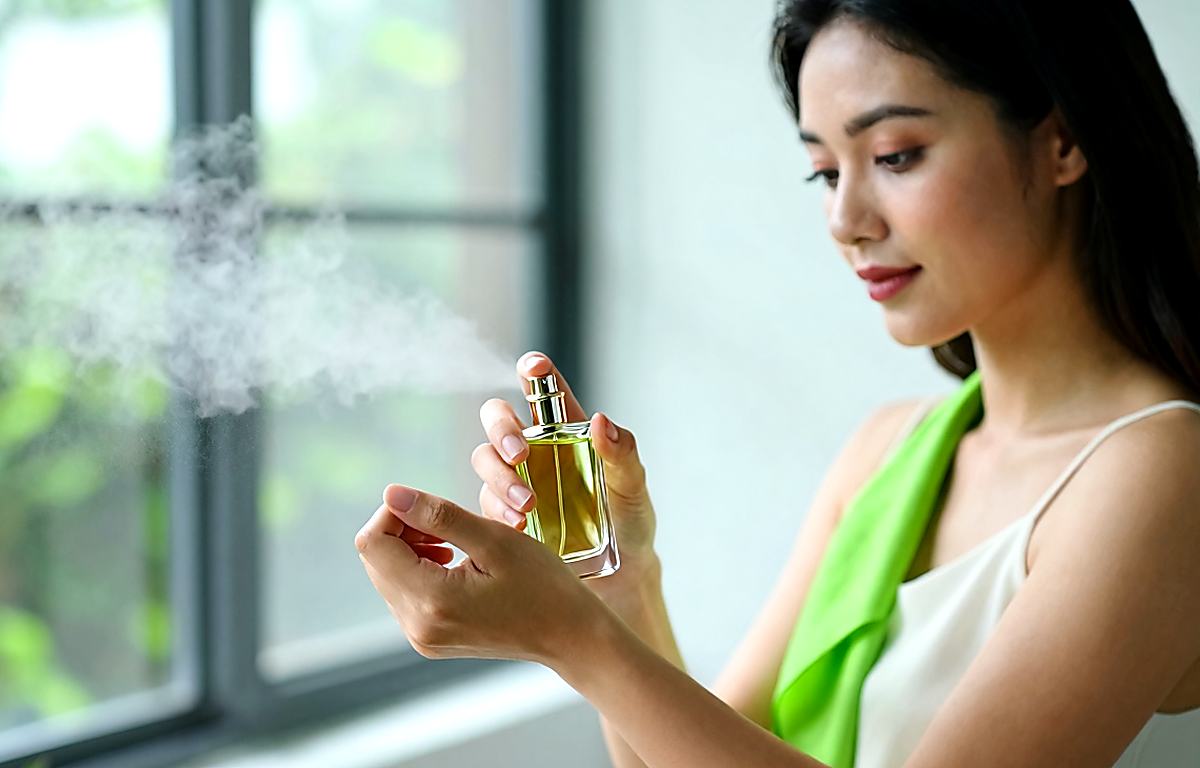
In summer, an office fragrance should work quietly: refresh you, not fill the entire room. The main guideline is simple: choose compositions with short or moderate projection, a transparent development, and a clean fresh character — citrus, green notes, tea, neroli, soft musk, aquatic accords, and light woods. Dense gourmand scents, overly sweet fragrances, resinous notes, heavy orientals, and very trail-heavy perfumes are better saved for evening, cool weather, or open air.
If you need a quick practical answer, here it is: for the office in summer, eau de toilette, eau de cologne, and light eau de parfum formulas labeled fresh, clean, airy, green, aquatic, tea, citrus, or skin scent tend to work best. Apply them sparingly — 1–3 sprays on skin under clothing or on points with minimal warmth, not on hair, a scarf, or in the elevator before work. It is the combination of the right composition and the right dosage that makes a fragrance comfortable for both you and the people around you.
Why even a good perfume can feel heavy in summer
Heat changes the way a fragrance behaves. On warm skin, the composition opens faster, the top notes disappear more quickly, and the heart and base become more noticeable and louder. As a result, what felt cozy and elegant on a cool day can turn into an intrusive cloud in a stuffy office.
There is a second factor too — enclosed space. Air conditioning does not always solve the problem: in a meeting room, elevator, open-plan office, or on public transport, scents mingle, and people vary in how sensitive they are to them. For one person a fragrance is barely noticeable; for another, it is already tiring. That is why an “office” perfume is not a separate genre but a balance between a pleasant scent, distance, and respect for other people’s space.
- The higher the temperature, the more strongly sweetness, amber, vanilla, patchouli, resins, and dense white florals are perceived.
- The drier and cooler the air, the easier woody and musky bases are to wear.
- The closer you sit to other people, the quieter your fragrance should be.
- The less ventilation there is, the more important minimal dosage becomes.
So in summer, the task is not simply to find a “fresh” bottle, but to understand how it sounds in actual working conditions: in the morning, in clothing, indoors, and around other people.
Which notes smell fresh and appropriate in the office
The word “fresh” can mean different things in perfumery. Sometimes it means lively citrus, sometimes cool greenery, and sometimes the feeling of a freshly laundered shirt. For the office in summer, the best directions are those that create an impression of neatness, composure, and lightness rather than dessert, a cocktail, or a dense bouquet.
The safest families for a workday are:
- Citrus notes: bergamot, lemon, grapefruit, mandarin, yuzu, petitgrain. They refresh quickly and are rarely perceived as heavy.
- Green notes: cut grass, violet leaf, galbanum, fig leaf, basil, and mint in moderation. They create a feeling of air and cleanliness.
- Tea accords: green tea, white tea, mate. They often smell intelligent, calm, and understated.
- Neroli and soft white florals: if they are not creamy or indolic, but transparent and sparkling.
- Aquatic and ozonic notes: good for those who like a feeling of coolness, although they can sometimes turn too “synthetically” fresh — this is worth testing on skin.
- Light woody and musky bases: cedar, pale woods, clean musk, ambrette. They help keep a fragrance close to the skin.
In summer office settings, gourmand accords — caramel, praline, dense vanilla, chocolate, liqueur notes — as well as heavy rose, tuberose, rich jasmine, oud, resins, incense, and sweet fruity compositions with a long trail deserve particular caution. This does not mean they are bad. It simply means their context is usually neither office-friendly nor suited to July.
Concentration and sillage: what to look for on the bottle besides the name
A common mistake is focusing only on the brand, the marketing description, or the word “fresh” on the product page. It is much more useful to look at the concentration and the overall structure of the composition. There are no universal rules, but some patterns still hold true.
Eau de cologne and eau de toilette often feel lighter and settle closer to the skin more quickly. This is a good option if you are afraid of overdoing it. Eau de parfum can vary greatly: one formula may sound delicate, while another lasts for hours and projects strongly. So the letters EDP are not a verdict in themselves, but they are a reason to test more carefully.
It is helpful to distinguish between three concepts:
- Longevity — how long a fragrance lasts on the skin.
- Projection — how strongly it is perceived around you in the first hours.
- Sillage — how far and how noticeably it trails when you move.
For the office in summer, the ideal is not “zero” longevity but moderate longevity: when you and someone at very close range can smell the fragrance, but it does not announce you before you enter the room. So-called skin scents, clean musks, and tea fragrances often fall into this category.
If you can test offline, do not spray five options at once. Choose two or three, apply them separately, and let them live on the skin for at least an hour. Very often it is the base that shows whether a fragrance is office-appropriate: the opening may be citrusy, but after forty minutes it turns into dense sweet amber. And the opposite can happen too — a modest opening develops into a fine clean woodiness that is ideal for a workday.
How to test a fragrance before buying so you do not make a mistake
A successful office fragrance is rarely chosen by paper blotter alone. Paper shows the idea, but not how it behaves on skin, not how loud it becomes in warmth, and not how comfortable the scent will be for you over several hours. Summer choices are better made a little more slowly, but more accurately.
- Test in the first half of the day. This makes it easier to understand whether you grow tired of the fragrance by lunchtime and how it feels in a working rhythm.
- Apply it to clean skin without a strongly scented cream. Otherwise your body care will change the way it smells.
- Do not judge only by the first 10 minutes. It is better to decide after 30–90 minutes.
- Check the dosage. One spray and three sprays can feel like two completely different fragrances.
- Assess the distance. If you can smell it constantly and vividly, your coworkers will most likely smell it too.
- Test it in similar conditions. If possible, wear the fragrance indoors, not only outside.
A good question to ask yourself during testing is: “Does this fragrance refresh me, or does it demand attention?” In an office, the compositions that win are usually the ones that do not distract and do not try to become the main event of the day.
Another useful reference point is the so-called clean effect. It is not necessarily connected to soap or laundry powder. It can be transparent citrus, slightly damp greenery, clean linen, pale wood, or white tea. When a fragrance creates an impression of good grooming rather than theatricality, it has a better chance of fitting into the office in summer.
How to apply perfume in summer so it does not become suffocating
Even the lightest fragrance can be spoiled by applying too much. In summer this is especially noticeable: warmth intensifies the scent, and fabric, hair, and enclosed areas can hold it longer than you expect. That is why technique matters no less than the bottle you choose.
The basic rule is this: it is better to under-apply than over-apply. For most office fragrances in summer, 1–2 sprays are enough, with 3 at most if the composition is very transparent and settles quickly on the skin.
- Best areas: chest under clothing, collarbones, and the inner elbow in a minimal amount.
- Use caution with: the neck, especially the front, because warmth intensifies the fragrance.
- Often not the best choice for the office: hair, scarves, and blazers, because fabric and hair hold scent for a very long time.
- Best avoided: refreshing your fragrance in the workroom, in an elevator, in an unventilated restroom, or right before a meeting.
If you want to smell your fragrance for longer, it makes more sense not to increase the number of sprays but to choose a softer, slightly longer-lasting formula, or carry a small atomizer and refresh once outside a shared space. Another approach can help too: apply fragrance not to the hottest pulse points, but slightly lower and closer to the body, and it will wear more calmly.
It is also important to remember how fragrance interacts with body care. A strongly scented shower gel, body cream, hairspray, and fabric conditioner can clash with your perfume. In summer this mix quickly becomes louder than you intended. If you want a neat result, it is better for your body care to be neutral or to stay within the same clean fresh range. If overall lightness in summer body care matters to you, you may find this article on a lightweight body cream for summer without stickiness helpful.
Which fragrances most often become a problem in the office
Sometimes it is easier to understand your ideal category by looking at a list of typical mistakes. A heavy trail is not only about oriental perfumes. Some “fresh” fragrances can be intrusive too if they are too sharp, metallic, sweet-fruity, or applied without restraint.
Most often, these are the fragrances that feel questionable in the office:
- very sweet gourmand scents with vanilla, caramel, coconut, or praline;
- dense white-floral compositions with creamy tuberose and loud jasmine;
- fruity fragrances with a syrupy, bubblegum, or candy-like effect;
- powerful amber-woody bases that trail after a person all day;
- oud, smoky, resinous, and leather compositions;
- overly sharp aquatic formulas with a cold “metallic” trail;
- any fragrance applied in an amount that you yourself can clearly smell for hours.
A separate mistake is choosing a perfume only because it gives the impression of “smelling expensive.” In an office, a different category matters more: “smelling appropriate.” That can come from niche, luxury, or affordable brands alike. Other people’s comfort is not determined by the price of the bottle.
If during the day you notice a dry throat, a heavy head from your own scent, or an urge to take off the clothes you sprayed it on, that is already a useful signal. Most likely the composition is either too loud for the heat or simply does not suit you in a work setting.
How to choose a fragrance for your office style and your lifestyle
The universal advice to “go for citrus” does not help everyone. It matters how you work and what kind of space you are in. The same fragrance will be perceived differently in a private office, a coworking space, a salon, a store, or a job with constant client meetings.
You can use these scenarios as a starting point:
- Open-plan office and closely spaced desks: quiet musky, tea, green, and clean woody fragrances with minimal projection work best.
- Constant meetings and negotiations: composed citrus-woody and neroli fragrances are a good fit because they suggest neatness and clarity.
- Creative environment: you can allow a little more character — fig leaf, soft herbs, dry herbal accords — but without loud sweetness.
- A long commute to the office in the heat: choose the lightest possible formulas, because they will intensify on warmed skin by the time you arrive.
- Sensitivity to scents in you or your coworkers: it is better to focus on skin scents and very restrained application.
It can make sense to have not one “perfect summer fragrance” but a small office capsule of two or three options: one completely transparent for extreme heat, one fresh but a little more polished for ordinary workdays, and one neutral clean scent for meetings. This approach is more practical than trying to find one bottle for every situation at once.
If you are building an overall summer look — light makeup, calm body care, minimalist styling — your fragrance should support that idea rather than clash with it. In that sense, office perfume is like a well-fitting shirt: you notice it through the quality of the impression, not through volume.
Signs of a successful summer office fragrance
Before buying, run through a short checklist. If most of the points line up, the chances of a good choice are high.
- You enjoy the fragrance from the first minutes, but it does not demand constant attention.
- After an hour, it does not become sweeter, heavier, or more powdery to the point of feeling tiring.
- It feels clean, fresh, composed, or calm rather than sticky and dense.
- One or two sprays are enough for you to catch it close to the skin.
- It does not clash with your body, hair, and clothing care products.
- You do not feel the need to “cover up” heat, fatigue, or the smell of air conditioning with it — a good office fragrance does not mask; it complements.
- You can imagine wearing it in an elevator, at a meeting, and at the next desk without embarrassment.
If you keep wanting to add another spray because the fragrance fades too quickly, do not rush to treat that as a disadvantage. For the office in summer, that can actually be an advantage: quiet longevity at close range is often more convenient than a long trail. And if you prefer to smell your fragrance more strongly, it is better to save richer compositions for evening, a walk, or the weekend.
If you experience any negative skin reaction — persistent burning, pain, pronounced redness, or swelling — wash the fragrance off and stop using it. If symptoms persist, if you have known skin conditions, or during pregnancy, it is better to discuss the choice of irritating or strongly scented products with a doctor.
Conclusion: the best summer office fragrance is the one you hear more closely than others notice
When choosing a perfume for the office in summer, do not follow the principle of “it has to last all day,” but rather “it has to feel comfortable for me and for the people around me.” The most successful options are usually transparent, fresh, clean, and moderate in sillage: citrus, green notes, tea, neroli, and light woody or musky accords. And the deciding factor is not only the fragrance itself, but also the dosage, where you apply it, and your working conditions.
If you are hesitating between two bottles, the one that seems slightly quieter and cleaner will almost always win. In a hot office, that is not a compromise but good taste. This kind of fragrance does not fight with the space, does not become tiring by midday, and does exactly what it should: create a feeling of freshness, good grooming, and lightness without a heavy trail.