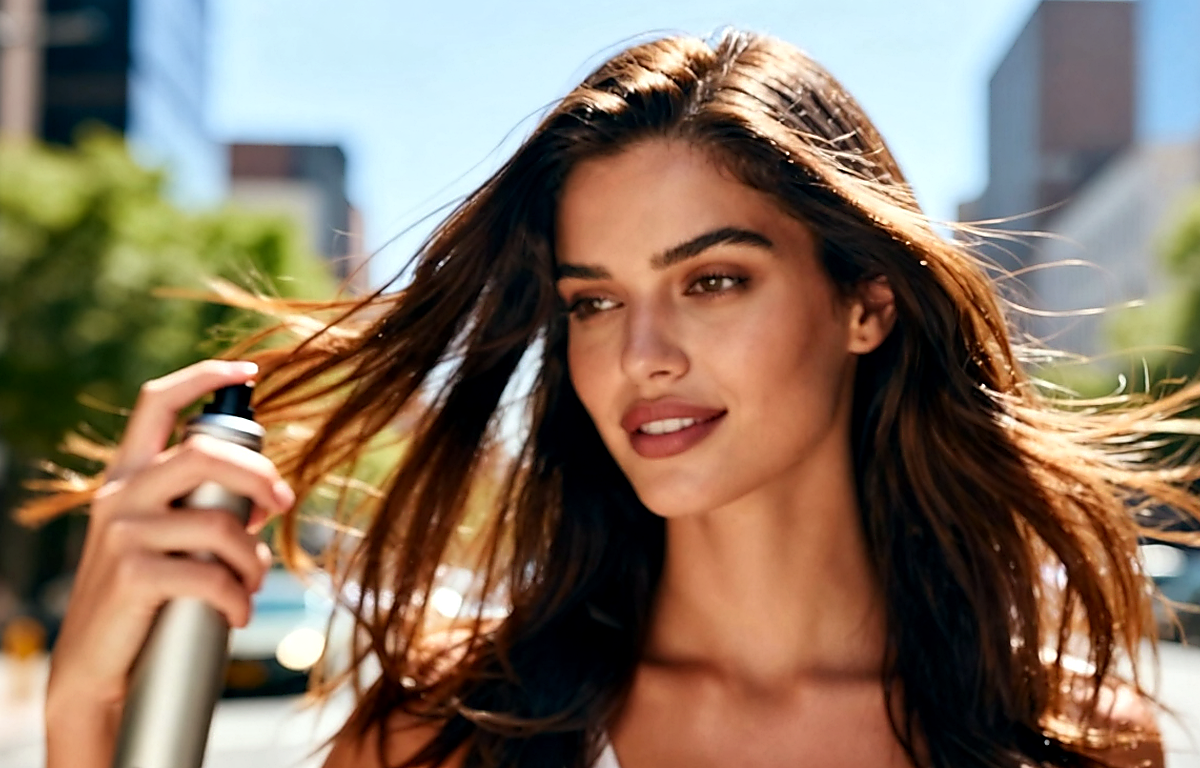
The main rule of summer styling is simple: in hot weather, it is not the strongest products that last, but the lightest ones layered the right way. If your hair quickly loses volume, frizzes around the face, or the strands fall apart just an hour after you leave home, the problem is often not that you need a “stronger hairspray.” Usually, it comes down to too much product, a texture that is too heavy, and the wrong order: a lot of cream goes onto damp hair, then everything gets locked in with another dense spray, and the result is a style that heats up, sticks together, and starts to look heavy.
To keep the shape without stickiness, focus on three things: clean, non-overloaded lengths, one main styling product for the job, and soft hold at the end. For volume, that may be an airy mousse at the roots; for smoothness, a lightweight anti-frizz spray through the lengths; for waves, a sea salt or texturizing spray in moderation. In hot weather, it is better when the hair stays flexible: it can move a little, but not completely fall apart. That kind of “living hold” looks modern, feels comfortable in the hair, and handles high temperatures much better than a stiff styling shell.
Why your hairstyle “falls” in the heat
Heat affects hair from several angles at once. First, scalp temperature and perspiration increase, so the root area loses freshness more quickly. Second, humid air can change the shape of the hair: straight strands start to frizz, wavy hair can break into messy sections, and a sleek style becomes less polished. Third, we often make the situation worse ourselves by touching our hair, fixing our bangs, tucking strands behind the ears, and applying too much product “just in case.”
The most common reasons a hairstyle does not last until evening are:
- leave-in care that is too rich before styling;
- using several hold products at once;
- styling hair that is not fully dry;
- too much oil or serum at the roots;
- heavy hairspray over the entire length instead of targeted hold;
- the wrong product format for your hair type.
The good news is that summer hold does not require a complicated arsenal. Usually, it is enough to reduce the number of textures, choose a product for one specific goal, and change the way you apply it. In hot weather, technique matters just as much as formula.
Which lightweight products work best
If you want your hairstyle to last without that sticky-film feeling, look not at promises of “concrete hold,” but at the product format. In summer, sprays, foams, and lightweight mousses are usually the easiest to work with. They distribute thinly, dry quickly, and are less likely to weigh down the lengths.
These are the product categories that most often truly help:
- Lightweight volumizing mousse. Good for fine to medium hair when you need support at the roots. The key is to use a very small amount and apply it mainly to the root area.
- Heat-protectant spray with light hold. Helpful if you blow-dry your hair and want to solve two tasks at once: protection and a more polished shape.
- Anti-frizz spray. Helps in humid weather when the hair starts to puff up through the lengths. Especially useful for porous hair.
- Texturizing spray. Useful when the hairstyle lacks grip and the strands are too soft and slippery. The main thing is not to confuse texture with dryness: too much can make the hair look dull and brittle.
- Veil hairspray. This is not a heavy, dense spray, but a fine mist that can set the finished shape without gluing the hair together.
- Dry shampoo. Formally, it is not styling, but in summer it is often the main product for maintaining volume, especially in the second half of the day.
Dense creams, thick gels, and rich oils more often work against you in the heat unless we are talking about very curly, very dry, or very thick hair. Even then, it is better to reduce the amount and apply the product locally rather than throughout the whole mass of hair.
How to choose a product for your hair type
The same spray may behave beautifully on thick hair and instantly overload fine hair. That is why summer styling is better chosen by hair structure, not by trend.
Fine hair. The lightest formats usually work best: volumizing mousse, dry shampoo, root-lift spray, lightweight hairspray. The main rule is to avoid large amounts of leave-in creams and oils. If you want smoothness, apply the product only to the ends.
Medium-density hair. This is the most flexible type: you can use mousse, anti-frizz products, and a little texture. But even here, it is better to choose one main product and one supporting one rather than building a style out of five layers.
Thick, dense hair. This type often needs not so much stronger hold as better control. Smoothing sprays, heat protection with frizz control, and lightweight cream sprays instead of dense creams work well here. If you want a polished, sleek look, set not the entire length but the top layer and the outline around the face.
Porous, frizz-prone hair. In hot weather, humidity is especially disruptive. In that case, products labeled anti-frizz, humidity shield, and smoothing spray can help. If the issue is specifically frizz after humid air, you may also find useful our guide on how to reduce hair frizz after humidity.
Wavy and curly hair. Here it is important not to try to “shellac” the shape with hairspray, but to let the curl gather properly. Lightweight jelly gels, curl mousses, and styling refresh sprays usually work better. A texture that is too dry, on the contrary, can break up the curl pattern.
Application technique: how to keep the product from making hair sticky
Even a good product can leave a heavy result if you apply too much or put it in the wrong place. The most common mistake is distributing the product from roots to ends “just to be safe.” In practice, targeted application works more reliably.
A useful routine looks like this:
- After washing, gently blot the hair with a towel without rubbing it.
- If you need care, choose one lightweight leave-in product and apply it only to the lengths and ends.
- For volume, add a little mousse at the roots or to the upper part of the lengths.
- If you need smoothness, spray an anti-frizz product from a distance and comb through with your fingers or a wide-tooth comb.
- Dry the hair completely. Areas that stay damp lose their shape faster.
- Only after styling should you use a lightweight hairspray or setting spray, and not over the whole head, but only on the sections that need to hold.
There are also a few small rules that noticeably change the result:
- spray from a distance rather than up close;
- do not apply hairspray to wet or damp hair;
- start with the minimum amount and add more only if needed;
- do not mix several strong-hold products at once;
- let each layer dry before applying the next one.
If your hair already feels stiff indoors after styling, the situation will almost certainly get worse outside in the heat. Good summer styling should feel almost imperceptible to the touch while you are still inside.
Best styling techniques for hot weather
In hot weather, long wear depends not only on the product but also on the shape of the hairstyle itself. The more natural the direction of the hair and the fewer fragile elements it has, the better the chance that everything will last until evening.
For root volume. Dry your hair while lifting the roots with a brush or changing the parting direction during drying. Once the hair is fully dry, you can return to your usual part and add a little dry shampoo at the roots. This helps volume last longer than trying to pin it down with hairspray.
For a sleek ponytail or bun. This is one of the best options for the heat: the hair has less contact with the skin on the face and neck, so it gets less damp from perspiration. Use a lightweight smoothing spray and a soft-bristle brush, then finish with a drop of serum only over the top layer.
For soft waves. If you curl your hair, let the curls cool completely before separating them with your hands. In the heat, this is especially important: a hot strand has not set its shape yet. Once cool, you can lightly mist the waves with veil hairspray.
For bangs and face-framing strands. These suffer the fastest from heat and humidity. Here it is better to use a very small amount of product and do a separate mini styling routine: round brush, blow-dryer, then light hold only on the shape of the bangs, not over the whole head.
For second-day hair. Do not try to refresh the style with another layer of hairspray. It is better first to remove excess sebum with dry shampoo, let it work for a minute, then gently shake up the roots and only after that add a little texture or restyle individual sections.
What is best to avoid in summer
Sometimes it is not the weather that makes a hairstyle harder to preserve, but habits that seem harmless. In summer, hair reacts especially quickly to overload.
The actions that most often make the result worse are:
- applying a lot of oil before going outside;
- layering hairspray repeatedly throughout the day;
- using a hot tool at too high a temperature without heat protection;
- constantly touching your hair with your hands;
- tight elastics that break the shape and leave creases;
- styling immediately after a very nourishing mask if your hair tends to lose volume quickly.
Another questionable trick is trying to “seal” the style with heavy wax or pomade through the entire length. For a few short strands, the temples, or a sleek ponytail, that may be appropriate, but for loose hair in summer it usually looks overloaded. If you want more control, a fine-mist spray used zone by zone is a better choice.
How to refresh your hairstyle during the day without starting over
A summer day is long, and even a successful hairstyle sometimes needs a small adjustment. The important thing is that this adjustment should not turn the hair into a heavy, sticky mass. The principle that works here is “remove the excess first, then add what is needed.”
A minimal daytime routine can look like this:
- Blot the hairline and the skin on your forehead with a tissue if it is hot and you are sweating.
- If needed, apply a little dry shampoo at the roots and wait 30–60 seconds.
- Gently distribute the product with your fingers or a brush.
- If strands have come loose, spray a brush with lightweight hairspray and smooth only the section you need.
- For waves or curls, lightly reactivate the shape with a water spray or a dedicated refresher product rather than a new dense layer of styling.
It helps if you have a travel-size dry shampoo, a compact brush or comb, and a soft hair tie in your bag. Sometimes the best way to keep a polished look is not to fight the weather to the last moment, but to move loose hair in time into a low ponytail, a claw clip, or a relaxed bun. It looks natural and is often much neater than a tired style that someone is trying to revive with a fifth layer of hairspray.
When it is not only about the weather
If your hair almost always looks overloaded, loses its shape within an hour after washing, or your scalp regularly becomes very sensitive, it is worth looking beyond summer styling alone. Sometimes the reason is care that is too heavy, the wrong shampoo, a habit of applying products too close to the roots, or scalp sensitivity to fragrance and active ingredients.
Pay attention to signs that should not be blamed on the heat alone: pronounced burning of the scalp, soreness, noticeable swelling, rashes, strong flaking, or persistent itching. If these symptoms continue, it is better to see a doctor. Extra caution is also needed during pregnancy, and if you use products with active ingredients or retinoids in skincare near the hairline: if irritation persists, it is safer to discuss the situation with a specialist rather than masking the discomfort with new products.
In everyday situations, though, what most often helps is a simpler routine: lighter care, fewer layers, fully dried hair, and one clear styling goal—volume, smoothness, or texture. When one product tries to do everything at once, it often does more than you need.
Bottom line: summer styling should stay flexible, not stiff
It is absolutely possible to make your hairstyle last in the heat without the feeling of glued-together hair. Lightweight formats, a moderate amount of product, and targeted application work best: mousse at the roots, anti-frizz through the lengths, veil hairspray at the end. Do not overload the hair with oils and dense creams, dry the style completely, and do not try to save it by endlessly layering more hold throughout the day.
The most practical summer approach is not to chase motionless perfection, but to create a shape that lives beautifully with the weather. Then the hair looks fresh, stays pleasant to the touch, and does not turn into a stiff, tired “helmet” by evening. Here, lightness is what creates lasting hold.