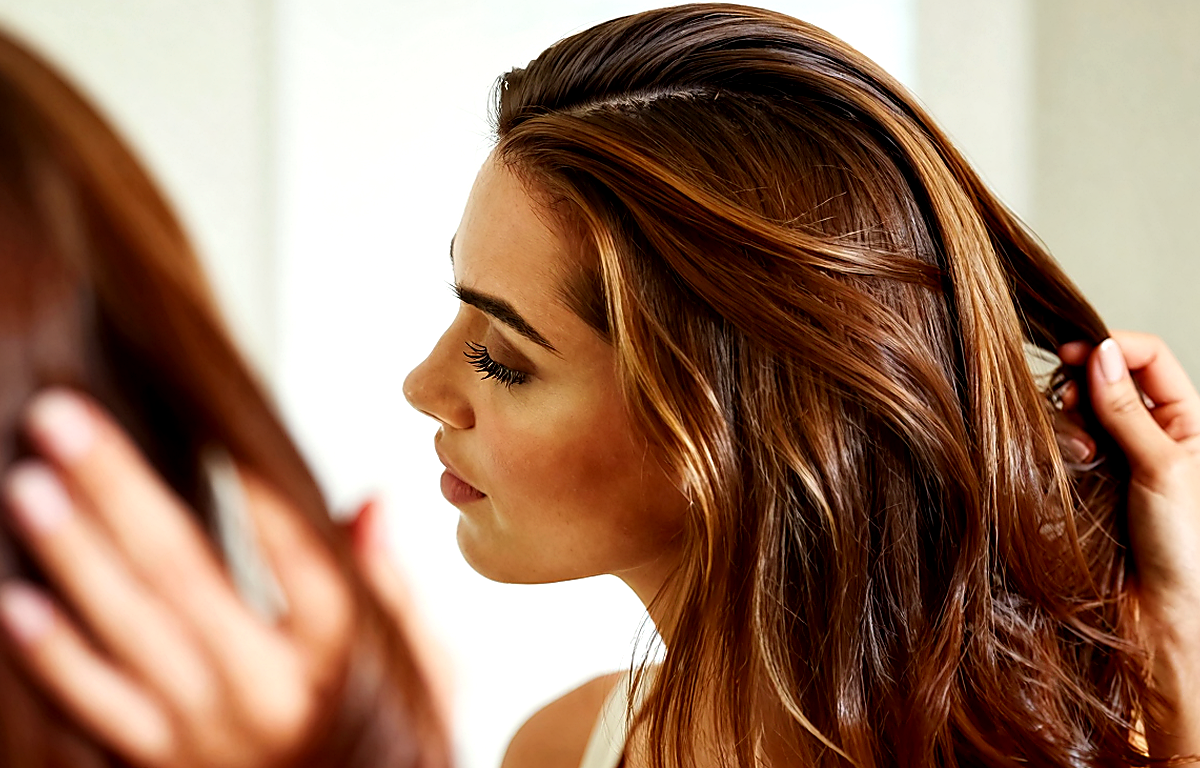
In summer, dry shampoo really can save your style between washes—but only if you apply it by summer rules rather than out of habit. The main idea is simple: spray a small amount only along the partings and only at the roots, from a distance, give it time to absorb sebum, and then brush it out thoroughly or work the residue in with your fingers and the cool air of a blow-dryer. It is excess product, spraying from too close, and trying to disguise hair that is already very dirty that most often create that grayish-white residue that makes the hairstyle look worse, not better.
In the heat, the job of dry shampoo is not to replace a proper wash but to quickly refresh the root area and remove the feeling of “not-fresh” roots after the city, public transport, an office without air conditioning, or a humid walk. If you choose the right format, take your hair color into account, and distribute the product properly, you can get a clean visual effect, light volume, and a more polished hairstyle without matte dust on the lengths. Below is a practical routine that is especially helpful in summer, when the scalp produces more sebum and styling loses its shape faster than usual.
Why Dry Shampoo Works Differently in Summer
In the colder months, dry shampoo is often used for volume and to extend a style a little longer. In summer, it plays a different role: it helps quickly tidy up roots that get oily faster because of heat, sweat, humidity, movement, and frequent touching. At the same time, mistakes are more noticeable because sunlight and open spaces highlight any residue, and humid air makes excess product more obvious.
Several factors affect how dry shampoo behaves in summer:
- increased activity of the sebaceous glands — roots get dirty faster, so it is tempting to apply more product than necessary;
- sweat and humidity — the product can mix with moisture on the scalp and become more noticeable;
- sun and heat — hair loses its fresh look and root volume faster;
- frequent styling, ponytails, caps, and sun hats — the root area gets flattened, and residue can collect in one spot;
- contrast between roots and lengths — if you spray too widely, the lengths will look dull and dry.
That is why in summer it is especially important to think of dry shampoo as a targeted tool rather than a universal spray for the whole head. The more precise the application, the cleaner the result. If your hair also frizzes in humidity, it helps to review your entire summer routine for the lengths as well: for example, the principles from this article on keeping hair frizz-free after humidity pair well with careful use of dry shampoo at the roots.
What Causes White Residue
A white or grayish trace does not necessarily mean the product is bad. More often, it is a combination of formula, technique, and timing. Most dry shampoos contain absorbent particles: starch, rice or mineral bases, and powdery components. They absorb sebum, but if there is too much of them, if they have not had time to settle, or if you sprayed the product over the top layer of the hair, the particles remain visible.
The most common reasons for white residue are:
- Spraying too close. When the can is held almost against the scalp, the product lands in a dense patch.
- Using too much. The urge to make hair feel definitely fresh almost always ends in overloaded roots.
- Applying it to hair that is already very dirty. The layer of sebum is too heavy, and the dry shampoo cannot distribute naturally.
- Not leaving it on long enough. The product needs at least 30–90 seconds to absorb oil.
- Not brushing or massaging it through. If you do not distribute the residue, it stays on top.
- Choosing the wrong tint or texture. On dark hair, light powdery formulas show up more strongly.
- Spraying it onto the lengths. Especially on dry or porous hair, this creates a dusty matte effect.
There is another detail too: in summer many people use sunscreen sprays, salt textures, styling creams, and anti-frizz serums. If you add dry shampoo on top without restraint, the roots can feel coated even without obvious whiteness. That is why the cleanest results usually come from not layering a lot of styling products right at the scalp.
How to Choose a Dry Shampoo for Summer
Not all dry shampoos are equally comfortable in hot weather. In summer, lighter formulas with a finer spray usually work better, because they do not turn the roots into a dense dry powder. If you have fine hair, look for a balance between absorption and movement: the product should refresh the hair without making the roots feel stiff. If your hair is dense, thick, or dark, the fineness of the mist and how easily it brushes out matter more.
What to look for when choosing one:
- A fine mist. The finer the spray, the easier it is to avoid white patches.
- A lightweight texture. For everyday summer use, less powdery formulas are often more comfortable.
- Tinted versions for dark hair. They may be less visible, but they still need to be distributed carefully.
- A moderate fragrance. In hot weather, very strong scents become tiring faster and mix with sweat.
- No sticky film feeling. Some products seem invisible at first but later make the roots feel heavy.
If your scalp is sensitive, it is better to avoid aggressive layered use. Dry shampoo should refresh, not cause tightness, itching, or the urge to wash everything off as soon as possible. If you have persistent burning, pain, noticeable swelling, marked scalp irritation, or skin conditions, stop using it and consult a doctor. During pregnancy, or when using products with retinoids, it is best to introduce any new cosmetic products especially carefully and, if in doubt, discuss them with a doctor.
The Right Technique: How to Apply It So the Roots Look Fresh
The most reliable way is to follow a method instead of spraying the product randomly. That way it does not overload the hair, and the roots really do look cleaner. Ideally, use dry shampoo either in the evening so it can absorb excess sebum overnight, or in the morning on roots that have only slightly lost freshness, not on hair that already feels completely worn out.
Step-by-step method:
- Shake the can well. This helps distribute the formula evenly.
- Section the hair into partings. Start with the center part, then the sides and the crown. There is no need to lift all the lengths.
- Hold the can 15–25 cm away. This matters more than it seems: distance often determines whether you get residue or not.
- Spray in short bursts. One or two quick sprays per area are enough. It is better to add more later than overdo it right away.
- Wait 30–90 seconds. Do not touch the hair immediately. The product needs time to absorb sebum.
- Massage the roots with your fingers. The movements should be light, as if you were distributing a dry powder.
- Brush out the residue. A brush or a fine-tooth comb will work, as long as it does not irritate the scalp.
- If needed, use a blow-dryer on a cool or slightly warm setting. A short burst of air helps remove excess powdery particles.
If you want volume, once the product is distributed, lift the roots slightly with your hands and blow-dry from underneath. But it is important not to turn the product into a full texturizing styler if your real goal is a clean, freshly washed look. In summer, the best result usually comes from using less, but using it more precisely.
A separate trick for dark hair: after spraying, do not leave the product sitting in a white layer for too long. One minute is enough; then massage and brush it out right away. In sunlight, even a slight residue is more noticeable than it looks at home in the mirror.
How to Refresh Roots Without That Dirty-Head Feeling
Sometimes dry shampoo seems to remove oiliness, but the hair still feels as if it cannot breathe. This usually happens when you try to revive hair that is already very far from fresh or when you combine dry shampoo with heavy products in the root area. Visually, the hair can turn matte, and to the touch it can feel dense and not very pleasant.
To make the refresh look natural, follow a few rules:
- Use the product before the hair reaches a critical level of oiliness. On day two it almost always works better than on day three or four in hot weather.
- Apply it only at the roots. The lengths do not need absorbent product if the goal is to remove oil rather than add extreme texture.
- Do not mix it with a lot of oils and creams near the scalp. Otherwise you get an uneven layer.
- Use moderation. If the roots still do not look fresh after distributing it, sometimes it is better to wash your hair than to keep adding more and more.
- Do not forget about accessories and hairstyle shape. A low ponytail, a loose bun, or a soft claw clip can help you get through the day far more elegantly than another layer of product.
This summer approach also works well: a little dry shampoo on the crown and the temple areas, then a light restyle with your hands. That is enough to make the hair look more polished again. If you also add a small touch to the lengths—smooth frizz, shape the ends, bring back shine—the whole look seems much fresher. The main thing is to keep products for the lengths away from the roots.
Mistakes That Make Hair Look Dull and Heavy
In summer, dry shampoo can easily turn from a helper into the reason a hairstyle falls flat. Below are the mistakes that come up most often.
- Applying it right after an intense workout onto a damp scalp. If there is obvious moisture, first blot the roots with a tissue or let the scalp dry. Otherwise the absorbent particles will mix with sweat.
- Spraying on too much “just in case.” An extra layer does not extend freshness forever; it only builds up.
- Ignoring the cleaning of brushes and combs. Dirty tools hold sebum, dust, styling residue, and dry shampoo itself—and then all of that goes back onto the hair.
- Applying it to the parting and immediately smoothing the hair down with your palm. That rubs the product into a patch and makes it more visible.
- Using dry shampoo several days in a row without a proper wash when the scalp is already irritated. This is not a question of a strict ban but of comfort and appearance: the result is usually no longer flattering.
- Trying to refresh the whole head in one pass. It is better to treat only the areas that have really lost volume and freshness.
Another typical mistake is carrying winter habits into summer. In the colder months, some people do well with a dense texturizing dry shampoo that holds volume nicely. But in hot weather it can look too heavy. If your hair suddenly starts looking dull faster in summer after your usual product, the problem may not be your hair at all but the formula no longer matching the season.
What to Do If White Residue Has Already Appeared
Even if you have overdone it, the situation can often be fixed quickly without washing again. The main thing is not to panic and not to pile on even more product. Residue is usually removed mechanically and with the help of air.
Here is a practical algorithm:
- Tip your head down and shake the roots with your fingers. This already breaks up dense areas of product.
- Brush carefully along the partings. Do not scrape the scalp; simply brush the residue out thoroughly.
- Use a blow-dryer on a cool setting. Direct the airflow along the roots and partings.
- Rub the remaining product in with your fingertips. Especially around the hairline and at the crown.
- If the patch is local, gently go over it with a clean microfiber towel. It will lift some of the excess.
Sometimes changing the part helps too: if the product is noticeable along your usual line, try shifting the part by a few millimeters or making a softer side part. But this is not about masking the problem at any cost—first, it is better to remove as much residue as possible.
If you get a whitish cast with almost any dry shampoo, pay attention to two things: you may be applying it too close to the scalp, or using more than your hair type actually needs. For fine hair, minimal amounts almost always work better. For dark hair, it is especially important to distribute the product immediately. If your scalp reacts with itching, burning, soreness, or pronounced flaking, it is better to stop experimenting and discuss the problem with a doctor.
What to Use Instead of Dry Shampoo on a Very Hot Day
There are days when the heat, humidity, and level of activity are so high that dry shampoo does not create the clean feeling you want. In that case, it is better to have a few alternatives instead of trying to solve everything with one aerosol can.
What may help:
- Blot the roots with paper tissues or facial blotting papers. They remove some sebum before you apply any product.
- Do a quick cool blow-dry. Sometimes the main problem is sweat and flattening, not oiliness.
- Restyle the hair. A half-up style, low bun, or sleek ponytail can look better than trying to preserve loose hair at any cost.
- Refresh only the bangs or the area around the face. These are often the first places to lose freshness, and a targeted fix changes the whole look.
- Wash just the hairline or bangs. It is not always convenient, but sometimes it gives a better result than layered dry shampoo.
Summer beauty routines work better in general when you separate the tasks: roots for freshness, lengths for smoothness and protection, facial skin for comfort without overloading it with makeup. The same principle of careful layering is useful in other summer beauty situations as well: for example, in the article on how to apply powder over SPF without patchiness, dosage and technique matter more than the amount of product.
Summer Mini Protocol: How to Use Dry Shampoo Beautifully and Without Overdoing It
If you want a very short and memorable routine, it is this: first assess the condition of the roots, then apply the minimum amount of product along the partings, pause, distribute it, and only then decide whether you need to add a little more. This order may seem obvious, but it is exactly what saves you from white residue and the feeling of heavy hair.
A handy everyday mini protocol:
- do not apply it to roots that are wet with sweat;
- work only by zones, not through the whole length;
- keep your distance when spraying;
- leave it on for at least a minute;
- massage and brush out the residue;
- do not use dry shampoo as an endless substitute for washing your hair.
Then, in summer, it really does become a useful product: it helps you get through a long workday, quickly refresh your hairstyle before a meeting, restore volume after heat or a hat, and still avoid the look of powdered hair. The secret is not applying more, but applying it more precisely.
Dry shampoo in summer is about control, not disguise. A small amount of product, the right distance, enough time to absorb, and careful distribution give you fresh roots without white residue much more reliably than trying to drench the problem in spray. If the hair is already very dirty or your scalp feels uncomfortable, it is better to choose a proper wash: for both appearance and the feeling of cleanliness, that is usually the most flattering option.