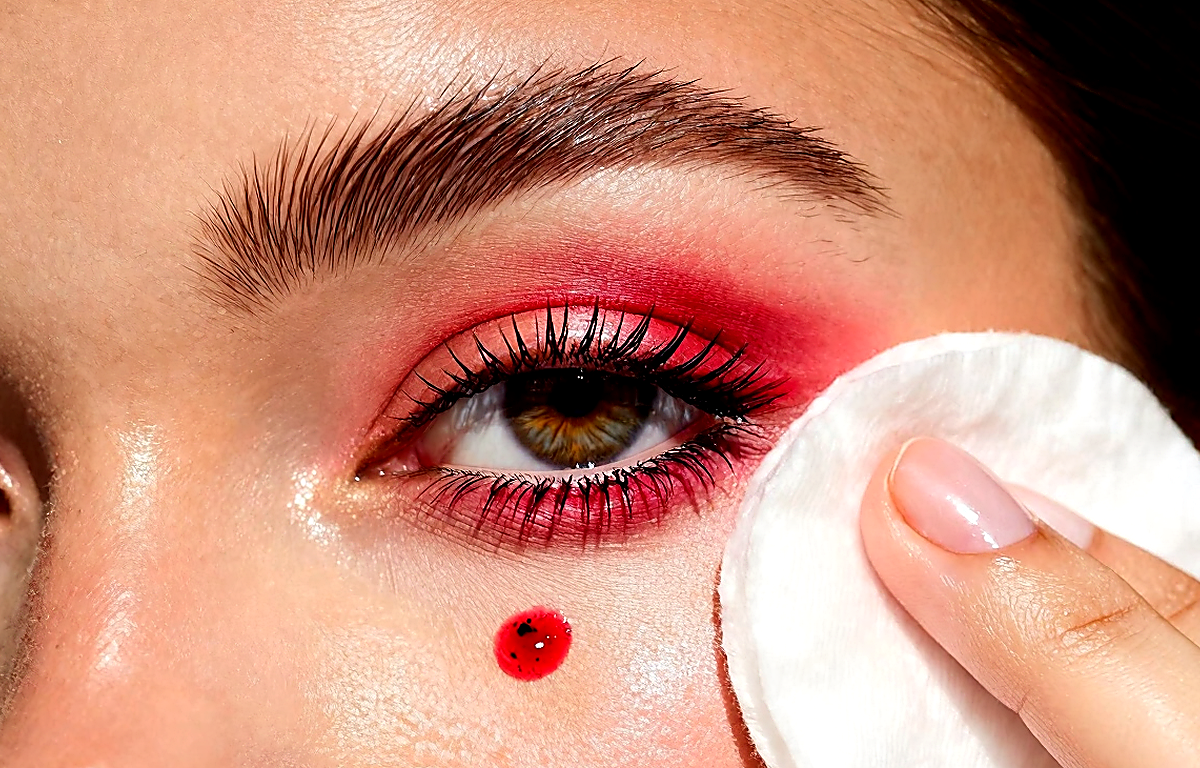
In summer, waterproof mascara really can save your makeup: it is less affected by humidity, sweat, the pool, and long days in the city. But summer is also when two problems show up most often: by evening it starts to flake or leave marks, and when it is time to remove it, you end up rubbing your eyes harder than you would like. The good news is that both problems are usually solved not by “the most long-wearing formula on earth,” but by technique: thin coats, proper lash prep, avoiding extra layers, and gentle two-step removal.
If you need the short practical answer, it is this: in summer, apply waterproof mascara only to clean, dry lashes, do not overload them with serums and cream, do 1–2 thin coats instead of one thick “shell,” let each coat set, and do not touch your lashes during the day. It is best to remove this kind of mascara with an oil-based remover or balm: press a soaked cotton pad onto the lashes for 20–30 seconds, let the film dissolve, and only then gently wipe the mascara away with a downward motion, without rubbing in different directions. That is what helps preserve both daytime wear and evening comfort.
Waterproof mascara is not a universal solution for every day and every kind of weather, but a tool for specific summer conditions. In high humidity, at hot events, on vacation, at the beach, on the go, and on days when makeup has to last through a long schedule, it usually justifies itself better than regular mascara. But if you apply it over a rich cream, keep adjusting your lashes with your fingers, or try to remove it with a foaming cleanser and no oil step, even an expensive formula will behave worse. Below is a clear plan for how to wear waterproof mascara in summer so that it does not flake, crumble, or turn your evening cleanse into a battle.
Why Waterproof Mascara Can Still Flake in Summer
Many people think that if the tube says waterproof, the mascara should stay perfect until night in any kind of heat. In practice, wear depends not only on the formula, but also on what happens on your lids and lashes throughout the day. In summer, the result is affected by humidity in the air, sebum, eye creams, SPF, the habit of touching your face, office air conditioning, and even the way you blink if your lashes are curled too sharply.
Most often, flaking and smudging happen for several reasons:
- there are still traces of cream, sunscreen, or oil on the lashes;
- too much mascara has been applied, so it dries unevenly;
- there was no pause between coats, so the product clumped together and later started to crumble;
- the formula is too dry or has already started to dry out in the tube;
- too heavy a coat has been applied to the lower lashes;
- you regularly rub your eyes, adjust your makeup, or blot your face carelessly;
- your lashes keep touching the lid because of a strong curl or a hooded eyelid.
It is important to understand the difference: flaking is when dry mascara particles fall under the eyes, while smudging is when gray or black marks stay on the skin. In hot weather these problems can happen together, but they are solved a little differently. Thin coats and a fresh formula are best for flaking, while a dry lid area, less product on the tips, and careful work on the lower lashes help most with smudging.
Preparing Your Lashes and Lids: Half of Summer Wear Comes From Prep
The most common mistake is giving all your attention to the mascara and almost none to prep. Yet in summer the skin around the eyes becomes “slippery” faster: your cream has not fully absorbed, the SPF is too rich, concealer has gathered in the crease, and then mascara goes on top of all that. As a result, the product does not set the way it should.
Before mascara, lashes should be clean and dry. If you have just applied skincare, give it time to absorb. Use only a minimal amount of eye cream, and apply it not along the lash line but slightly below and above it so that it does not migrate onto the hairs. If you use SPF close to the eyelids, choose textures that do not leave a greasy film. By the way, if you like layered summer makeup with sunscreen and powder, this article on how to apply powder over SPF without patchiness may also be helpful: carefully setting the skin around the eyes and the upper cheeks affects how mascara behaves during the day too.
Effective prep looks like this:
- Cleansing: remove the remains of your evening skincare and morning oiliness.
- Skincare: apply eye cream very thinly and let it settle completely.
- Makeup base if needed: if your lids get oily quickly, you can use a little primer or a thin layer of long-wear concealer set with powder, but not right at the lash line.
- A dry lash line: before mascara, if needed, run a clean dry spoolie or a cotton swab along the base of the lashes to remove product residue.
If your lashes are naturally straight and you use an eyelash curler, curl them before mascara, not after. A curler on a set waterproof formula can crack the coating and make it more fragile. In addition, a curl that is too sharp can make the lashes touch the lid more and leave marks.
If the skin around your eyes is often irritated, prone to stinging, dryness, or flaking, it helps to review your whole basic skincare routine, not just your mascara. This article on how to build a basic facial skincare routine may help. The calmer and more stable the skin is, the more predictably your makeup behaves.
How to Apply Waterproof Mascara in Summer So It Does Not Crumble
Summer wear almost always favors moderation. Waterproof mascara should not go on like a heavy thick crust: the bulkier the layer, the greater the chance that it will start cracking, flaking, or feeling uncomfortable on the eyes by the end of the day. So the main strategy is not “the more, the more dramatic,” but “the thinner and more precise, the longer it lasts.”
The best way to apply it:
- wipe excess product from the tip of the wand on the neck of the tube;
- apply the first coat thinly, from roots to tips, with a slight twist of the wand;
- focus most on the roots rather than endlessly building length;
- let the first coat set for 20–40 seconds;
- add a second thin coat only where you need more volume or separation;
- do not comb through nearly dry mascara over and over again.
If you want an especially natural but long-wearing everyday option, you can coat only the upper lashes, and either leave the lower lashes bare or lightly brush them with the leftover product on the wand. In summer, the lower lashes are often the source of gray marks under the eyes, especially if you have expressive facial movement, damp skin, or spend a lot of time outdoors.
There is another subtle point: it is not always worth trying to get theatrical volume from waterproof mascara. These formulas usually perform better at lengthening, holding a curl, and maintaining shape. If you try to turn them into extremely dense lashes in five coats, the price is usually the same: crumbling and difficult removal. For a very dramatic result, it is more logical to separate the lashes well first and then stop at two coats than to keep building bulk until they turn stiff.
A popular trick for hot days is to use regular mascara in one thin coat for volume, then add just a little waterproof mascara on the tips and outer corners to lock it in. But this method does not work with every formula: if the products layer badly, the lashes can feel brittle and start flaking faster. If you want to try this method, test it on an ordinary day first, not right before an event.
What to Do in Heat, Humidity, by the Sea, and in the City
A summer day rarely happens in sterile conditions. In the morning there is air conditioning in the car, in the afternoon heat and humidity, and in the evening a walk, a restaurant, or a workout. Waterproof mascara handles these changes better than regular mascara, but it still needs a little help.
Here is what works especially well in real life:
- Do not apply mascara right after cream or SPF. Let those products settle first.
- Do not do your lashes in a rush when your lids are still warm and damp after a shower.
- If you know you sweat heavily, focus on the upper lashes and keep the lower lashes almost clean.
- Do not rub your eyes with a tissue. Instead, gently blot the skin around them without touching the lashes.
- If your lashes are long and touch the lid, reduce the amount of product on the tips.
- Do not “refresh” mascara during the day on top of what is already there. That is almost guaranteed to lead to clumps and flaking.
At the beach and by the pool, wear is often ruined not by the water itself, but by the combination of salt, sunscreen, and the habit of rubbing your eyes after swimming. Even if the mascara is waterproof, it is better to blot your face with a towel and let your lashes dry calmly. Mechanical friction breaks down the coating faster than moisture does.
In the city, the main enemy is sebum and micro-movements. If you have hooded lids or long lashes, a softly matte finish under the brow and on the upper lid helps reduce the risk of smudging. And if humidity affects not only your makeup but your overall look, you may also want to note this article on how to get through humidity without frizzy hair: in summer, the neatest result usually comes from a combination of small but correct decisions.
Which Mascara Formats Are More Comfortable in Summer: What to Look For Without Chasing Loud Claims
Choosing waterproof mascara for summer is not a contest of advertising slogans. It is much more useful to understand which qualities actually affect wear. Broadly speaking, waterproof mascaras can be divided into several formats: lengthening, volumizing, curl-holding, heavily pigmented, and lighter tubing or film-forming options with enhanced wear. Not all of them are equally comfortable in hot weather.
In summer, the easiest formulas to wear are usually the ones that:
- give separation without too much waxy heaviness;
- set quickly but do not dry out during application;
- do not require three or four coats for a visible effect;
- have a wand that makes it easy to coat the roots without excess product;
- come off with an oil-phase remover without prolonged rubbing.
Very volumizing, dense, stage-like options may be beautiful for shoots, but they are harder to manage in everyday summer life. They are more likely to create a heavy layer that is sensitive to overheating, touch, and repeated layering. If you know that in hot weather you often wear glasses, walk a lot, use public transport, or simply dislike the feeling of product on your eyes, choose formulas that focus on separation and holding a curl.
The freshness of the tube matters too. Waterproof mascara that has started to dry out is one of the most common reasons lashes feel stiff and tiny black specks appear under the eyes by evening. If the texture has become noticeably drier, the product stretches in strings, or the wand gives you clumps even on the first coat, the issue may not be your skincare or the weather at all, but the fact that the mascara is simply no longer in its best shape.
How to Remove Waterproof Mascara Without Rubbing: The Safest Technique at Home
The main rule for removing waterproof mascara is to dissolve it first and remove it second. Not the other way around. If you try to wash off this kind of formula with only a foaming cleanser, gel, or micellar water without an oil phase, your hand almost automatically starts rubbing harder. That is exactly when redness, stinging, loss of individual lashes, and the feeling that your eyes are “tired” from makeup appear.
The gentlest at-home method looks like this:
- Apply an oil-phase product to a cotton pad: a bi-phase eye makeup remover, cleansing oil, or balm suitable for the eye area.
- Press the pad onto the closed eye for 20–30 seconds. There is no need to move it back and forth right away.
- Once the product starts dissolving, gently wipe downward along the direction of lash growth.
- Remove residue at the roots with a cotton swab and the same product, without pressure.
- After that, wash your face with your usual gentle cleanser to remove any oily residue.
If there is a lot of mascara, it is better to repeat the short press once more than to increase the pressure. Do not stretch the skin sideways and do not “saw” across the lashes with the pad. Those movements do not speed up cleansing; they only irritate the skin and mechanically damage the hairs.
For people who wear contact lenses, it is especially important not to rush and not to leave oily residue at the lid margin. It is more convenient to remove the lenses first, then take off the mascara, and after cleansing use lubricating drops if needed, if they were recommended by a specialist. If you experience strong stinging, pain, swelling, pronounced redness, blurred vision, or symptoms that do not go away during removal, it is better to stop experimenting and see a doctor. The same applies if you have diagnosed eye conditions, recent procedures in the periocular area, or active skin irritation. If you use retinoids around the eyes, are pregnant or breastfeeding, and are choosing new products with active ingredients for removal or care, it is sensible to discuss that choice with a specialist as well.
Mistakes That Make Lashes Look Worse by Evening
Sometimes it seems as if the problem is the mascara itself, when in fact it is caused by repeated small habits. In summer these are especially noticeable, because heat amplifies everything: skin shine, makeup sensitivity to touch, and the speed with which products begin to migrate.
The most common mistakes are:
- Too much skincare before makeup. A rich cream, oil, serum, and SPF in several layers easily end up on the lashes.
- Trying to “top up” lashes in the evening. Waterproof mascara does not respond well to being refreshed over an old coat.
- Heavy application on the lower lashes. It can look beautiful in photos, but it is not always practical in hot weather.
- An old tube. The drier the formula, the higher the risk of crumbling.
- Constantly touching your eyes. Even waterproof coverage does not like mechanical friction.
- Removing it with foam alone. That almost always ends in extra rubbing.
If you notice that mascara flakes only on certain days, try tracking not the product itself but the conditions: how much cream you used, whether you used a curler, whether you applied a second or third coat, whether it was hot, and whether you had to blot your face often. This kind of small “post-mortem” is often more useful than endlessly changing brands.
An Everyday Summer Routine: A Short Algorithm That Really Works
When you do not want to think about nuances every morning, a simple routine helps. It suits most situations, from the office to vacation, and lowers the risk of both flaking and evening irritation.
Try this sequence:
- In the morning, cleanse your skin and apply only minimal skincare around the eyes.
- Let your cream and SPF absorb completely.
- If needed, lightly set the upper lid with powder, without getting it on the lashes.
- Curl your lashes before mascara.
- Apply 1 thin coat of waterproof mascara.
- Check the result after half a minute and add a second coat only if necessary.
- Use minimal product on the lower lashes, or skip them completely on very hot days.
- During the day, do not rub your eyes and do not layer on more mascara.
- In the evening, remove makeup in two steps: dissolve first, then cleanse gently.
This routine may seem too simple, but simple things are usually what work best. In summer makeup, staying power is almost never born from overload; it comes from discipline: fewer unnecessary textures, less layering, more pauses, and more gentleness.
Conclusion
For waterproof mascara not to flake in summer, it needs clean dry lashes, thin coats, and minimal excess oil around the eyes. To remove it without rubbing, you do not need force, but the right remover and a short pause to let it dissolve. If you remember these two principles — “do not overload during the day” and “do not rub at night” — waterproof mascara really does become a convenient summer product rather than a test of your skin’s and lashes’ endurance.
And if your makeup suddenly stops behaving well, do not rush to blame only the formula. Often it is enough to rethink your lid prep, the number of coats, and your removal method for mascara to work the way you want again: wear calmly, look neat, and come off without a fight.