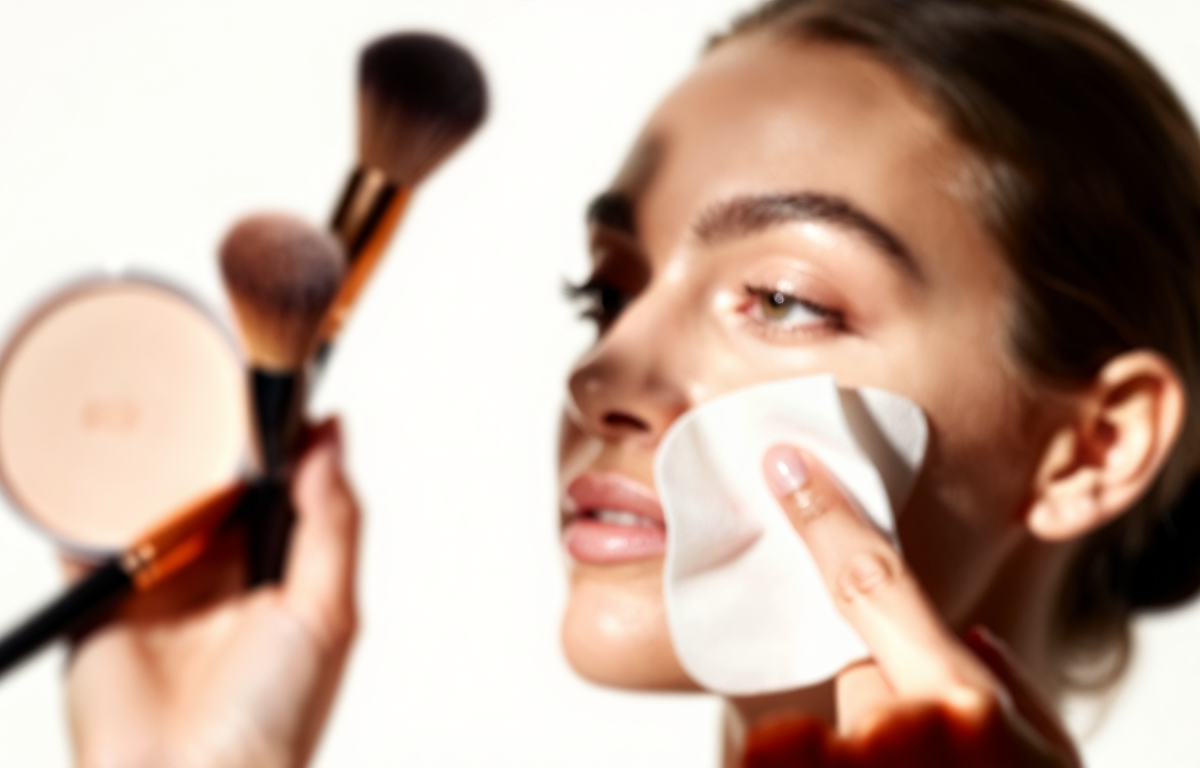
Oily shine on its own does not make makeup look messy—the problem usually comes from trying to hide it with too much powder. That is why the most effective way to quickly freshen up your face during the day looks like this: first remove excess sebum with a blotting paper, then, if needed, add a little powder only where necessary. This sequence helps keep the skin looking alive, does not overload your base, and does not turn makeup into a thick, dry layer.
If shine appears after just a couple of hours, there is no need to “seal” the face each time with another layer of product. What matters much more is understanding exactly where the shine appears, how much product you really need, and which textures work well together. In everyday life, one blotting paper on the T-zone and a light veil of powder only where the coverage has started to break apart is usually enough. Below is a clear guide to mattifying skin without a mask-like finish, patchiness, or a heavy feeling.
Why the face starts to look shiny and why powder often makes it worse
Shine during the day appears for different reasons, and it is not always about “very oily skin.” Sebum mixes with skincare, SPF, foundation, blush, and the skin’s natural moisture. As a result, the surface starts reflecting more light, especially on the forehead, nose, around the sides of the nose, and on the chin. In hot weather, humidity, on public transport, or in an office with dry air, this process happens faster.
The main mistake is trying to remove shine right away with powder on top of a fresh layer of skin oil. In that case, the particles cling not to a dry, prepared surface, but to a mix of sebum and makeup. The result is familiar to many: pores are emphasized, the complexion looks uneven, and the face gets that very “mask” effect—dense, matte, but untidy.
In practice, the problem is usually caused by three things:
- too heavy a layer of skincare products and SPF under makeup;
- frequent layering of powder without removing shine first;
- an unsuitable texture, for example, a heavy powder on dehydrated skin.
If you want coverage to look natural, it is important not to fight your skin, but to work in stages: blot, assess the state of the makeup, and then powder only the areas that truly need it.
Blotting papers: when they are more useful than powder
Blotting papers are often underestimated because they do not give an instant, airbrushed matte effect. But they are exactly what allows you to remove excess shine as gently as possible. A paper does not add a new layer of product—it simply lifts excess sebum from the surface. Because of this, the foundation shifts less, and the face keeps the texture of real skin rather than a powdered mask.
Blotting papers are especially useful if:
- your makeup is already applied in several layers and you cannot overload it further;
- the shine is localized—only on the nose, center of the forehead, or chin;
- your skin is prone to dehydration, and heavy mattifying makes it look older;
- you need a quick refresh away from home, without a brush or mirror;
- you are wearing SPF and it is important not to smear it around with active rubbing.
How to use them correctly: do not rub or “polish” the skin. Instead, gently press the paper onto the shiny area for a few seconds. If needed, repeat on a nearby area with a clean side. This kind of motion does not break up the base or create new patches.
If your skin already looks neat after the blotting paper, you can stop there. Not every situation calls for powder. Sometimes a natural satin finish looks much more expensive and fresher than completely flat matte skin.
When you need powder and which one to choose to avoid a mask-like finish
Powder becomes truly useful when you need not only to remove shine, but also to slightly smooth the surface, set makeup, or visually blur pores. However, for daytime touch-ups, light textures and a small amount of product work best. The denser the formula and the more actively you layer it, the higher the chance of ending up with a dry, dusty, aging-looking finish.
For shine control, people usually choose among several types of powder:
- Loose translucent powder—good at home for morning makeup when you want a light finish without extra color.
- Pressed translucent powder—convenient in a bag and suitable for targeted touch-ups during the day.
- Tinted pressed powder—helpful if you also need to slightly correct coverage, but with careless layering it more often creates a mask effect.
- Micronized blurring powder—helps visually smooth texture if applied in a very thin layer.
What to look at when choosing:
- how finely milled the powder is;
- whether it has strong color that may build up during the day;
- how it behaves over your foundation and SPF;
- whether it emphasizes dryness around the nose and on the cheeks.
If you have already dealt with patchiness when applying product over sunscreen, it is helpful to separately look into how to apply powder over SPF without patchiness. There, using a minimal amount of product and the right application technique is especially important.
The golden rule is simple: the more visible makeup is on the skin in daylight, the less likely it is that an extra layer of powder will look fresh. That is why, for your bag, a compact semi-translucent formula is usually a better choice than a dense two-in-one product.
The ideal order during the day: blotting paper, pause, then powder
To remove shine neatly, it is important not only what you use, but in what order you use it. The cleanest and most predictable routine looks like this:
- Assess your face in normal lighting. Do not hold the mirror too close—this makes it easier not to overdo it. Often only the center of the face is shiny, while the cheeks still look fine.
- Blot the shine with a paper. Press it onto the forehead, around the nostrils, and the chin. Do not drag it back and forth across the face.
- Wait a few seconds. Once excess sebum is gone, you can tell whether you need powder at all. Sometimes the makeup already looks even enough.
- Apply powder only where needed. Not all over the face, only on the areas that need mattifying again or where the makeup has started to slip.
- Press, do not rub. A brush, puff, or sponge should press in a thin layer rather than move it around the skin.
This pause between the blotting paper and the powder seems minor, but it is exactly what prevents overload. When the skin is no longer covered in fresh oil, the powder goes on in a thinner, cleaner layer. But if you apply it straight over sebum, you get a mixture that collects in pores and folds.
If the makeup has slightly separated around the nose, you can first very gently smooth the area with a clean finger or a soft sponge, and only then use powder. This will help you avoid setting unevenness with a new layer.
How to apply powder so the skin looks alive, not flat
The mask effect is often connected not only to the amount of powder, but also to the way it is applied. When product is swept across the whole face with broad, active movements, it catches on peach fuzz, texture, and dry areas. Up close, this is immediately noticeable, and in photos it can look even heavier.
Here are a few practical techniques that help preserve a natural finish:
- Use the smallest amount possible. One very thin layer is better than trying to achieve absolute mattness in one go.
- Tap excess off the brush. A fluffy brush gives lighter coverage, while a puff gives a more matte and denser result.
- Press the product in. Especially on the nose and in the center of the forehead. This helps keep the base from shifting.
- Do not automatically powder the whole face. On the temples, around the perimeter of the face, and on the upper cheekbones, a natural finish usually looks better.
- Do not keep layering color unless you need to. If all you want is to remove shine, translucent powder is safer than a dense tinted one.
Pay special attention to expressive areas—around the nose, around the mouth, and under the eyes. That is where excess powder quickly emphasizes fine lines and dryness. If an area is prone to flaking, it is better to stick to a blotting paper or apply only a micro-layer of product around the edges, without going over the irritated zone.
The face looks fresher when mattness is distributed unevenly, in a natural way. There is no need to turn the skin into a perfectly matte canvas. A light, natural glow on the cheeks or around the perimeter of the face usually makes makeup look more expensive.
Common mistakes that make shine come back even faster
Paradoxically, some attempts to “lock” the skin down only make shine return faster. When textures clash or skincare is too aggressive, skin can look oily and dehydrated at the same time—and makeup loses its neat appearance more quickly.
The most common mistakes are:
- Overly harsh cleansing. If the skin feels tight after washing, it may respond by producing more sebum faster.
- Skipping moisturizer. Trying to “dry out” the face before makeup often ends with patchy foundation that emphasizes texture.
- SPF or primer that is too heavy. Some combinations of skincare and makeup create excess shine within an hour.
- Too much powder in the morning. If the face is already heavily powdered, it is almost impossible to refresh makeup invisibly later in the day.
- Rubbing motions. A blotting paper, brush, or sponge will all shift the base and create patches if used with too much friction.
If shine feels impossible to control, sometimes it is more useful not to change your powder, but to rethink your basic skincare. For that, you can use a simple guide on how to build a basic skincare routine for the face so the skin feels more balanced and makeup wears more calmly.
It is important to remember that makeup longevity depends not only on mattifying products, but also on the condition of the skin itself. When the skin is irritated, over-dried, or overloaded with actives, it is much harder to achieve a beautiful surface.
What to choose for different skin types and situations
The same mattifying method will not work equally well for everyone. If you want the face to look natural, it helps to adjust your approach to your skin’s characteristics and the circumstances of the day.
If your skin is oily. The combination that usually works best is “blotting paper + translucent pressed powder on the T-zone.” In the morning, it is better not to create a very dense, multi-layered base: during the day it is harder to refresh discreetly.
If your skin is combination. Do not treat the whole face the same way. The center can be mattified more actively, while the cheeks may not need anything at all, or only the lightest pass of a brush if necessary.
If your skin is dehydrated but shiny. This is a common situation. Here it is especially important to blot away sebum first and use only a minimal amount of powder. An overly dry finish will quickly emphasize texture.
If your skin is sensitive. The less friction and the fewer unnecessary layers, the better. Choose soft blotting papers without fragrance and powders that do not leave the skin feeling tight.
If you are facing heat, humidity, or a long day away from home. Take blotting papers and a small translucent powder with you, but do not chase absolute mattness. In these conditions, it is better to gently blot your face several times than to apply too much product at once.
If your makeup is minimal. Sometimes blotting papers alone are enough. This is especially true if you are wearing a light tint, concealer, and cream blush—extra powder can kill the natural look.
Seasonality is a separate factor. In summer, the face usually gets shiny faster not only because of the heat, but also because of richer SPF. In winter, the cause may be the contrast between outdoor cold and dry indoor air: then the skin loses moisture and starts to shine in the center of the face at the same time.
When mattifying is no longer enough and it is time to pay attention to your skin’s condition
If your face suddenly becomes much shinier and your usual products stop working, the issue may not be the blotting papers or the powder. Sometimes this is how irritation, unsuitable skincare, overly active acids, retinoids, or an overload of incompatible textures shows up. In that situation, it is better not to keep trying to fix everything with makeup, but to simplify your routine for a while.
It is worth paying attention if shine is accompanied by:
- burning, soreness, or noticeable redness;
- flaking and a feeling of tight, “stretched” skin;
- swelling, itching, or discomfort after a specific product;
- unusual breakouts or a flare-up of existing issues.
If these symptoms persist, and also if you have pain, ongoing burning, swelling, suspected skin disease, are pregnant, or are using retinoids or other active products, it is best to discuss your skincare with a dermatologist or with the doctor managing your pregnancy. Mattifying should make makeup look neater, not cover up discomfort that needs attention.
Sometimes it also helps to look at your overall approach to skincare: textures that are too rich for the face and body in hot weather can increase the feeling of stickiness overall. That is why many people like the seasonal principle of choosing lighter formulas—this approach works well not only for the face, but for other care areas too, as in the article about a lightweight body cream for summer without stickiness. The logic is the same: less overload, cleaner finish.
Quick reminder: how to remove shine in a minute without ruining your makeup
If you want the shortest possible daily algorithm, remember it like this:
- Do not rush to cover shine with a fresh layer of powder.
- First press a blotting paper onto the T-zone.
- See whether anything else is needed.
- If it is, apply just a tiny amount of powder only where it makes sense.
- Leave the cheeks and the perimeter of the face more natural if they are not shiny.
This approach is exactly what most often gives the result of “neat skin” rather than “a face covered in makeup.” The more gently you handle makeup that is already on the skin, the more expensive and fresh it looks throughout the day.
Blotting papers and powder do not compete with each other—they work best as a pair when each has its own role. The papers remove excess, the powder refines the finish. If you do not mix up those roles, you can easily control shine without a dry, overloaded mask and without feeling like you have to repair your makeup from scratch every two hours.