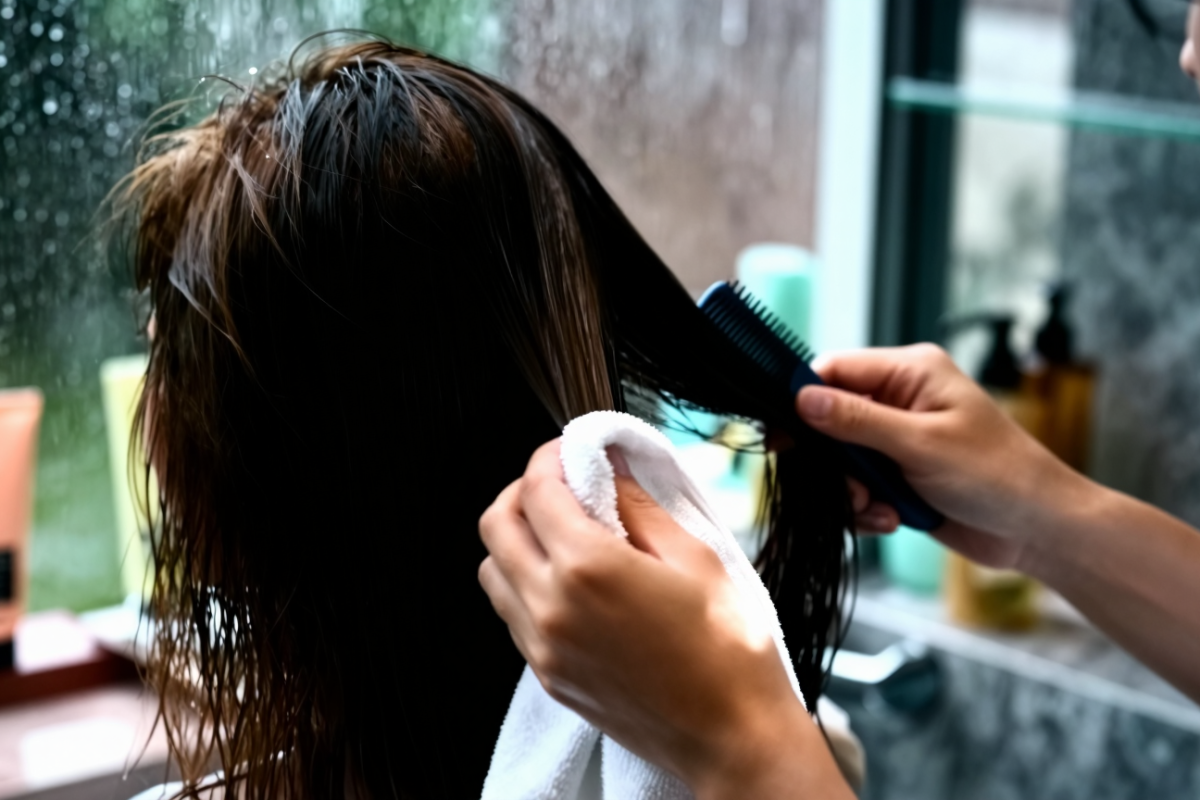
If your hair has puffed up after humidity, do not try to smooth it down right away with a large amount of oil or cream. A gentler approach works better: blot the length with a microfiber towel or a smooth T-shirt, detangle with wide teeth, apply a very small amount of leave-in care through the mid-lengths and ends, and then finish drying with warm air in the direction of hair growth.
The main rule is to remove excess water and friction first, then add a thin protective film. When a heavy layer of product is applied to damp, ruffled hair, frizz often turns into sticky strands around the face and dry ends. It is better to work in small amounts and leave the roots free.
Why humidity quickly makes frizz rise
Hair reacts more strongly to humid air when the cuticle is lifted: after hot water, a rough towel, aggressive brushing, frequent lightening, or drying styling. Moisture from the air gets into the hair unevenly, and individual strands start sticking out in different directions.
This does not mean your hair is “bad” or that it needs to be coated in styling products. More often, a calm technique helps: less friction, careful blotting, moderate leave-in care, and drying in one direction. For fine hair, it is especially important not to overload the roots — there is a separate guide on that here: fine hair without weighing it down.
Step one: a towel without friction
After a shower, do not rub the length with a terry towel. It is better to wrap your hair in microfiber or a soft cotton T-shirt and gently squeeze the strands with your hands. This removes excess water without roughing up the hair surface.
If you find it convenient to keep a separate towel for your lengths at home, focus not on a trendy format but on the softness of the fabric and the absence of rough friction: similar logic is covered in the article hair turban towel.
If your hair has already frizzed up after rain, the approach is similar: do not brush it dry with a brush. Blot the damp areas, let them settle a little, and only then detangle. The fewer chaotic movements on wet lengths, the calmer the final shape will be.
A comb: wide teeth instead of a stiff brush
Wet hair is easier to damage with abrupt movements. Start at the ends, then move upward while holding the section with your hand. Wide teeth help detangle knots without unnecessary stretching, and a stiff brush is better saved for already partly dried lengths if it suits your hair type.
If you have waves or curls, after detangling you can gently scrunch the strands again with your palms to bring back the pattern. For straight hair, it is more important to direct the hair downward and not lift short hairs against their growth.
Leave-in care: how much to apply
For the first amount, think of a pea size, and for very thick hair, two small amounts — but not all over the head at once. Rub the product between your palms and apply it through the mid-lengths and ends. The roots, bangs, and the area around the face are best touched only with what remains on your hands, if they truly need softening.
If after five minutes the ends still feel dry, add one more drop only there. If hair around the face starts to feel sticky, that means there was too much product or the texture was too dense. A more detailed guide to dosage is in the article leave-in hair care without greasiness.
Blow-drying without frizz
A hair dryer does not necessarily make things worse: often it is harder on the hair when it dries slowly in a messy way and rubs against clothing. Use warm, not scorching, air, keep the airflow pointed from top to bottom, and do not whip the strands around in different directions. A concentrator nozzle helps direct the air more neatly.
If your hair is wavy, you can dry it with a diffuser on a moderate speed without breaking up the strands with your hands every ten seconds. If your hair is straight, a soft round brush or simply combing downward will give a smoother finish.
What to do during the day if it starts raining
Keep a small hair tie, a smooth clip, or a mini comb in your bag. When humidity suddenly rises, it is sometimes better to put your hair up for twenty minutes than to keep touching it endlessly with your hands. Constant touching adds frizz and quickly makes the strands around the face look dirty.
If you need to refresh the lengths quickly, dampen your palms with water, rub in the остаток лёгкого крема or leave-in product and smooth it only over the top layer and the ends. Do not apply product straight from the tube onto already styled hair: that makes it easier to end up with patches and heaviness.
What not to do with frizz
Do not straighten damp hair with a hot flat iron. That is a risk to the quality of the hair fiber and usually does not solve the problem for long: the next time humidity hits, short hairs will rise again. Dry your hair first and use heat protection if you choose hot tools.
Do not try to fix frizz with dry shampoo through the lengths. Its job is roots and freshness, not smooth ends. Do not layer oil, cream, hairspray, and spray all at once: if something goes wrong, it will be hard to tell what exactly overloaded the hair.
For fine, dense, and color-treated hair
Fine hair often does better with a lightweight spray or milk that does not take volume away from the roots. Dense and porous hair may need a cream, but in small amounts. Color-treated and lightened lengths often need gentler blotting and regular protection for the ends.
If after humidity your hair is not just frizzy but breaking, tangling badly, or your scalp is irritated, it is better not to build your routine only on advice from the internet and, if needed, consult a specialist. In an ordinary everyday situation, the goal is simpler: reduce friction and find a comfortable dosage.
A quick morning routine
Blot your hair with a soft fabric, detangle the ends, apply a drop of leave-in care to the lengths, dry in the direction of growth, and do not touch the strands until they have fully cooled after blow-drying. If needed, at the end smooth the top layer with the product left on your palms.
This routine does not promise perfect salon-level smoothness in any weather, but it does help you look neater without a heavy film. The less friction and chaotic layering there is, the more calmly your hair gets through a humid day.