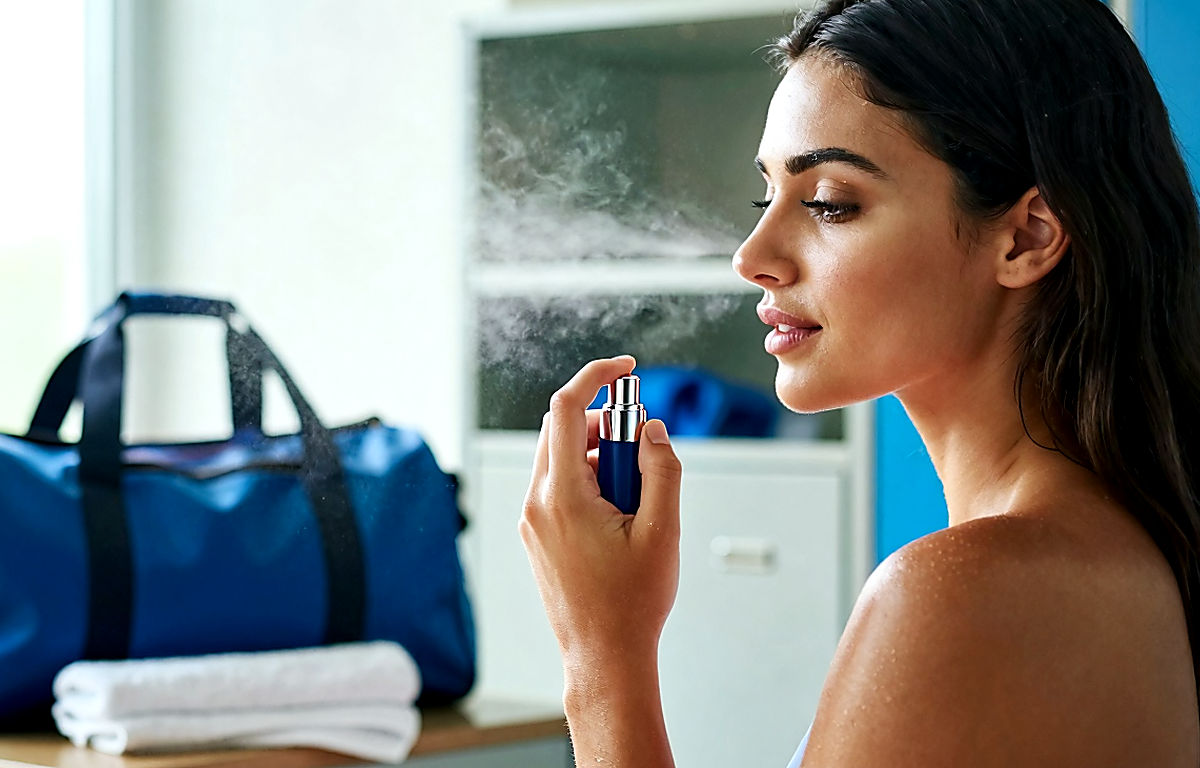
After a workout, you want one thing: to smell clean, fresh, and appropriate—not to hide sweat under a dense cloud of perfume. The most reliable rule is simple: first remove the source of the odor—sweat, salt, damp clothes, overheated skin—and only then add a light fragrance. If you try to “cover up” a workout with a heavy composition, the result is almost always the opposite: sweet, ambery, or very intense notes smell denser on hot skin, become tiring faster, and can mix with sweat less pleasantly than you would like.
That is why a post-workout scent is not a separate heroic perfume but a whole sequence: a shower or at least a quick cleanse, dry clothes, the right deodorant, light body care, and only then a moderate amount of fresh scent. Transparent citrus, green, watery, musky, and “soapy-clean” styles without an overly long, loud trail work best. Below is a clear system for choosing that kind of fragrance, when to apply it, where to spray it, and what to avoid so you smell polished rather than intrusive.
Why fragrance often smells stronger after a workout than you expect
After physical activity, your skin is warmer than usual, circulation is more active, and both your body and clothes are more humid. All of this affects how a fragrance opens up. Even a perfume that seems calm at home can smell much brighter after exercise. That leads to a typical mistake: a person applies their usual amount and ends up with a scent trail that is far too noticeable.
It is also important to understand something else: sweat itself does not always smell sharp right away. Unpleasant odor more often appears when moisture stays on the skin and in the fabric for too long, mixes with sebum, and lingers in the underarms, on the neck, back, sports bra, or T-shirt. So the main secret to “smelling good after the gym” is not buying another bottle, but reducing the time your skin stays in contact with sweat and damp clothing.
- Hot skin intensifies the evaporation of fragrance molecules.
- Humidity makes the scent more noticeable in the first few minutes.
- Residue from sweat and fabric can distort even a good perfume.
- Heavy sweet bases often feel more suffocating after a workout.
- People around you in the locker room, elevator, taxi, and office smell your fragrance from closer range than you think.
The conclusion is simple: after exercise, the best fragrance is not the longest-lasting one, but the one that smells the cleanest and is dosed well.
Where freshness begins: not with the bottle, but with the care base
If you can take a shower after your workout, that is the best-case scenario. Gentle cleansing removes salt, sebum, and product residue, which means fragrance will sit more cleanly afterward. But even without a full shower, you can improve the result significantly if you work step by step instead of trying to solve everything with a single perfumed mist.
- Take off damp clothes as quickly as possible. Sweat-soaked fabric holds odor and keeps “returning” it to the skin.
- Clean the areas where odor lingers the most. Underarms, neck, chest, back, and the bends of the arms. Water, a gentle cleanser, or wet wipes without a sharp fragrance will work.
- Dry the skin thoroughly. Many fragrances smell too harsh on a wet surface.
- Apply deodorant or antiperspirant. This is what controls odor and moisture—not eau de toilette.
- Use a light cream if needed. If your skin feels tight after showering, choose a fast-absorbing option without a heavy sweet scent. By the same principle, you can use tips on how to choose a light body cream for summer without stickiness.
- Only then add fragrance. Not before.
This order creates a true feeling of cleanliness. In this system, perfume is the finishing touch, not camouflage.
Which fragrances work best after exercise
An appropriate post-workout fragrance is rarely dramatic. Ideally, it should feel like an extension of a fresh body, not an evening entrance. The most successful fragrance families are the ones associated with clean laundry, cool water, greenery, citrus, and neutral musk.
It helps to focus not only on the brand or a catchy name, but first and foremost on the character of the scent. It is a good sign if the fragrance feels transparent, bright, and airy from the very first seconds.
- Citrus. Bergamot, lemon, mandarin, grapefruit, yuzu. They create a feeling of freshness, but usually do not last too densely, which is more of a plus after a workout.
- Green. Leaves, grass, tea, basil, petitgrain, fig leaf. These notes create an effect of composure and cleanliness without obvious sweetness.
- Aquatic and ozonic. Good for those who like a cool, just-showered feeling.
- Musky and “soapy.” If the composition is soft and not powdery or stifling, it works beautifully at close range.
- Light florals. Neroli, orange blossom, transparent jasmine, a fresh lily-of-the-valley-like accord—provided they do not turn thickly sweet.
And here is what to be more careful with after a workout:
- dense vanilla and caramel;
- heavy amber and resins;
- very intense oud, leather, or tobacco;
- overly loud white florals in a dense base;
- perfumes with a pronounced “evening” character and a long trail.
That does not mean these directions are bad. It simply means their time is more likely to be evening, cool weather, or situations where you are not leaving the gym for a shared space with close proximity to other people.
How to read the pyramid and description if you want a “clean and polished” effect
You do not always have the chance to test a fragrance for a long time, especially if you are choosing something specifically for your gym bag or quick use after training. In that case, it helps to know how to read between the lines of a description. The effect you want is often hidden not in the word “fresh,” but in the combination of notes and the overall character of the composition.
Look for these markers in descriptions:
- clean, crisp, airy, transparent, watery, green, citrus, linen, soap, musk;
- notes of bergamot, neroli, green tea, leaves, aldehydic cleanliness, soft white musk;
- phrases such as “skin scent,” “second skin,” “freshly showered,” “laundered shirt.”
Be cautious with words like:
- intense, extrait, opulent, gourmand, syrupy, rich, seductive, enveloping;
- the notes may include rum, chocolate, dense vanilla, smoke, resins, or patchouli in a heavy interpretation.
There is another practical criterion: ask yourself whether you would want to smell this fragrance in a tight elevator twenty minutes after cardio. If the answer is not obvious, the composition is probably too loud for this purpose.
It is useful to have two different formats: one for everyday freshness after a workout and another for full perfume pleasure at another time. That way you do not have to force a sports context onto something that was created for a completely different atmosphere.
How much to apply and where: the formula that works best
Most post-workout fragrance problems are connected not to the smell itself, but to the dosage. After a shower and on warm skin, perfume feels more noticeable, so the amount almost always needs to be reduced. The goal is for someone standing close to catch a pleasant freshness only at short range—not to smell your trail before they even see you.
A good guideline is:
- Spray eau de toilette or eau de parfum: usually 1–2 sprays are enough.
- Body mist: 3–5 light sprays can work because the concentration is lower.
- Scented cream or lotion: a good standalone soft option without additional perfume.
Where it is best to apply it:
- on dry skin on the chest or collarbones, if you have already cooled down after the workout;
- on the nape of the neck or hair from a distance, if the product is suitable for that and you are not overdoing it;
- on clothing—only if the fabric is clean, dry, and you are sure the scent will not leave marks.
Where it is better not to apply it right after exertion:
- on very hot, reddened, or irritated skin;
- directly on the underarm area over freshly shaved skin or active deodorant;
- too generously on a scarf, hoodie, or T-shirt that will hold the scent trail for hours.
A good rule is one spray first, then a pause for a few minutes. If you still want to intensify the scent, it is better to add just a little than to create a dense aromatic cloud right away. The same principle works for body mist or a light citrus water: do not spray it ten times “just in case”; assess how the product behaves on your own skin.
Deodorant, cream, body mist, perfume: how to avoid a clash of scents
A clean impression is almost always built on harmony, not on the number of products. If you already use a strongly scented shower gel, a deodorant with a distinct masculine or sweet fragrance, a scented lotion, and then perfume on top, the result can feel overloaded even with good taste. After a workout, this becomes especially noticeable.
The safest approach is to build a quiet base and leave the role of the main scent to one product.
A convenient formula:
- Gentle cleansing with a neutral or barely noticeable scent.
- Deodorant without a conflicting fragrance—neutral, fresh, or almost imperceptible.
- Light cream or body milk without a sweet trail, if the skin needs moisture.
- One scented accent: body mist or perfume, but not everything at once at full strength.
If you enjoy more complex combinations, it is better not to experiment after a workout. This is not the best moment for heavy layering, gourmand pairings, or mixing several noticeable compositions. Simply put: a clean body, dry clothes, calm deodorant, and one transparent fragrance almost always smell more refined and appropriate than five beautiful products all at once.
Hair deserves a separate mention. Hair and fabric hold scent for a long time, so they are exactly what can make a fragrance louder than you planned. If you want a light effect, one cloud in front of you and a step forward is enough, rather than a direct intense spray onto the strands. This matters even more in heat, humidity, and after active exertion.
Popular product formats: what to choose for the gym, the office, and the trip home
Not everyone finds a classic perfume bottle convenient in a gym bag. A post-workout scenario often demands practicality: the product should be quick to use, considerate of others, and appropriate immediately after a shower or on the go. That is why it helps to choose not only the fragrance, but also the format.
- Body mist. One of the friendliest options after exercise. It gives a feeling of freshness, usually smells softer than perfume, and is less likely to overwhelm in enclosed spaces.
- Eau de toilette. Good if you like a more defined scent but are ready to limit yourself to 1–2 sprays.
- Perfumed body lotion. Suitable for dry skin and for those who want a very close, delicate fragrance without a trail.
- Solid fragrance. Convenient for travel, but it is important to make sure it is not too waxy, sweet, or heavy in the base.
- Rollerball or small travel format. A practical solution for your bag if you already know that the scent does not become too loud on you after exercise.
For the office after a morning workout, it is better to choose the calmest format. If you are going home rather than into a work space, you can allow yourself something slightly more noticeable, but still fresh. For public transport, the rule remains the same: the people around you did not sign up for your scent trail, especially in summer.
Common mistakes that turn freshness into overload
Even good fragrances are easy to ruin with the wrong habit. Below are the most common mistakes that turn post-workout freshness into a feeling of “too much of everything.”
- Applying perfume before the skin is clean. The fragrance mixes with sweat and damp fabric instead of settling on a neutral base.
- Using the same amount as in the evening. After exertion and in a warm room, that is almost always too much.
- Choosing longevity as the main criterion. For sports, what matters more than record-breaking wear time is how clean the fragrance smells.
- Layering a sharp deodorant, a scented cream, and a dense perfume. This creates a clash of scents.
- Staying in damp clothes for too long. This cancels out even good care.
- Applying fragrance to irritated skin. If there is burning, redness, or discomfort, the skin needs calm first, not more fragrance.
If after a workout you notice persistent burning, soreness, pronounced redness, swelling, a rash, or an unpleasant odor that is not connected with ordinary exertion and does not go away, it is better not to mask the problem with fragrance but to discuss the situation with a doctor. This is especially important during pregnancy, with skin conditions, after aggressive cosmetic procedures, and in any case where the skin is reacting in an unusual way.
A ready-made formula: how to smell fresh after a workout every day
So you do not have to rethink this every time, it helps to build a simple repeatable system for yourself. It works better than an endless search for the “perfect” bottle.
- Before your workout: do not apply a heavy sweet perfume if you know you will be heading to the office afterward or staying around people in an enclosed space.
- Right after: take off damp clothes, quickly cleanse the skin, or take a shower.
- Dry the body: especially the areas where moisture lingers longer.
- Use a neutral deodorant: let it handle odor control rather than compete with your perfume.
- Moisturize if needed: with a light cream without an intrusive scent.
- Add 1–2 sprays of a fresh fragrance: citrus, greenery, tea, neroli, clean musk, or an aquatic accord.
- Check the distance: if you can clearly smell yourself all the time, the scent may already be too noticeable for others.
This formula is especially convenient in hot weather, when the skin heats up more and even beloved compositions behave more actively. If you want to make the routine even more comfortable, choose clothing and care textures that do not add extra stickiness or heaviness. In general, the same principle of minimalism is useful in basic care too: fewer conflicting layers, cleaner results.
And one more nuance: do not chase a fragrance that “lasts until night” specifically after the gym. It is far more valuable to have a product that gently accompanies you for the first hours after exercise and then softens, without tiring either you or the people around you. In the context of freshness, moderation is not a compromise but a sign of good taste.
Conclusion
Smelling clean after a workout means not hiding sweat behind perfume, but building the right sequence: cleansing, dry skin, an appropriate deodorant, light care, and only then a little fresh fragrance. Transparent citrus, green, aquatic, and softly musky compositions without a heavy sweet base work best. If you reduce the dosage and avoid mixing too many scented products, the result will be exactly what you want: composed, polished, and genuinely fresh.