If the skin on your body is flaking, the first thing to understand is this: the problem is not always that the product is “not nourishing enough.” More often, something else is going on—overly harsh cleansing, hot showers, dry air, the habit of applying oil to completely dry skin, or simply a formula that does not suit your particular type of dryness. That is why, when choosing Topicrem or any other body oil, it helps to look beyond the word “nourishing” and consider the whole care routine: what you wash with, when you apply the product, which ingredients help hold moisture in the skin, and whether anything is constantly damaging the skin barrier.
In short, if flaking is a concern, there are five things worth checking: whether the product contains emollient and occlusive ingredients, whether fragrance is irritating your skin, whether you apply the oil right after contact with water, whether an oil texture alone is enough or your skin also needs a cream, and whether there are signs of a condition that is better discussed with a doctor. This practical approach is what helps explain why one oil can feel “useless,” while another noticeably improves skin smoothness after just a few days of regular use.
Why skin flakes even if you are already using an oil
Flaking is not only about dryness in itself. Most often, it is the visible result of a disrupted skin barrier: water evaporates more quickly, the surface becomes rougher, and the scales of the outer layer start to shed more noticeably. A body oil can help reduce moisture loss and make the skin feel softer, but if the barrier is being damaged every day, one product may not be enough.
In practice, the most common reasons for body flaking are:
- showers that are too hot and too long;
- aggressive shower gels that leave a “squeaky-clean” feeling after washing;
- dry indoor air, especially during heating season or after air conditioning;
- infrequent application of skincare or applying it only to very dry skin;
- frequent use of harsh scrubs and acids without enough compensating hydration;
- shaving and friction from clothing, especially on the shins, elbows, and thighs;
- individual skin reactivity to fragrance and certain actives.
That is why it is better to assess Topicrem or any other product not in isolation, but together with the rest of your routine. Sometimes switching your cleanser and starting to apply the product within the first few minutes after a shower is enough to make the situation noticeably better without any complicated steps.
What to check in a body oil formula if flaking is a concern
When the packaging says “body oil,” it can mean very different kinds of formulas. Some work as a light softening finish, others are better at locking in moisture, and others feel pleasant to spread but do very little for pronounced dryness. That is why it helps to look not at the marketing promise, but at the type of ingredients.
For skin that is flaking, three groups of ingredients are especially important.
The first is emollients, meaning softening substances. They help fill in unevenness on the skin’s surface and make it feel smoother to the touch. These can include plant oils, esters, squalane, and other softening components. After them, the skin usually looks less dull and less “dusty.”
The second is occlusive ingredients, which create a protective film and reduce water evaporation. These are especially useful if the skin is not just dry, but loses moisture quickly after a shower. An oil without enough occlusion may spread pleasantly, yet still fail to give the skin the protected feeling it needs.
The third is humectants, which attract and hold water. Pure oil formulas may not contain many of them, so when flaking is more pronounced, not only oils but also a combination of oil with a body cream or balm may work better.
When choosing Topicrem or a similar product, pay attention to the following:
- whether the product has a reputation for caring for dry and sensitive skin, rather than simply giving a “radiant finish”;
- whether the first ingredients include a large amount of lightweight silicones or dry texturizing components without enough barrier support;
- whether it has an intense fragrance, especially if your skin tends to become red and itchy;
- whether the product promises everything at once—strong exfoliation, an active perfume composition, and “ultra comfort”—if your skin is currently irritated.
It also matters what you expect from the formula. If you mainly want help with flaking on the shins, elbows, and knees, denser, more barrier-focused products are usually more suitable than dry oils designed mainly for sensory appeal. And if the dryness is moderate and what bothers you most is tightness after a shower, a comfortable oil may fit very well into an everyday ritual.
How to tell whether Topicrem itself will suit you: useful guideposts without extra expectations
Popular pharmacy and dermocosmetic brands, a category Topicrem is often placed in, usually do well when it comes to skin comfort, soft textures, and straightforward at-home care. But even successful brands offer different products for different needs. So it is not worth relying on the brand name alone: it is better to mentally check whether the specific format matches what your skin is asking for.
If your main issue is flaking after a shower rather than simply wanting more polished-looking skin, it helps to ask yourself a few questions.
- Is your dryness present all year round or only seasonally?
- Is the flaking localized or spread across the whole body?
- Do you also have itching, stinging, or redness along with the flaking?
- Are you comfortable applying richer textures, or do you stop using the product because of stickiness?
- Do you use anything after the oil, such as a body cream?
If you do not like sticky formulas, ease of use may turn out to be the deciding factor. The most effective product will not help if it sits unused on the shelf. In that case, a lighter routine used regularly is better than rare use of a very rich product. By the way, if you prefer not an oil but a comfortable everyday format, you may find this article useful: how to choose a lightweight body cream for summer without stickiness. The principle of balancing texture and comfort is relevant far beyond the warm season.
One more important point: oil does not always have to be the only step. When flaking is pronounced, many people do better with a “water or lotion first, oil on top” routine, because the oily film helps seal in existing moisture rather than fully replacing it.
Application technique: why even a good oil can seem useless
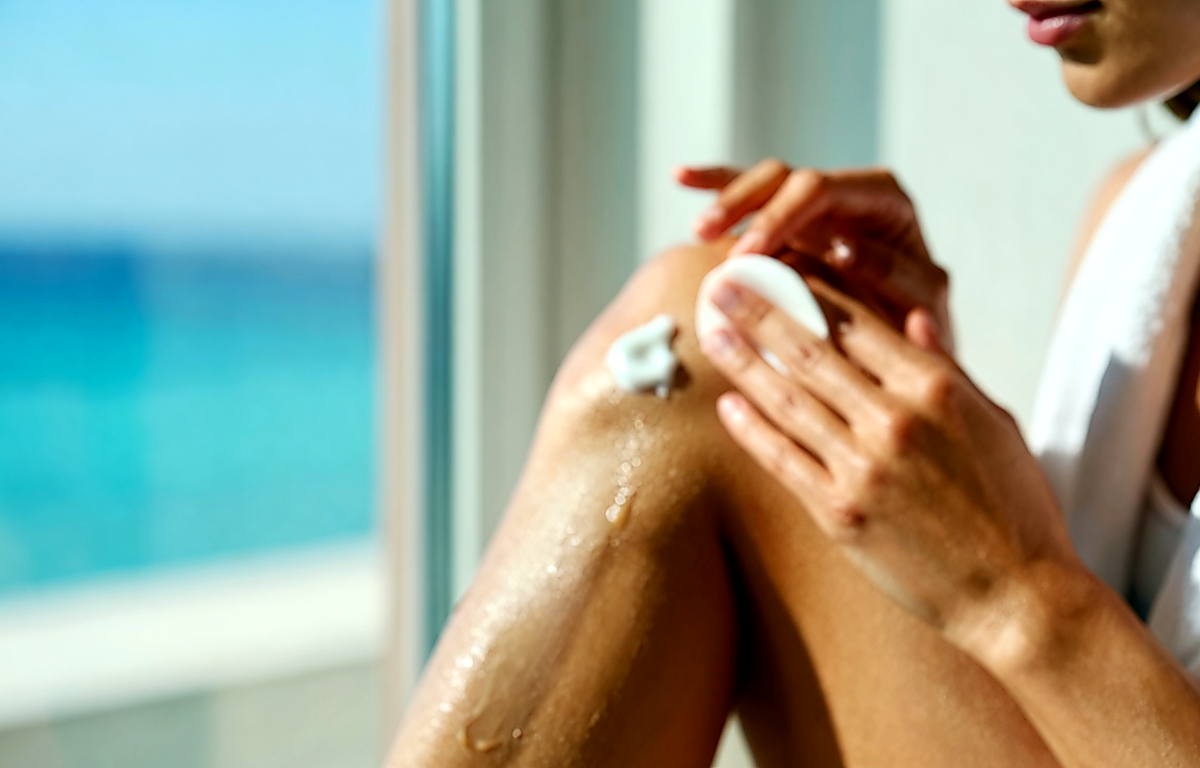
One of the most common mistakes is applying oil to completely dry skin half an hour after a shower. In that case, the product will soften the surface, but the effect may be weaker than you expected. For flaking, the best results usually come from applying it to slightly damp skin, when there is still water on the surface that needs to be held in.
The ideal routine looks like this:
- Take a short warm, not hot, shower.
- Use a gentle cleanser that does not leave the skin feeling stripped.
- Pat the skin dry gently with a towel instead of rubbing it.
- Within a few minutes, apply the oil, or first use a light hydrating layer and then the oil.
- Pay special attention to the shins, elbows, knees, and areas where the skin rubs against dense clothing.
If the flaking is pronounced, try not just spreading the product in a thin veil, but lightly pressing it into the skin with your palms. On problem areas, you can apply a second thin layer. The main thing is not to push it to the point of a heavy greasy film if that makes clothing uncomfortable and reduces the chance that you will use it regularly.
Frequency matters too. A one-off application after an especially dry day rarely changes the overall picture. Daily use for one to two weeks, however, already gives you a fair way to judge whether a particular product is helping. If there is no improvement at all, it is worth reconsidering either the product format or the entire surrounding routine.
When oil alone is not enough: what to pair with body care for flaking
The more pronounced the flaking, the more likely it is that your skin needs not just a softening finish, but a more systematic routine. In that situation, oil can be part of the solution, but not the only tool. The good news is that the routine can be simplified and still work very well without overloading your shelf.
A basic set usually includes:
- a gentle shower cleanser;
- a body cream, lotion, or balm with hydrating and barrier-supporting ingredients;
- oil as a finishing or targeted step for the driest areas;
- a gentle attitude toward scrubs and brushes.
A common mistake is trying to “remove” flaking with aggressive exfoliation. It may seem logical to scrub away the scales mechanically, but if the barrier is already weakened, a harsh scrub usually only makes the dryness worse. It is much better to restore skin comfort first and only then think about achieving a smoother surface texture.
If the skin on your body is both dry and sensitive, follow the same logic used in facial care: first a gentle, solid base, then everything else. In that sense, it is useful to remember the general principle of building a routine gradually, which is often discussed in facial care articles as well, for example here: how to build a basic skincare routine for the face. It works just as well for the body.
Sometimes flaking becomes worse not because of a lack of nourishment, but because of dehydration after air conditioning, sun exposure, frequent showers, or swimming. In that case, the most comfortable solution may be a combination of lightweight hydration all over the body plus a denser oil only on the areas that dry out the most. This approach is practical and saves time.
Which skin signals to notice before buying and while using the product
When flaking is involved, it is important to distinguish ordinary dryness from a situation in which home care is only a supportive measure. If the skin simply feels tight and looks dull and rough, that is one scenario. If there is soreness, obvious inflammation, or marked itching, the approach should be more cautious.
Check whether you have any of the following signs:
- bright redness that lasts longer than usual;
- burning immediately after applying even gentle products;
- painful cracks, oozing, or swelling;
- dense areas of flaking with pronounced itching;
- sudden worsening after a new fragranced product;
- the problem spreading across large areas of the body.
If any of this sounds like your situation, it is better not to keep experimenting endlessly with oils and scrubs, but to discuss your care routine with a dermatologist. This is especially important if there is persistent burning, pain, swelling, suspected skin disease, or during pregnancy, as well as if you use active products with retinoids and are not sure how to combine them safely with body care. Cosmetics should not promise treatment, and prolonged discomfort is already a reason not to delay a consultation.
While using a new oil, also watch how your skin responds over time. A good sign is that the skin feels softer, tightness decreases, and the scales become less visible. A bad sign is increased itching, persistent irritation, red patches, or a “sauna under a film” feeling followed by more itching.
How to choose the format: oil, balm, or a combination of two products
Sometimes the question is not really “Will Topicrem suit me?” but rather “What kind of format does my skin actually need right now?” And that is a very sensible question. A body oil is not a universal winner for every dryness scenario. It is especially pleasant for massage, quick softening, protection against moisture loss, and care for localized dry areas. But if the skin is dehydrated and flaking all over the body, an oil layer alone may not give the sense of replenishment you are looking for.
As a general guide:
- Mild seasonal dryness—oil may be enough if you apply it correctly and regularly.
- Dryness after showering and shaving—a combination of gentle cleansing and oil on damp skin works well.
- Pronounced flaking on the shins, elbows, and knees—it is often better to add a cream or balm as well.
- Sensitive skin that reacts to scents—it is worth looking for the calmest possible formulas without extra perfume load.
- Dislike of sticky textures—a lotion or cream may be the more convenient option, while oil remains a targeted product.
It is also useful to remember seasonality. In summer, lighter textures are more comfortable for many people, while in winter the skin often tolerates denser, more occlusive options better. If your goal is not only to reduce flaking but also to keep body care pleasant, do not fight the season or your own habits. A routine that is easy to repeat almost always wins over one that “should work” but annoys you because of its texture.
A practical checklist before buying a Topicrem body oil or a similar product
To avoid choosing blindly, it helps to run through a short checklist. It separates your skin’s real needs from beautiful promises on the packaging.
- Define the scale of the issue: localized flaking or dryness across the whole body.
- Think about what triggers worsening: showers, shaving, heating, scrubs, sun exposure.
- Check whether you truly need an oil format or whether it would be better combined with a cream.
- Assess your sensitivity to fragrance and rich scents.
- Consider whether you will realistically be able to use the product every day.
- Apply it to slightly damp skin and give the formula at least 1–2 weeks of regular testing.
- Pay attention not only to how glossy the skin looks after application, but also to whether tightness and visible flaking have actually decreased.
And one more nuance: do not expect any oil to make the skin perfect instantly if external factors are chronically drying it out. In body care, results are often built on the repeatability of simple actions. A gentle shower, mild cleansing, timely application, and the right texture choice have more impact than the search for a “magic” bottle.
If dryness is combined with overall skin reactivity and you notice that weather, humidity, and household conditions strongly affect the condition of your hair and skin, you may also be interested in the topic of adapting care to an unstable environment—for example, this article on how to deal with frizz after humidity. Although it is a hair article, the logic of adapting care to weather and microclimate is very much in tune with body care.
Conclusion
If flaking is bothering you, choosing Topicrem or any other body oil should be based not on a promise of “nourishment,” but on how well the product fits your skin’s real needs. Check the formula for barrier support, make sure the texture is convenient for you, apply the product right after water, and do not be afraid to combine oil with a cream if the dryness is pronounced. And if flaking comes with burning, pain, swelling, persistent itching, or seems related to a medical condition, it is better not to delay a consultation with a doctor. Good body care does not begin with loud promises, but with a precise understanding of what your skin is missing right now.