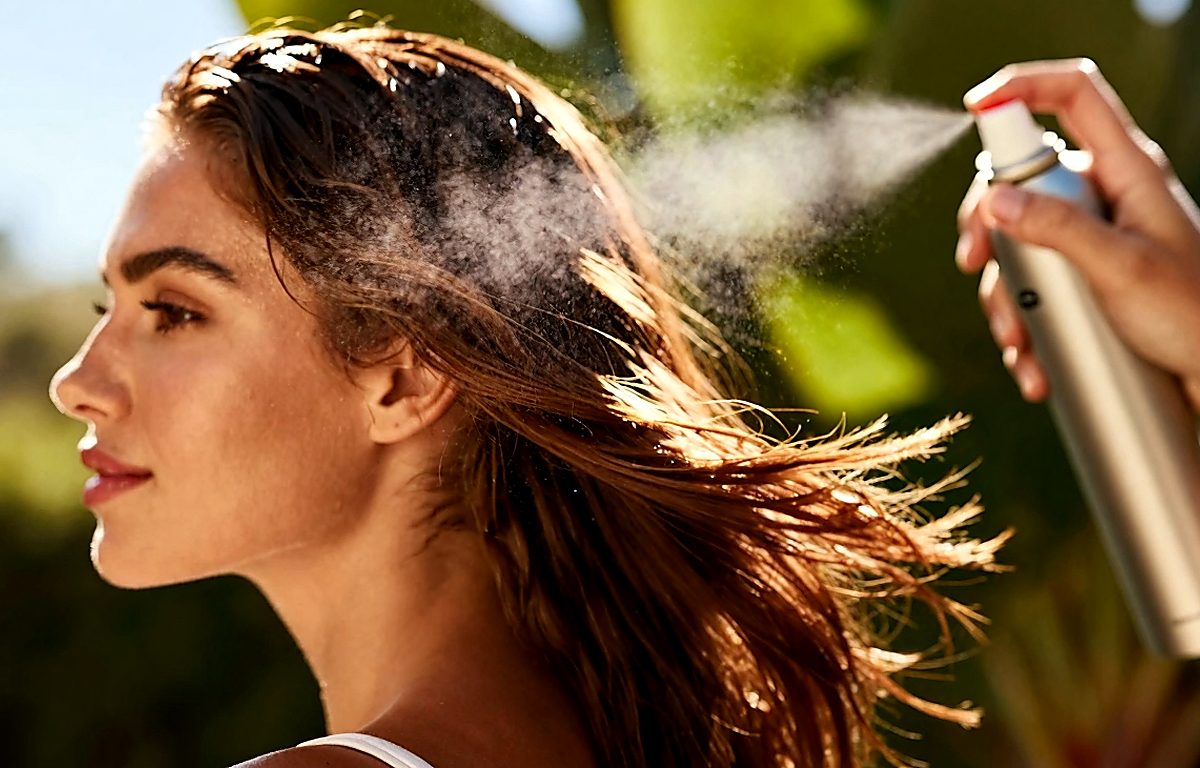
In summer, leave-in hair spray can easily turn from a helpful step into the reason your hair feels sticky, looks dull, and seems “dirty” by midday. The main cause is usually not the product itself, but the way it is applied: sprayed too close, used in excess, aimed at the wrong area, or layered over lengths that are already overloaded. If you need the quick answer, it is simple: apply the spray only to damp or lightly towel-dried hair, hold the bottle 15–25 cm away, distribute the product through the mid-lengths and ends rather than the roots, and start with a small amount — it is better to add one extra spritz than to try to “lighten” the strands afterward.
The second important thing is to understand exactly why you need a spray in summer. One type of formula is needed for humidity protection, another for detangling and softness, and a third for heat protection. When the product is chosen for a specific purpose rather than on the principle of “just put something on,” stickiness drops dramatically. Summer hair care works especially well with a simple system: light cleansing, a moderate conditioner, one leave-in product with a clear function, and minimal layering. That way, the hair keeps its movement, shine, and shape instead of clumping into heavy strands.
Why spray feels sticky more often in summer
In heat and humidity, hair behaves differently than it does in winter or the shoulder seasons. Sebum production becomes more active, sweat mixes with styling products, dust settles on the lengths faster, and humid air changes the texture of a style. Even a good leave-in spray can feel heavier in these conditions than the manufacturer promises.
Most often, stickiness appears because of several factors at once:
- a formula that is too nourishing for hot weather;
- applying it to dry hair instead of damp hair;
- spraying the top layer too close to the hair shaft;
- getting it on the roots and scalp;
- layering it with oil, cream, hairspray, dry shampoo, and heat protectant all at once;
- too much product on fine, porous, or already damaged areas;
- infrequent cleansing of built-up polymers and silicones.
In summer, it is especially important not to confuse a feeling of hydration with a feeling of coating. A good spray helps hair feel more manageable and soft, but it should not make it slippery, “rubbery,” or as if it is covered with film. If, after applying it, you immediately want to tie your hair up because it feels unpleasant to the touch, the issue is most likely either the amount used or the formula’s incompatibility with your hair type.
If your hair frizzes in damp weather, it is worth reviewing not only your leave-in care but your whole summer styling routine. The article hair without frizz after humidity may be helpful here: it shows clearly how humid air amplifies every mistake in your routine.
What kind of leave-in spray to choose for summer
The most common mistake is using the same rich product in summer that worked beautifully in winter. In the cold season, it compensated for dryness caused by indoor heating, but in the heat it starts to overload the lengths. That is why in summer it is better to focus not on big promises, but on texture format and purpose.
Use these principles as a guide:
- For fine hair — watery, lightweight conditioning sprays, detangling sprays, and weightless heat-protectant mists.
- For thick and dry hair — slightly more softening formulas can work, but in hot weather a spray is still usually better than a dense cream.
- For wavy and curly hair — hydrating mists for curl reactivation are convenient, but they are best paired with a small amount of hold product rather than several care layers in a row.
- For color-treated hair — sprays with color protection, antioxidant care, or UV-focused care can work well if the texture stays light.
- For hair that gets oily at the roots — it is especially important to choose products without a waxy feel, creaminess, or an obvious “nourishing” trail.
A useful indicator is how quickly the product absorbs into the strand after combing through. If the hair still looks wet or stuck together even after distribution, the formula may simply be too rich for your summer needs. The spray mechanism matters too: a very heavy stream is more likely to cause local overload, while a fine mist allows for a thinner, more even application.
If you already use a good conditioner and mask, your leave-in spray does not need to solve every concern at once. In summer, simpler scenarios usually work better: either detangling and softness, or heat protection, or frizz control. Universal “15-in-1” products are convenient, but they are often the ones that create too much coating.
Where and how much to apply to avoid the effect of dirty hair
The correct application zone matters more than it may seem. Most people need leave-in spray not on the roots, but on the mid-lengths and ends — where hair tangles, frizzes, gets static, and loses smoothness. In summer, the root area already looks less fresh more quickly, so it usually does not need an extra film on top.
The basic method looks like this:
- After washing, gently blot the hair with a towel or a soft T-shirt without rubbing.
- Leave the hair damp but not soaking wet: water should not be dripping from it.
- Divide the lengths into 2–4 sections if the hair is thick.
- Spray the product from a distance of 15–25 cm.
- Use fewer spritzes than you think you need: for fine hair, 2–4 is often enough; for medium density, 4–6; for very thick hair, apply by sections, but without overdoing it.
- Run your fingers or a wide-tooth comb through the hair to distribute the product.
- If needed, add one more spritz only to dry or tangling areas.
There is another effective method for people whose spray almost always feels too heavy: spray it into your palms or onto a comb first, and only then work it through the lengths. Yes, it is a little less quick, but it gives you immediate control over the amount and helps you avoid overloading the top layer of the hair, which is the most visible part.
It is especially important to be careful with bangs, the temples, and the area around the face. These sections are finer, become oily faster, and come into closer contact with SPF, sweat, makeup, and skin sebum. That is where the familiar “sticky residue” that spoils the whole style is most likely to appear.
Step-by-step application technique for different hair types
The same instructions do not work equally well for everyone. To keep a spray from feeling heavy, it is better to adapt the technique to the density and behavior of your hair.
Fine straight hair. Here, the main risk is loss of volume. Apply the product only from ear level downward, and very sparingly. After distributing it, tilt your head down and lightly blow-dry the lengths on a medium setting to preserve movement. If you want more smoothness, do not add more spray on top — it is better to stretch the hair with a brush while drying.
Normal hair of medium density. It is best to spray section by section onto damp lengths, then comb through. If you air-dry, scrunch the strands with your hands so the product does not dry in patches. If you use a blow-dryer, direct the airflow from top to bottom: this helps close the cuticle and reduces the feeling of coating.
Thick, dense, dry hair. Here, spray often seems to “disappear” too fast, creating the temptation to use a lot. It is better to work in layers: first a little over the full length, then a bit more only on the ends. This approach gives softness without a heavy film on the surface.
Wavy and curly hair. Spray the product not over curls that have already formed, but onto damp strands before final styling. Then scrunch the hair upward with your hands. If you add too much leave-in spray, the curl pattern may stretch out and feel sticky to the touch. For second-day refreshes, 1–2 light sprays into the palms followed by scrunching is enough, rather than a full repeated layer.
Lightened and porous hair. This hair often needs softness, but porosity also makes it quick to hold onto excess polymers. Focus on the driest areas and do regular deep but gentle cleansing if the hair suddenly starts to feel dull and stiff.
Mistakes that make even a good spray feel sticky
Sometimes the problem looks like “no product works for me,” when in reality the same application technique keeps repeating itself. These are the mistakes that most often create a sticky feeling in summer.
- Applying it to hair that is too wet. Water dilutes the product unevenly, and it settles in patches, especially if the hair then dries without being combed through.
- Applying it to completely dry hair after several previous layers. In that case, the spray sits on top rather than blending into the hair.
- Spraying too close. Instead of a fine cloud, you get a wet spot.
- Trying to replace conditioner, mask, and anti-frizz product with the spray all at once. Leave-in care should not carry the entire burden of the routine.
- Mixing incompatible textures. For example, a rich cream, oil on the ends, and then another spray on top.
- Reapplying without reassessing the hair’s condition. If the lengths are already coated with product from the morning, an extra layer by evening rarely improves the situation.
- Washing your comb too rarely. Product residue builds up on the teeth and goes right back onto the hair at the next brushing.
If stickiness appears specifically in the second half of the day, think not only about the spray but also about the weather, hats, public transport, sweat along the hairline, and the habit of touching your strands with your hands. In summer, hair picks up more external “extras” than it may seem.
How to pair leave-in spray with a blow-dryer, the beach, humidity, and SPF
Summer hair care rarely exists in a vacuum: in the morning we dry our hair, during the day we go out into the heat, sometimes we use body and face sprays, and in the evening we touch up our styling. That is why it is important for your leave-in product not to clash with the rest of your routine.
With a blow-dryer. If your spray is marketed as a heat protectant, apply it before drying and do not duplicate it with another dense heat-protectant cream unless there is a clear need. If it does not include heat protection, it is better to choose a separate very lightweight product and reduce the number of other layers.
In humid weather. In damp conditions, many people want to apply more product to “press down” frizz. But extra product often has the opposite effect: the hair clumps together and still frizzes around the edges. In high humidity, it makes more sense to rely on drying technique and an anti-frizz product with moderate hold rather than simply increasing the amount of leave-in care.
After the sea or the pool. Leave-in spray does not replace rinsing away salt and chlorine. If the lengths feel dry after swimming, rinse the hair first and only then apply lightweight care. Otherwise, the spray will only “seal in” the stiff feeling on the surface.
Near SPF. If you apply sunscreen to the face, neck, ears, and hairline, some of it will inevitably get onto the front sections of the hair. That is why it is especially important not to overdo leave-in spray in this area. Otherwise, the mix of SPF, sweat, and hair care quickly creates a sticky outline around the face. In terms of summer comfort, this is similar to choosing textures for body skin: the less unnecessary heaviness, the better it feels. On a related note, you may want to read light body cream for summer without stickiness.
What to do if stickiness has already appeared
When the hair already looks overloaded, the worst solution is to add more dry shampoo, more spray, and more hairspray in the hope of “fixing” it. Sometimes this disguises the problem for 15 minutes, but then the hair becomes even heavier.
It is better to follow one of these approaches:
- If the stickiness is mild: comb through the hair with a clean brush, then blow the lengths with the cool setting of a dryer. Sometimes that is enough to remove local build-up of product.
- If only the ends are overloaded: lightly dampen your palms with water and run them over the ends, then blot with a microfiber cloth or a soft towel.
- If the heaviness is at the roots and around the face: use a minimal amount of dry shampoo only in the root area, not through the full length.
- If the hair is clearly coated with residue: it is better to wash your hair, or at least rinse the lengths, than to keep layering more products.
For the future, it is helpful to do a small test: next time, use half of your usual amount and apply the product only to one side of the head. The difference becomes noticeable immediately and helps you understand whether the real issue is the formula or the quantity.
If stickiness keeps happening again and again with different products, review not only the spray but also your basic routine: perhaps the conditioner is too rich, the mask is used too often, or cleansing is not handling product build-up well enough. Sometimes the balance of the entire routine changes the result more than replacing one bottle. If you want to refresh the overall logic of choosing products by texture and purpose, it can be useful to return from time to time to the basic care principle described in how to build a basic skincare routine: first the need, then the product format, not the other way around.
When to be cautious and how to make summer hair care feel more comfortable
Stickiness itself usually points to formula overload or poor application technique, but sometimes unpleasant sensations are not only about aesthetics. If, after using a leave-in spray, you develop persistent burning, pain, pronounced itching, swelling, or redness of the scalp or hairline, it is best to wash the product off and avoid using it again. If the discomfort persists, if you have scalp conditions, a tendency toward contact reactions, or if you are pregnant, it is worth discussing product selection with a doctor. This is especially important if you are also using medicated topical products, acids, or retinoids along the hairline or on the facial skin: such actives can increase the sensitivity of neighboring areas.
To help hair feel lighter overall in summer, a few habits make a difference:
- wash your comb at least once a week;
- avoid touching the lengths with your hands unnecessarily;
- apply fewer products on very hot days;
- do not carry your winter routine into summer without reviewing it;
- use a clarifying shampoo every few washes if you feel product build-up;
- dry the hair fully if it is specifically under-dried lengths that create the feeling of sticky residue.
Summer hair comfort does not necessarily mean minimalism for the sake of minimalism. It is more about precision: one suitable product, in the right area, in the right amount, at the right moment. Then a leave-in spray truly works as a convenient helper rather than the reason for hair that always feels heavy.
The takeaway is simple: to apply leave-in hair spray in summer without stickiness, choose a lightweight formula for a specific purpose, spray it sparingly onto damp lengths, keep it away from the roots, and do not layer too many products in one day. If the hair stays movable, soft, and does not need urgent “rescue” an hour after styling, your method is working.