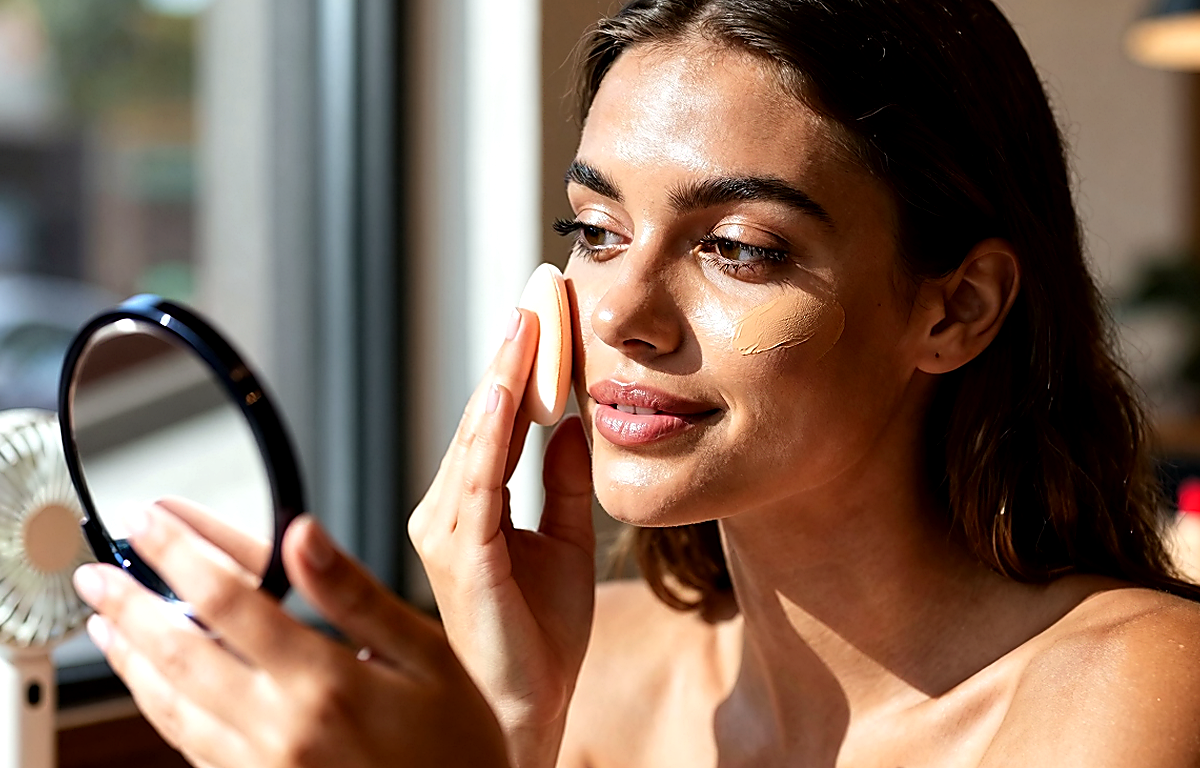
Refreshing foundation in hot weather does not mean adding a new heavy layer over tired makeup. A neater method works better: first remove excess sebum and moisture, then bring coverage back only where it has disappeared, and finally set the result with a light veil of powder or spray. This order is exactly what helps prevent patches, streaks, a cakey layered look, and a heavy feeling on the face.
In short, the working routine looks like this: blot the skin with a tissue without rubbing; if needed, go over it with a clean dry sponge; add a drop of lightweight foundation or concealer only to areas of redness and worn-off coverage; gently press the product in; powder only the parts that get shiny quickly. In hot weather, precision matters more than the amount of makeup. The fewer unnecessary movements and layers, the fresher the skin looks even by evening.
Why foundation turns patchy and heavy in hot weather
Heat changes the way any complexion product behaves. Sebum is produced more actively, sweat mixes with SPF, skincare, and makeup, while touching your face, your phone, glasses, and a mask mechanically wear coverage away. As a result, instead of an even finish, you get uneven areas: in some places the foundation has dissolved, in others it has collected in pores, and elsewhere it has dried down and become more noticeable.
The main mistake is trying to cover all of this with a new dense layer over an already unstable base. The old foundation, sebum, and dust do not disappear; they mix with the new product. That is how patches around the sides of the nose, stripes on the chin, emphasized texture on the forehead, and an overall heavy look that makes the face seem tired appear.
Several factors affect wear time at once:
- skincare that is too rich under makeup and has not fully absorbed;
- too much SPF or incompatible SPF and foundation formulas;
- a heavy foundation not suited to heat and high humidity;
- frequent powder touch-ups without removing sebum first;
- rubbing movements with a brush or fingers when correcting makeup;
- refreshing the whole face instead of restoring coverage only where needed.
If your base regularly starts breaking apart after just a couple of hours, it is worth reconsidering not only the foundation itself but your whole summer application routine. It helps to simplify skin prep and leave under makeup only what is truly necessary. If you want to build a lighter routine, this guide may help: how to build a basic facial skincare routine.
Prep before refreshing: what to do in 30 seconds
To refresh your face beautifully, you first need to create a cleaner, drier surface. This is not a full cleanse, just a quick correction. The most important rule is not to smear anything around. The more actively you rub the skin, the more you break down what is left of the coverage and the more visible the texture becomes.
Start with blotting papers or a regular paper tissue. Gently press it onto the T-zone, the sides of the nose, the center of the forehead, the chin, and any areas where makeup has started to look shiny. If your skin is very oily, you can repeat the step with a second clean side of the tissue. Only after that should you assess where the foundation has truly disappeared and where removing shine is enough.
Next, a clean dry sponge or mini puff is useful. Use light pressing motions over areas where the foundation has slightly separated in pores or gathered in fine lines. Often this alone is enough to make the coverage look neater again without adding any new makeup.
If your face has become very warm, do not apply foundation straight over sweat. Give the skin half a minute to cool down, or step into the shade and only then correct your makeup. Otherwise the new layer will start slipping almost immediately.
What is convenient to carry with you in summer:
- blotting papers or regular thin paper tissues without lotion or impregnation;
- a small clean sponge;
- a lightweight concealer or foundation in a compact format;
- translucent or finely milled powder;
- a small brush or puff for targeted setting.
Many people love thermal water in summer, but right before refreshing foundation it does not always help. If you mist it over makeup that has already started slipping and immediately begin adding more product, you may end up with even more streaks. Refreshing sprays are better used separately and sparingly, when the makeup is stable.
Step-by-step: how to refresh foundation without a mask-like effect
The most reliable technique is not to repaint the whole face but to repair only the places where coverage has worn away. This keeps the skin looking natural and prevents it from appearing overloaded.
- Remove shine. Blot the face with a tissue. Do not rub or sweep it across the skin like a towel.
- Smooth what is left of the coverage. With a clean sponge, gently press the areas around the nose, on the chin, and in the center of the forehead.
- Use the smallest amount of product possible. You need literally a drop of foundation, fluid, cushion, or concealer. Too much will almost certainly create a patch.
- Apply it only where needed. Add product only where redness, pigmentation, or completely worn-off coverage is showing through.
- Press it in instead of stretching it out. Pressing motions help the new layer join the old one. Rubbing lifts what is already on the skin and makes the edges more visible.
- Let the product settle. Wait 20 to 40 seconds, then decide whether setting is needed.
- Powder only specific areas. Powder is for the parts that get actively shiny, not the whole face. A light veil works better than a dense patch.
If you want the result to be as invisible as possible, these often work better than a full foundation for touch-ups:
- a creamy concealer with a natural finish;
- a lightweight skin tint;
- a cushion with sheer coverage;
- a tinted stick that you can pick up on a sponge in a very small amount.
For the area around the nose and mouth, it is especially important to use very little product. That is where makeup most often breaks apart because of facial movement, sweat, and friction. One thin layer pressed in with a sponge looks cleaner than several attempts to keep covering redness.
If you wear SPF and reapply it over makeup during the day, the order of steps matters even more. First refresh your sun protection, let it settle, and then, if needed, bring coverage back only in specific spots. Otherwise foundation may start to pill. If this topic is relevant to you, see this guide: how to apply powder over SPF without patches.
Which textures are easier to refresh in hot weather, and which are more likely to turn patchy
In summer, not only technique matters but also the texture itself. The more flexible and lightweight the product, the better the chance that it will blend nicely into the layer already on the skin. The hardest products to refresh during the day are dense matte foundations that set quickly: they may wear beautifully in the morning, but during spot correction they can show up as obvious patches.
These usually behave best in hot weather:
- fluids with light to medium coverage;
- foundation serums;
- cushions with a natural or semi-matte finish;
- flexible concealers that can be blended almost to nothing;
- finely milled loose or baked powders without a heavy talc-like effect.
Use extra caution with these formats:
- ultra-matte foundations that set very quickly;
- thick cream products with a high percentage of pigment;
- dense pressed powders if applied over sebum that has not been removed;
- products with a very radiant, slippery finish if your skin is already getting very shiny.
If you know you will almost always need to touch up during the day, it is better to choose a lighter base from the start in the morning. That kind of makeup is easier to keep fresh all day than trying to revive a dense evening-style base in 30-degree heat.
There is another nuance too: air humidity. In dry heat, products are more likely to dry down and emphasize texture, while in humid heat they slip faster. So there is no universal ideal. Test products not only at home in front of the mirror, but in real summer conditions too: transport, a walk, an office without air conditioning, a terrace, an active day out.
What to use for touch-ups: sponge, brush, fingers, tissues
The tool matters just as much as the formula. In most hot-weather situations, a small sponge works best. It helps press product into the skin rather than moving it around, so there is less risk of creating holes in makeup that is already on.
A sponge is a good choice if:
- you need to add coverage in specific spots;
- foundation has gathered around the nose;
- you need to soften the line between the old and new layer;
- you want the most natural-looking finish possible.
A brush is convenient if the product is very fluid and you need minimal coverage. But it is important not to buff the face in circular motions. It is better to place the product lightly and then immediately refine it with a sponge.
Fingers can help on the go when you have nothing else. But in hot weather they often warm the product too much, and it starts applying more strongly than you want. It is also easier to accidentally wipe away the surrounding areas with your fingers. If you use this method, work literally with the pad of one finger and only on a small area.
Tissues are an essential prep step, not an alternative to foundation. They remove excess shine but do not restore coverage where it has already worn away.
It is also worth mentioning cleanliness. In summer, tools get dirty faster because sweat, sebum, and SPF stay on them. A dirty sponge can do more than ruin the result; it can also irritate the skin. If your makeup causes persistent burning, soreness, pronounced redness, or swelling, it is better to stop using the product and consult a dermatologist. During pregnancy, and also when using retinoids or acid-based skincare routines, it is best to discuss any potentially irritating products and active touch-ups with a doctor.
The most common mistakes when refreshing foundation in summer
Sometimes the problem is not the heat itself but your habits. A few common mistakes almost guarantee that makeup will look heavier and more noticeable.
- Applying a new layer to wet or sticky skin. If your face is sweaty, first remove the moisture and let the skin cool down a little.
- Reaching for powder right away. If you do not blot away sebum first, powder will mix with it and turn into a dense paste.
- Covering the whole face instead of just problem areas. In most cases makeup wears off unevenly, and only certain spots need refreshing.
- Using too much concealer. It quickly becomes visible in creases, especially around the nose and under the eyes.
- Rubbing the product in. Pressing motions look cleaner than dragging it across the skin.
- Trying to mattify the skin into a completely flat finish. A little natural glow in hot weather looks more alive than an over-dried, over-powdered mask.
Another mistake is ignoring the condition of the skin itself. If the base already went on badly in the morning because the cream was too heavy or the SPF had not absorbed properly, during the day it will almost always show even more. In summer, it is better for both facial skincare and body care to feel lighter: less stickiness means less temptation to keep adjusting your makeup. You can choose seasonal skincare textures by the same principle, for example lighter formulas like those discussed in light body cream for summer without stickiness.
Quick routines for different situations: office, outdoors, evening plans
You do not always need the same correction method. It is easier to have a few short routines for different situations.
If you are in the office or at a café and have a mirror:
- Blot the T-zone.
- Use a sponge to lift away product gathered around the nose and on the chin.
- Refresh redness and the area around the nostrils with a drop of concealer.
- Powder only the center of the face.
If you are outside and have almost no time:
- Remove shine with a tissue.
- Press the coverage back into place with a clean puff.
- If needed, add a little cushion product only to one or two areas.
If after work you need to quickly turn daytime makeup into an evening look:
- Remove excess shine.
- Restore coverage only where needed.
- Instead of adding yet another heavy base layer, put the emphasis on blush, bronzer, or the eyes.
- Set only the places that truly need it.
Often the feeling that the face looks tired is connected not so much with foundation as with the fact that blush and sculpting tones have faded. After lightly restoring the coverage, it is often enough to bring a little color back to the cheeks, and the makeup looks polished again without overloading the skin.
If you have a long day ahead in humid weather, it helps to think through the whole look in advance so it can handle the climate better: fewer heavy layers, smoother textures, fewer frizzy strands around the face that create extra friction and wear foundation away. The same seasonal approach works here as in haircare for humidity: the less chaos around the face, the neater the whole look appears. This article may also be useful: how to keep hair from frizzing after humidity.
How to make foundation need fewer touch-ups
The most beautiful daytime repair is the one you barely need. For that, it helps to rebuild your makeup routine for hot weather from the morning. You do not have to buy everything again: often it is enough to change the order and number of layers.
What really helps:
- using less skincare before makeup and letting it absorb fully;
- choosing an SPF that feels comfortable specifically under foundation;
- doing one thin layer of base instead of two;
- using concealer only where needed, not on half the face;
- setting not the whole face but only oil-prone areas;
- avoiding touching your face during the day unless necessary;
- carrying a compact touch-up kit instead of hoping to fix everything with a random powder from your bag.
It is also helpful to know your own weak spots in advance. For some people it is the nose that gives way first; for others it is the chin, the area between the brows, or the glasses line. If you know these zones, you can set them a little more carefully in the morning instead of overloading the whole face.
Finally, do not expect summer makeup to stay museum-still. In hot weather, skin should still look alive. A little natural glow is normal. The goal is not to stop all shine completely, but to keep the face looking fresh, even, and comfortable, without patches or extra heaviness.
Conclusion
To refresh foundation in hot weather without patches or a heavy layer, do not pile makeup on top of shine and sweat. First blot the skin, then smooth what is left of the coverage with a sponge, after that add the smallest amount of product only where needed, and if necessary set the result in targeted areas. In summer makeup, delicacy wins over density: fewer products, less friction, more local precision. That is what keeps the face looking fresh even at the end of a hot day.