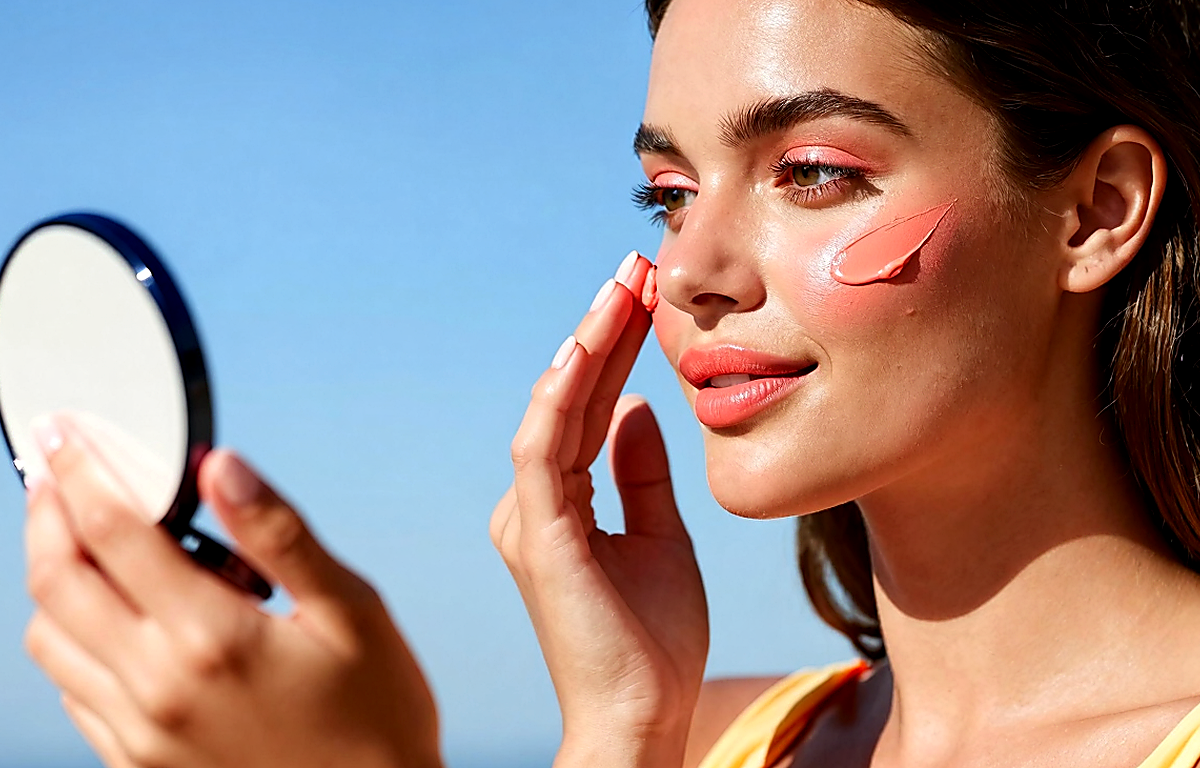
In summer, cream blush really can look better than powder: it blends into the skin faster, gives a lively flush, and does not emphasize dehydration as noticeably as dense powder textures. But the main secret to a fresh result is not the product itself, but the amount you use and the order of application. In short: in summer, blush should be applied in a very thin layer over well-absorbed skincare and SPF, not stretched over a large area, and always checked in daylight. Then the face looks rested rather than obviously made up.
The second important point is not to try to get full intensity from the first touch. The most natural summer flush is built gradually: a tiny dot of product, blending with fingers, a brush, or a sponge, a pause for a few seconds, and only then deciding whether you need another layer. This technique is exactly what helps avoid overloading the skin in the heat, creating stickiness, or ending up with patches that are especially noticeable against SPF, sebum, and high humidity.
Why cream blush often looks better than powder in summer
Cream textures have several advantages specifically in the warm season. First, they echo the skin’s natural sheen and do not create extra dryness in areas where the face becomes dehydrated from sun, air conditioning, and active cleansing. Second, soft cream pigment is easier to blend into a haze rather than a sharp stripe of color. Third, this type of blush is easier to apply quickly, without the layered makeup that often feels heavy in summer.
But this format has its own specifics too. Cream reacts more strongly to what is already on the skin: a rich sunscreen, a sticky serum, a full-coverage base, a mattifying primer, or, on the contrary, pronounced skin oil. So the result depends not only on the shade, but also on the base. If cream blush slides, pills, or gathers in patches, the reason is usually not the blush itself, but incompatible layers underneath.
In summer, blushes with a sheer finish work especially well: a cream stick with a melting texture, a cream gel, a liquid tint that allows quick blending, or balm-like formulas without an overly greasy film. Very dense waxy products or rich oily textures, on the other hand, can be trickier on a hot day: they spread less easily and feel heavier on the skin more quickly.
How to prep the skin so blush does not go on patchy
A fresh result starts not with blush, but with how you prep the face. In summer, the skin usually needs a lighter, calmer layer of skincare. If there is already a rich cream, a substantial SPF, primer, foundation, and concealer on the skin, any extra cream product increases the risk of overload. So before makeup, it helps to rethink the number of layers you are using.
A good routine looks like this: gentle cleansing, light moisturizing skincare as needed, sunscreen, a pause to let it set, then foundation or only localized correction, and only after that blush. If you are unsure how light your base skincare should be, a useful guideline is: “the skin feels comfortable, but there is no noticeable film.” On this topic, it is also worth reading a basic skincare guide: how to build a basic skincare routine for the face.
There are several rules that are especially important in summer:
- let SPF fully settle on the skin for at least 5–10 minutes before applying makeup products;
- if the face still feels very slippery, gently blot away excess shine with a tissue without wiping off the protective layer;
- do not apply blush onto skin that is damp from mist or thermal water — the pigment may grab in patches;
- if you use foundation, choose a thinner layer specifically in the cheek area;
- if the skin is noticeably oily, do not try to mattify everything at once: sometimes it is enough to powder only the center of the face rather than the cheekbones.
If the skin is irritated after acids, retinoids, active sun exposure, or shaving the face, cream blush may further emphasize sensitivity. If you have persistent burning, pain, swelling, peeling with inflammation, or suspect a skin condition, it is better not to mask the discomfort with makeup, but to discuss the condition with a doctor. During pregnancy and when using retinoids, it is especially important to pay close attention to irritation and to the skincare ingredients you apply under makeup.
How to choose texture and shade for a summer effect
The most common mistake is choosing summer blush by how the color looks in the stick or in the packaging. On the skin in hot weather, any shade shows up differently: warmer, brighter, and sometimes glossier than expected. So the main criterion is not only a pretty color, but also how sheerly the product can be layered.
For a natural summer effect, these shades are usually the easiest to work with:
- soft peach — freshens the face and looks approachable even with minimal makeup;
- pink-peach — a good balance between warmth and liveliness;
- muted pink — gives an effect of coolness and a neat flush;
- watermelon or berry in a very thin layer — beautifully revives the face if applied sparingly;
- terracotta pink — suits more sun-kissed skin and makeup in warm tones.
Very pale, chalky, or neon shades are more demanding in summer: they are more visible on skin texture, and against a tan or active SPF they can create contrasting edges. Very deep plum and brick-toned blushes also require care — in the heat, they quickly shift from “sculpted warmth” to the look of overloaded makeup.
By texture, the options are easiest to divide like this:
- cream gel — light and usually the most airy on the skin;
- balmy cream — gives a beautiful fresh finish, but it is important not to overdo it if the skin is oily;
- stick — convenient on the go, but it is better to transfer the product to a finger or brush first rather than drawing broad stripes directly on the face;
- liquid cream pigment — offers good wear, but requires fast blending.
If you want the most natural effect possible, look for formulas that can be applied in one light layer and built up with a second if needed. Controlled sheerness almost always wins over pigment that is too intense from the start.
Where to apply it in summer so the face looks fresh, not overloaded
Summer blush rarely needs the classic wide blending from “the apples to the temples.” In real life, that method often makes the face too color-heavy, especially when combined with SPF, bronzer, and the skin’s natural shine. More localized application looks much more modern and light.
For a fresh result, three areas work well:
- The upper part of the cheeks. Apply a small amount slightly above the center of the cheek and blend toward the temple. This visually lifts the face and makes the flush look airier.
- The point between the cheek and temple. This method suits those who want a lifting effect without bright apples of the cheeks.
- A tiny остаток on the bridge of the nose. Only if a lightly sun-kissed effect suits you and you are not prone to redness in the center of the face. Literally a trace of product is enough.
And here is what is best avoided in summer if freshness is the goal:
- placing it too low, close to the nasolabial area — this can visually weigh the face down;
- a wide stripe of color extending almost to the ears;
- multiple layers in several shades at once without a real need;
- the combination of “bright blush + dense highlighter + strong bronzer” in an everyday look.
If you have pronounced natural redness, couperose, or sensitive skin, it is better to place blush a little higher than usual and choose calmer shades. Then the makeup will not blend into areas of irritation.
What to apply it with: fingers, a brush, or a sponge
There is no single correct tool — it all depends on the texture and the effect you want. But in summer, controlling the amount of product is especially important, so your method of application should help make the layer thinner rather than denser.
Fingers are great if you love a very natural result. The warmth of the skin slightly melts the cream, and it blends into foundation or bare skin more quickly. A convenient technique is to place one tiny dot on the hand, pick up a little with the fingertip, and transfer it to the cheek with tapping motions. This makes it easier not to overdo it.
A brush works well for those who want a more delicate haze and a neat shape. Soft synthetic brushes of medium density work best: not too firm, so they do not shift the layers underneath, and not too fluffy, so they do not diffuse the color endlessly. A brush is convenient for blending blush upward toward the temples while keeping the edges clean.
A sponge helps when the blush turned out brighter than you expected, or if the skin is already shiny and you want the thinnest possible blend with the base. It is useful for pressing the product into the skin and removing excess. But if the sponge is too damp, it can absorb almost all the color or create streaks on an unstable base.
The practical rule is simple: if the formula is very pigmented, start from the hand and use fingers or a brush; if the blush is soft and sheer, you can work directly on the cheek, but still with a minimal amount.
A step-by-step technique that does not overload the skin
If you want a reliable summer method, this is the easiest one to follow. It works both on bare skin and over a light base.
- Prep the base. Make sure your skincare and SPF have already absorbed, and that the skin surface is not too slippery.
- Take a micro-dose. It is better to start with less than a pea-sized amount or with one touch of the stick on your hand.
- Transfer it to the upper cheek. Do not draw a long line. Place 1–2 tiny dots where you want the flush to appear.
- Blend by tapping. Use short pressing motions rather than circular smearing. This reduces the risk of lifting SPF or foundation.
- Pause. Wait 20–30 seconds and look at the face in daylight or by a window.
- Add a second layer if needed. Only in the area where there is not enough color, not over the entire cheek.
- Set selectively. If your skin gets oily quickly, lightly powder the sides of the nose, forehead, or chin, and leave the blush more alive. If you need to set the cheeks themselves, use only a very small amount of powder.
By the way, pairing SPF and powder in summer raises a lot of questions. If you use powder over sunscreen or makeup, this separate guide may help: how to apply powder over SPF without patchiness. It helps explain why selective setting often looks better than mattifying the whole face.
For an evening look, you can intensify the blush with a drop of a second layer or add a very thin veil of powder blush in a similar shade on top. But on a hot day, everyday makeup usually benefits from the opposite principle: fewer layers, less friction, fewer attempts to do everything at once.
Common summer mistakes and how to fix them
Even good cream blush can look unsuccessful if you make several common mistakes. The good news is that almost all of them can be corrected without removing your makeup completely.
Mistake 1: too much product at once.
Fix: gently go over the edges and center of the blush with a clean sponge or a brush with no product, lifting away the excess. You can also add a drop of foundation or tinted SPF onto the sponge and lightly soften the color.
Mistake 2: the blush went on in a patch.
Fix: do not rub harder. It is better to lightly mist the brush with setting spray, not to a wet state, and gently work over the edge. If the problem happens regularly, rethink the base under your makeup: the SPF may be too sticky, or the foundation may be setting too fast.
Mistake 3: the face looks greasy rather than fresh.
Fix: remove shine from the T-zone with a blotting sheet and powder only the areas that need it. Sometimes the blush itself still looks beautiful, and the entire “overloaded” effect comes from excess shine in the center of the face.
Mistake 4: the color is too warm or too bright.
Fix: you can slightly mute the shade on top with a thin layer of a more neutral powder or soft powder blush close to your skin tone.
Mistake 5: the blush fades quickly.
Fix: apply it over a more stable base, not over a cream that is too oily, and use the technique of thin layers. One dense layer wears off more visibly than two very thin ones.
One more important point — it is not a good idea to keep touching up blush with your fingers throughout the day once SPF, sebum, and dust have already mixed on the skin. This increases the risk of patchiness and irritation. Sometimes it is better to blot the face with a tissue and leave the makeup alone than to keep endlessly “perfecting” it.
How to pair cream blush with the rest of your summer makeup
For blush to look truly fresh, the whole look should support the same idea of lightness. If the cheeks are glowing and dewy but the base is full and matte, the result feels discordant. If the blush is delicate but the contouring next to it is aggressive, the face again looks overloaded. So it is better to think of makeup as a whole.
The most flattering summer combinations are usually these:
- light base or only concealer + cream blush + brow gel + mascara;
- glowy skin tint + peach blush + lip balm;
- semi-matte base + calm pink blush + soft bronzer only around the perimeter of the face;
- blush and a tinted lip balm in a similar color family — this ties the look together and makes it feel more polished.
If your skin tends to feel sticky in summer, it is worth remembering that “glow” and “wetness” are not the same thing. Glow looks alive when the skin has light on the cheekbones and natural smoothness. Wetness looks heavy when there are too many layers and they start to slide. So sometimes the best move is to skip highlighter altogether if the blush already gives a beautiful semi-gloss finish.
It is also helpful to keep the skin’s overall summer comfort in mind. In hot weather, textures feel best when you do not want to wash them off immediately. By the same principle, many people rethink body care too and choose lighter, non-sticky formulas: light body cream for summer without stickiness. The logic in makeup is the same: less heaviness means more of a cared-for feeling.
Who this format suits especially well — and who needs a more cautious approach
Cream blush is especially good for normal, dry, dehydrated, and mature skin when you want to bring back softness, dimension, and color without the effect of a powdered mask. It often looks beautiful on combination skin too, as long as you apply it locally and do not overload the center of the face.
It is worth taking a more cautious approach to this format if you have:
- very oily skin and makeup that slides quickly in the heat;
- active inflammation on the cheeks that is easy to disturb while blending;
- strong sensitivity, burning, or reactivity after active skincare;
- pronounced skin texture that overly shiny formulas emphasize.
This does not mean cream blush is completely unsuitable for you. Often the issue can be solved by choosing a thinner texture, a calmer shade, and a very small amount. But if any product causes discomfort, persistent redness, or burning, it is better to address the condition of the skin first. With ongoing pain, swelling, oozing, rashes, or suspected dermatological problems, what you need is not a new makeup method, but a doctor’s consultation.
And finally, there is no need to chase perfect “Instagram” symmetry. Summer blush looks best precisely when it feels lively and a little natural, rather than like strictly measured geometry. A slight asymmetry often makes the face look even more attractive.
The takeaway is simple: in summer, cream blush works best when you treat it not as a bright statement, but as a subtle adjustment to the color of the face. A light base, a micro-dose of product, localized placement, and checking the result in daylight create that fresh effect without overload. If you do not rush and do not try to make the flush heavier, the skin will look lively, cared for, and comfortable even in the heat.