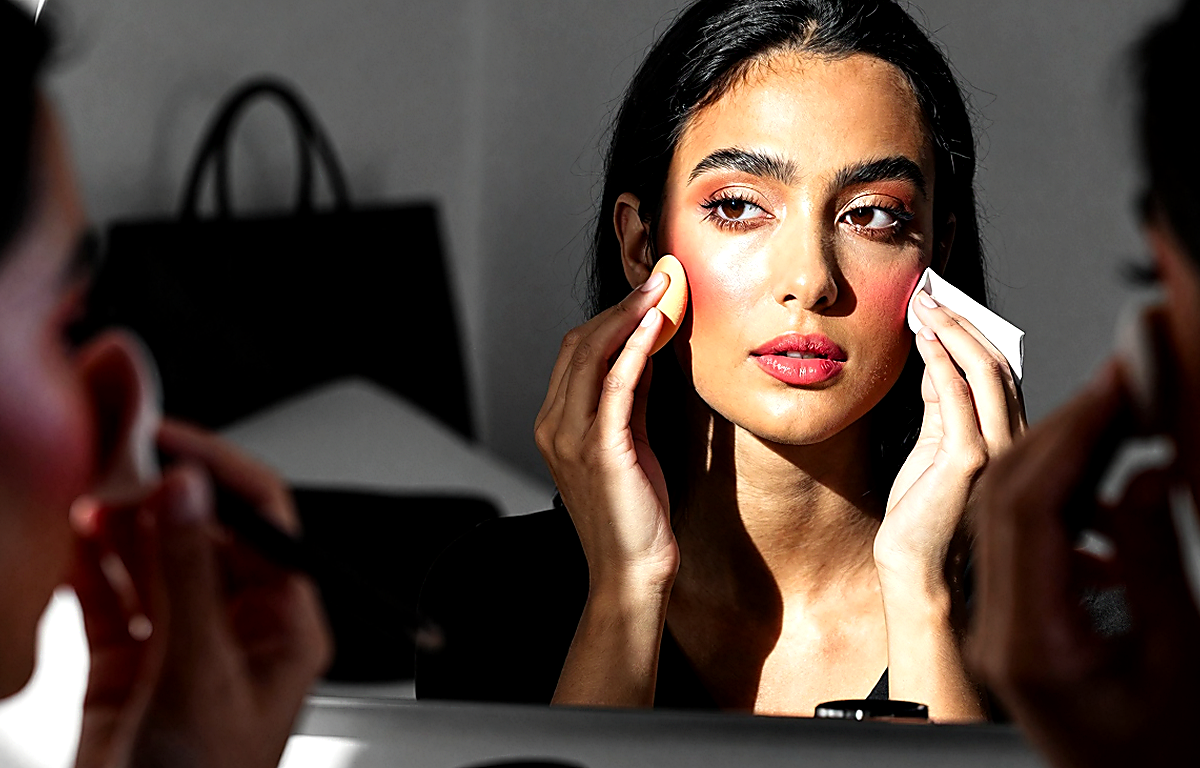
If a tint looks fine right after application but an hour later starts gathering into dry little granules, emphasizing texture, and literally “flaking off” certain areas, the cause is usually not a single product but a combination of factors. Most often, the issue is overly dry or poorly prepped skin, too thick a layer, formula conflicts with SPF or primer, or trying to set the product with the wrong powder. In other words, even a good tint can behave unpredictably if there is pilling skincare underneath it and overly dry setting on top.
If you are dealing with a NYX tint, it is worth checking not only the product itself but the entire makeup sequence: what you cleansed with, what you applied beforehand, how much time you gave skincare to settle, how you spread the texture, and how you set the result. The good news is that in most cases, flaking can be reduced without replacing your entire makeup bag. Below is a practical breakdown to help you understand exactly where the mistake is happening and what to fix first.
First, clarify what you mean by flaking
Different problems often get grouped under one word, which means the solutions will differ too. One situation is when the tint pills while you are still blending it out. Another is when the coverage dries down, cracks over dry areas, and starts lifting away in fragments by midday. A third scenario is when the surface seems intact, but the pigment sinks into pores and looks patchy.
Before you change products, it helps to quickly identify the scenario:
- Pilling immediately after application. This is more often linked to incompatible skincare, SPF, or base products.
- Dry crumbs or peeling edges after some time. These usually point to dehydrated skin, a lipid barrier that is too thin, or excess powder.
- Patchiness and uneven fading of pigment. This often happens because of localized oiliness, friction, and uneven product distribution.
- Emphasized flakes. This almost always means the skin texture was not prepared for tint.
This kind of breakdown is not just theory. If the problem starts at the application stage, there is no point trying to “save” the coverage with thermal water or a new setting spray. First, you need to remove the conflict in the base underneath. But if the coverage only starts breaking apart after a few hours, the cause is more likely to be your skin condition, the number of layers, and the way you set it.
Check your skin prep: this is where the problem most often begins
Tint is usually lighter and more fluid than classic foundation, so it is especially sensitive to skin texture and leftover skincare. On a dehydrated surface, it catches on micro-flaking; on an overloaded one, it starts to pill and separate. If flaking is your concern, start with the basic question: what condition is your skin in before makeup?
Here is what to check:
- Whether your cleansing is too aggressive. After washing, your skin should not feel squeaky-clean or tight. If there is a feeling of a dry film, any pigment on top is at greater risk of applying poorly.
- Whether there is visible flaking. You cannot “cover it up” with tint—it will only become more noticeable.
- How many layers of skincare you have applied. Serum, cream, SPF, primer—sometimes the length of the routine itself makes makeup less stable.
- Whether you gave the products time to absorb. If you apply tint over a still-wet or tacky layer, it may start gathering while you blend.
Before makeup, it is better to aim not for the richest possible skincare but for an even, calm, supple surface. If your skin is prone to dehydration, a thin comfortable cream and a pause before makeup are usually more helpful than several extra products “just in case.” If you are still unsure about your basic skincare, you can use the principles of a gentle, stable routine from the article about basic facial skincare as a guide—in the context of makeup, this matters even more.
Also assess the areas where flaking shows up most strongly. Often these are the sides of the nose, around the mouth, the chin, and areas with active facial movement. If those zones are dry or irritated, the issue may not be NYX as a brand or tint as a format, but simply that the skin there is not ready for thin pigmented coverage.
Look at how it interacts with SPF, primer, and skincare
One of the most common reasons for “crumbing” and pilling is texture incompatibility. For example, underneath the tint there may be a very silicone-heavy primer, a dense SPF with a pronounced film, or a rich cream that has not had time to settle. As a result, the top layer does not adhere to the lower one and starts coming away in tiny fragments.
It helps to check a few things:
- How many products form a film. The more film-forming layers you have, the higher the risk of pilling.
- Whether there is too much silicone-heavy base. It may create a beautiful first impression, but it does not always pair well with a fluid tint.
- How your SPF behaves. Some sunscreen formulas are prone to pilling on their own, especially when rubbed repeatedly.
- Whether you apply primer all over the face. Sometimes it is only needed on the T-zone, while on dry areas it creates extra risk.
A practical test is simple: one day, apply the tint only over skincare plus SPF, without primer. Another day, apply it over skincare and primer, but without an extra rich cream. If the way the coverage behaves changes noticeably, you have found the point of conflict. That is more reliable than blaming the product right away.
If you use both SPF and powder, remember that overly aggressive setting on top of a sun-protection layer can increase dryness and coverage breakdown. On the subject of combining makeup and sun protection, the article about powder over SPF without patchiness may be helpful: it clearly shows why the amount of product and the application technique matter.
Flaking is often caused not by the formula, but by too thick a layer
Tint is designed for thin, almost veil-like coverage. When people try to cover redness, post-acne marks, and uneven tone with it as heavily as they would with a medium- or full-coverage foundation, it starts working against them. The layer becomes overloaded, does not have time to properly bond with the skin, and breaks down faster throughout the day.
What helps:
- Apply a little at a time. Two very thin passes are better than one dense layer.
- Start from the center of the face. That is usually where more evening-out is needed, while the perimeter can be covered with the product left over.
- Do not keep layering over dry areas. This almost always makes the problem more visible.
- Leave targeted correction to concealer. Tint does not have to cover everything.
If a particular NYX tint feels too light for you, that does not mean it should be built up until it behaves like a full foundation. It is often better to accept a more natural finish and perfect only the areas that actually need it. That approach usually looks cleaner and lasts longer.
There is another common mistake too: stretching out the same drop for too long. Many liquid textures set faster than they seem to, especially in heat, dry air, or over certain SPF formulas. If you keep moving a brush or sponge over the same spot for too long, you are effectively starting to remove the layer that has already begun to set, and that can also look like flaking.
Application technique matters no less than the formula
Even a good formula can look unstable if the application method does not suit it. Fingers, a brush, and a sponge all give different results. There is no universal rule, but if flaking is the complaint, it is better to move away from overly intense rubbing and choose the gentlest technique.
It usually makes sense to test it like this:
- Fingers. Convenient for quickly spreading a thin layer, especially if you want to keep the finish natural. But it is important not to rub the product for too long.
- A dense brush. It can give more even coverage, but with aggressive circular motions it may lift the skincare underneath and trigger pilling.
- A slightly damp sponge. It often helps settle the product and remove excess, but if it is too wet, wear time may decrease.
If you notice little crumbs already during application, try changing not the product but the mechanics. Instead of rubbing, use short pressing motions. Instead of going over the same area repeatedly, spread quickly and pause. Instead of loading a lot onto the brush, use micro-doses. With fluid pigmented textures, that can make all the difference.
There is also a nuance around the nose and mouth. Coverage breaks down there most often because of active facial movement and friction. In those areas, a minimal layer is almost always better than perfect density right after application. Otherwise, by midday the makeup will start to “break” exactly where you tried hardest to even it out.
How to tell whether setting is making the problem worse
Sometimes the tint itself sits quite well, and the flaking only starts after powder or setting spray. This is especially noticeable on dehydrated skin, when you want to “seal” the makeup more securely, but the surface ends up too dry and fragile. Then the coverage first looks matte and neat, but later starts lifting at the edges, emphasizing texture, and breaking down during the day.
What matters to assess:
- How much powder you use. With tint, minimal targeted setting is often enough rather than full-face mattifying.
- What finish the powder has. A very dry matte texture can clash with light liquid coverage.
- Whether you apply powder immediately. Sometimes it is better to give the tint a couple of minutes to settle.
- Whether you rub the face with a puff or brush. Strong mechanical pressure can lift the layer underneath.
If everything looks better without setting than with it, that is already an important clue. In that case, it makes sense to reduce powder to the T-zone or apply it only where there is a real tendency toward oiliness. For many lightweight complexion textures, excessive setting becomes the final straw that makes the makeup start flaking.
Setting sprays do not always save the situation either. If the formula is already clashing with your skin or the base underneath, a setting spray will not fix the foundation of the problem. And sometimes extra hydration on top makes the coverage look prettier temporarily, but later it breaks apart even more noticeably. So it is better to fine-tune the application system first and only then bring in products for wear.
When the issue is not technique, but your skin condition
If you have already tried changing the base, reducing the layer, and testing different application methods, but the flaking remains, it is worth honestly assessing your skin’s current sensitivity. Irritation, a compromised barrier, active acids, retinoids, over-exfoliation, and even simple dryness from air conditioning can sharply reduce your skin’s “compatibility” with makeup.
Signs the issue may not be just the tint:
- makeup has started behaving worse with several products, not just one;
- you have developed tightness, stinging, or increased reactivity;
- flaking is visible even without color cosmetics;
- your skin flushes more easily and tolerates your usual skincare less well.
During this kind of period, it is often better to simplify makeup temporarily: fewer layers, less mattifying, and more careful targeted correction. When the skin barrier recovers, the way the tint behaves often improves as well.
If flaking comes with persistent stinging, pain, pronounced swelling, inflammation, or suspicion of a skin condition, it is better not to try to solve the issue with makeup alone but to discuss the situation with a dermatologist. During pregnancy, and also when using retinoids or active resurfacing products, it is especially important to pay close attention to skin reactions and not mask ongoing discomfort with decorative cosmetics.
Quick algorithm: what to check step by step if it is specifically a NYX tint that flakes
When the problem has been frustrating you for more than a day, it is easier to follow a checklist than to act randomly. That way, you will understand more quickly what is actually affecting the result.
- Do one “clean” test application. Gentle cleansing, a light cream or only your usual SPF, with no primer and no multi-layer skincare.
- Apply a very thin layer. Do not try to get full coverage right away.
- Choose one technique. For example, only fingers or only a slightly damp sponge, without constantly switching tools.
- Do not set the whole face. If needed, lightly powder only the T-zone.
- Assess the result after 15 minutes, 2 hours, and 5 hours. It is important to understand when the coverage starts to break down.
- The next day, change only one factor. For example, add primer or use a different powder. Do not change everything at once.
This approach helps distinguish true product incompatibility from a routine mistake that has built up over time. Very often, it turns out the tint becomes noticeably more stable simply after reducing the number of layers underneath and making the tint layer thinner.
If, however, even with neutral prep, the thinnest possible application, and no extra setting, the product still keeps crumbling and going on patchy, it may simply be that this formula does not match your skin type and your expectations for the finish. That is completely normal: not every product that performs well on the market suits every face in real life.
What to do so your makeup still looks neat by evening
The main goal is not to achieve perfect immobility at any cost, but to make sure the coverage ages gracefully. For that, thinness and flexibility of the layer matter more than maximum mattness or density. A light tint works best when it moves with the skin rather than trying to cover it completely.
A few practical habits can help especially noticeably:
- do not apply too much skincare right before makeup;
- let SPF and cream settle properly;
- do not layer tint over areas where little crumbs have already appeared;
- if you need to touch up makeup, do it in a targeted, delicate way rather than adding another dense layer;
- during the day, remove excess sebum with a blotting tissue first, and only then add a little product or powder.
If flaking only shows up in heat, in dry office air, or after long wear, that is also a clue: your skin may need not more mattifying but more balanced prep and less mechanical stress on the coverage. Sometimes the difference between “it flakes terribly” and “it sits quite well” comes down to two things—one fewer skincare layer and one extra minute of waiting before application.
In the end, if a NYX tint flaking off is your concern, do not rush to write the product off immediately. First, check your skin condition, compatibility with SPF and base products, the thickness of the layer, your application technique, and the nature of your setting step. In most cases, the problem is solved not by radically replacing your entire makeup routine but by making targeted adjustments to it. And if your skin has also become irritated and sensitive in parallel, its comfort should be the priority: neat makeup almost always starts there.