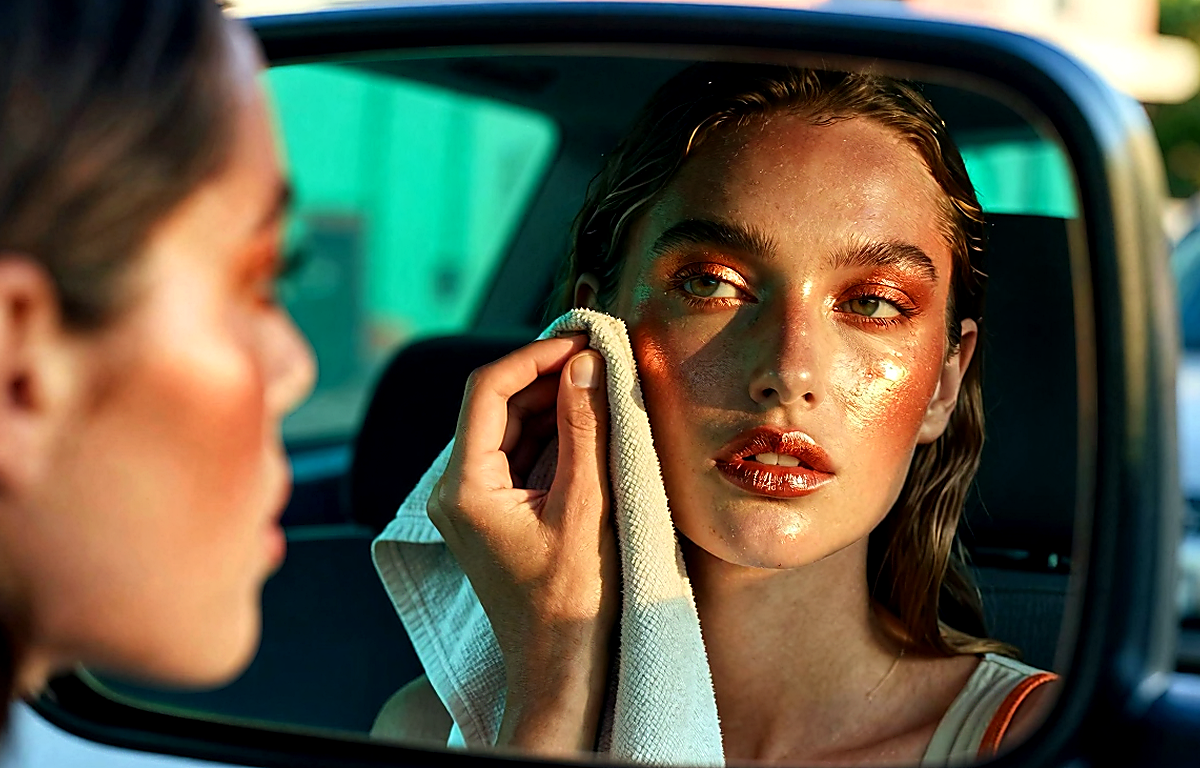
If spots concern you—post-acne marks, traces left after inflammation, pigmentation, or small areas of uneven tone—a concealer really can noticeably improve the look of the skin. But with these areas, coverage alone is not the main point. It is much more important to check how the product behaves specifically on the spot: whether the area turns gray, whether dryness along the edges becomes more visible, whether the pigment starts to show through after an hour, and whether the camouflage looks like a separate “island” on the face. When it comes to Shiseido and concealer, it makes more sense to focus not on bold promises but on four practical things: the accuracy of the shade, compatibility with your skincare and SPF, the type of coverage, and how well the texture works with your skin’s surface.
The main useful takeaway is simple: spots are usually covered best not by the fullest-coverage or lightest concealer, but by one that is close to your skin tone, can be layered thinly, and does not clash with the base underneath your makeup. If you are considering a Shiseido concealer as a reference point in the premium segment, check not only whether it “covers or not,” but also how it looks after 10 minutes, after 2 hours, and over a layer of SPF. That kind of testing is what most often separates beautiful correction from a dense, noticeable patch on the face.
What kind of spots do you want to hide, and why that changes the choice
The word “spots” sounds broad, but in makeup these are very different tasks. A fresh pinkish post-breakout mark is one thing, dense brownish pigmentation is another, and an area with uneven texture and flaking is something else again. The same concealer can perform beautifully in one case and fail in another.
Before buying or testing, it helps to identify exactly what is bothering you:
- Red or pink post-acne marks. Here it matters that the coverage does not turn dirty beige and does not emphasize inflamed texture.
- Brownish or gray-brown pigment spots. In this case, pigment density and an accurate match to your skin tone are especially critical.
- Areas with flaking or dryness. A texture that is too dry or too matte can make the spot more noticeable rather than less.
- Post-inflammatory marks with uneven surface texture. Here the challenge is not only color correction but also how the product sits on the skin’s relief.
The more precisely you understand the type of spot, the easier it is to assess whether a particular concealer is right for your situation rather than relying on general praise.
Why the shade matters more than “strong coverage”
When people want to hide a spot, they often reach for a lighter concealer, assuming it will brighten and disguise the area better. In practice, that choice often makes the spot more visible. A shade that is too light can create a pale patch, and over pigmentation it may even make the area look ashy or gray.
What usually works better is a shade that is as close as possible to your natural skin tone. If the spot is darker than the surrounding skin, the goal is not to highlight it but to blend it into the overall tone of the face. That is why the best test is not on the hand, but directly on the area you want to conceal.
When checking a concealer, pay attention to the following:
- Does the shade merge with the surrounding skin rather than stand out?
- Does the spot turn gray after blending?
- Does the color still look natural in daylight and not only under artificial lighting?
- Does the concealer still look harmonious after foundation, powder, and SPF are all in place?
If the shade match is off, even a technically good formula will not give a convincing result.
Texture and finish: what to check on the skin itself
For spots, texture often matters as much as color. A very dense concealer may seem appealing at first because it gives a quick masking effect. But if it sits heavily, catches on dry edges, or becomes visible on textured skin, the correction will draw attention instead of reducing it.
That is why it is worth checking not only how much the product covers, but what kind of finish it creates:
- Too matte textures can emphasize dryness, flaking, and unevenness.
- Too emollient textures may slide off faster, especially over SPF or in warm weather.
- Balanced satin textures often look the most natural because they do not flatten the skin visually or make the correction too obvious.
Ideally, the concealer should allow thin layering. One dense coat often looks heavier than two very thin ones. If a product starts to look mask-like immediately after application, that is an important warning sign.
Compatibility with skincare and SPF
Even a good concealer can behave unpredictably if it conflicts with the skincare or sun protection underneath. This is especially relevant if you use SPF daily, because sunscreen often changes how makeup grips, sets, and wears throughout the day.
When testing, it is useful to ask not only whether the concealer looks good right away, but whether it stays stable over your usual base. Pay attention to signs such as:
- the product separating on the spot;
- the coverage sliding after a short time;
- patchiness when blending over sunscreen;
- the area looking thicker than the rest of the complexion.
If a concealer only works on bare skin but behaves poorly over your normal morning routine, that limits its real usefulness. In everyday life, the best option is not the one that looks ideal in isolation, but the one that stays consistent in your actual makeup conditions.
How to test wear properly
A quick swatch or a first impression in the mirror is not enough. Spots often reveal a concealer’s weaknesses later: once the product warms up on the skin, settles into the texture, or starts to interact with sebum, powder, or sunscreen.
A practical wear test looks like this:
- Apply the concealer in a thin layer directly onto the spot.
- Wait 10 minutes and check whether the shade changes, the edges become visible, or dryness is emphasized.
- Look again after 2 hours in natural light.
- Check whether the coverage remains even or whether the spot starts to show through in an obvious way.
- Assess the area from a normal conversational distance, not only in close-up.
This approach gives a much more realistic picture than judging the result immediately after application.
Application technique without overloading the area
Even a suitable concealer can look worse if too much product is applied at once. Spots generally respond better to targeted, controlled correction than to a thick blanket of coverage.
A simple technique is often enough:
- apply a minimal amount directly where the discoloration is strongest;
- blend only the edges, not the entire spot aggressively;
- if needed, add a second very thin layer rather than one thick layer;
- set lightly only if your skin and the formula require it.
This helps preserve a natural skin-like look and reduces the risk of creating a visible patch. The goal is not to erase the skin’s texture completely, but to make the color discrepancy less noticeable.
What can indicate that the concealer is not right for this task
Sometimes a concealer is simply not the best choice for concealing spots, even if the brand and formula are attractive overall. Warning signs usually appear quite clearly during testing.
- The spot becomes gray or dull after application.
- The edges of the corrected area remain visible.
- The product settles into dryness and emphasizes flaking.
- The coverage breaks apart quickly over SPF.
- The correction looks heavier than the surrounding skin.
- You feel the need to keep adding more and more product to get a decent result.
If several of these issues appear at once, it is usually better to keep looking than to try to force a product to work.
What is worth concluding before you buy
If spots concern you, the key question is not whether a Shiseido concealer sounds premium or promises strong coverage. What matters is whether the shade is close to your skin, whether the texture can be layered thinly, whether it sits well on uneven areas, and whether it remains stable over your skincare and SPF.
In other words, the most successful concealer for spots is usually the one that stays visually quiet on the skin. It does not turn the area gray, does not emphasize dryness, does not separate during the day, and does not create a dense, obvious patch. That is the standard worth using when you evaluate whether a product truly suits this purpose.