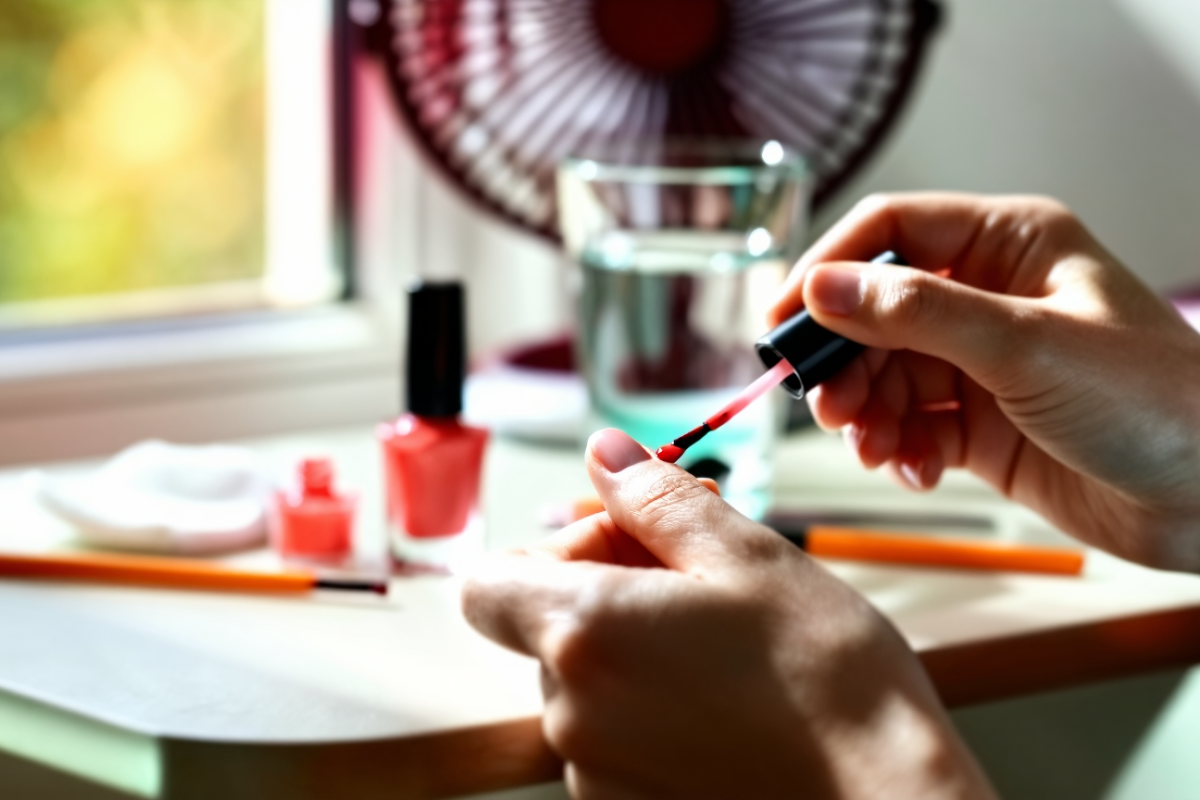
If your nail polish bubbles in hot weather, the fix is almost never a “better top coat,” but a calmer technique: a cool spot, a dry nail plate, a thin coat of polish, and a pause between coats. Do not shake the bottle before applying, do not dry your nails under a strong stream of air, and do not try to cover bubbles with another thick coat.
A practical rule for a summer at-home manicure is this: one thin coat is better than two quick, heavy ones. The brush should leave polish, not a droplet. If the room feels stuffy, move your manicure closer to an open window or turn on gentle general airflow in advance, but do not point a fan directly at wet nails.
Why nail polish bubbles in summer
In hot weather, polish thickens faster on the brush and on the surface of the nail. When the coat goes on too heavily, the top sets before the layer underneath has time to level out. Air stays trapped inside, and small dots or bumps appear on the surface.
The second reason is the habit of shaking the bottle. Air bubbles get inside and then transfer to the brush. It is better to roll the bottle between your palms for a few seconds: the pigment will mix more gently, without extra foam inside.
Prepare your nails without rushing
Before polish, your nails should be dry and clean. If you have just washed your hands, soaked them, or applied hand cream generously, wait a bit. Moisture and an oily film keep the polish from going on evenly.
There is no need to push the cuticle back aggressively at the last minute. It is enough to gently remove any excess at the base of the nail and wipe the area with a dry tissue. If you need a separate calm step-by-step guide, there is also an article on at-home manicure without hangnails.
How to load the brush with polish
Wipe off the excess on the neck of the bottle so that a large drop is not hanging from the brush. For the first coat, a thin film is enough: it may look slightly sheer, and that is normal.
Apply the polish in three calm strokes: center, one side, the other side. Do not move the brush back and forth too many times, or the coat will start to drag and collect air. You can lightly cap the free edge with an almost dry brush.
The pause between coats matters more than speed
Let the first coat become tacky, but not wet. If you apply the second coat right away, the brush shifts the lower layer and traps air. If you wait too long and then apply a very thick amount, the finish can also go on unevenly.
The same logic applies to base coat: a thin layer and control near the cuticle matter more than the amount of product. You can find a detailed breakdown in the article base coat without a thick layer.
Where to dry nail polish in hot weather
The best place is somewhere without direct sun, a hot radiator, steam from the bathroom, or a strong directed wind. An open window, shade, and a normal room temperature are better than trying to dry your nails under a powerful fan.
If you need a fan, switch it on in advance on a low setting and aim it into the room, not at your hands. A strong airflow can dry the top layer too quickly, leave dust marks, and make the surface less smooth.
What to do if bubbles have already appeared
If there are only a few bubbles and they are visible only up close, do not add a thick top coat right away. Let the polish dry completely, then assess it in daylight. Sometimes one careful layer of top coat visually smooths out minor unevenness.
If there are a lot of bubbles, it is better to remove the polish from one or two nails and reapply it more thinly. Covering a noticeable texture with several layers is almost always worse: the nail looks heavier, and the polish takes longer to dry.
Mini checklist before applying
Roll the bottle between your palms; do not shake it. Remove the excess drop from the brush. Apply a thin first coat. Pause. Do not dry under direct hot air. Do not try to fix bubbles with a new thick coat.
After your manicure, you can apply hand cream, but not right before polish and not on the nail plate. If your skin gets dry from frequent washing, this separate guide on hand cream after frequent washing without stickiness may help.
Short conclusion
A summer manicure without bubbles is not a race against time. The hotter it is around you, the more important a thin coat, a calm pause, and no direct airflow over wet polish become. Then the polish looks smoother and needs less fixing.
How to check the result in different lighting
After it dries, look at your nails not only under a lamp, but also by a window. Bubbles and flooding are often visible from the side, when light skims across the surface. If the finish looks even in that position, it will almost always look neat in everyday life.
Do not judge your manicure right after the last coat: wet polish can look wavy at first and then level out slightly. Let it set calmly, keep your hands away from direct airflow, and only then decide whether you need a top coat or a targeted redo of one nail.
If the polish has already thickened
When polish stretches in strings, goes on in ridges, and leaves streaks even with a thin brush, technique will not always save it. Do not add water, alcohol, or random liquids to it: that can ruin the texture and wear of the finish. It is better to use a special thinner, if it is suitable for the product, or set the bottle aside.
For a hot day, choose the most easygoing polish you already have at home: one that spreads easily from the first stroke and does not require a thick coat. Dense tricky shades, old bottles, and textures that thicken quickly are better saved for the evening, when the room is cooler.
Safe short routine
First prepare dry nails, then roll the bottle between your palms, remove the excess drop, apply a thin coat, and pause. The second coat is needed only after the first is no longer wet. If your hand is shaky because of the heat, it is better to stop for a minute than to rush and cover the mistake.
The main goal is not a perfectly fast manicure, but a smooth surface without extra thickness. In summer, this is especially noticeable: the less overloaded the nail is, the lower the risk of bubbles, brush marks, and a long sticky drying time.