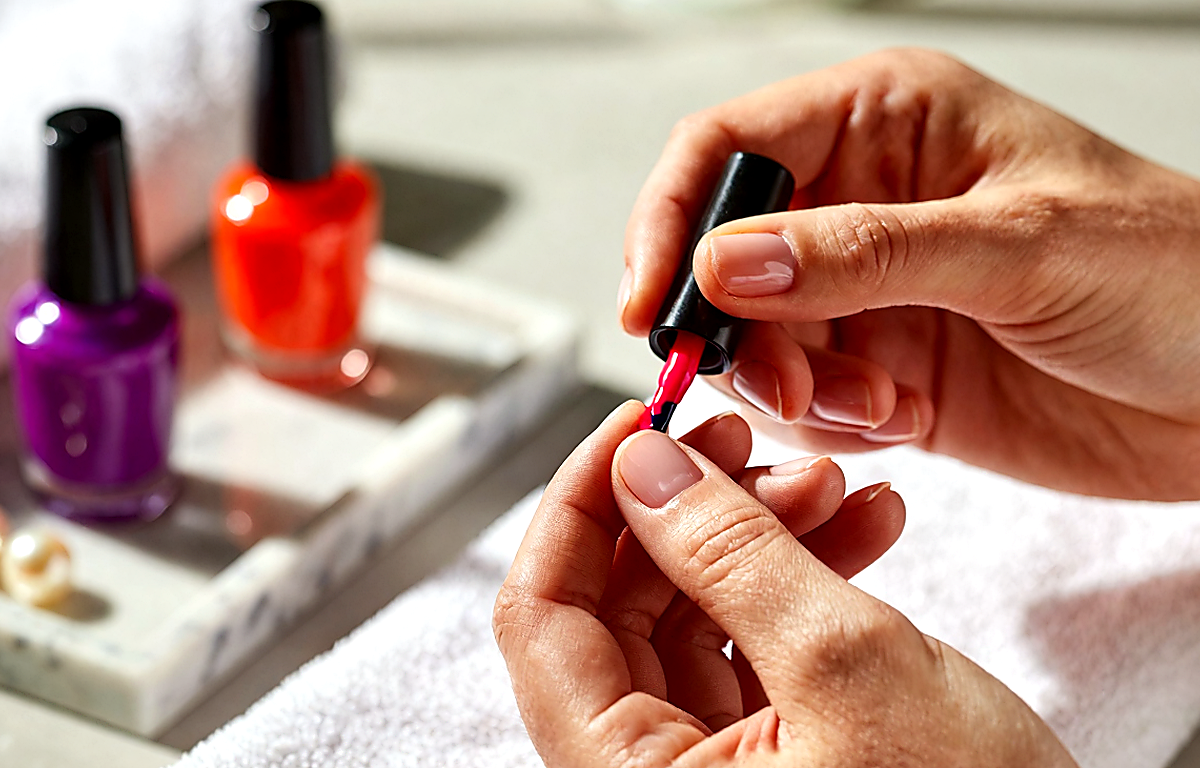
If the skin around your nails quickly turns white, feels tight, or starts to peel after a manicure, the problem is not always the mere fact of using a nail strengthener—very often it comes down to the details of the formula and the way it is applied. When it comes to popular Sally Hansen strengthening coats, it makes more sense to check not the promises on the bottle first, but how well the product fits your tendency toward dryness: how it smells, how quickly it “sets,” whether it requires aggressive degreasing, and whether it reaches the cuticle with every layer.
The main practical takeaway is simple: if your skin is over-dry, it is safer to choose a nail strengthener with the clearest possible purpose, apply it only to the nail plate in thin layers, and offset the risk of dryness in advance with care for the skin around the nail. If the cuticle area becomes stiff after use, or you notice burning, tiny cracks, or pronounced irritation, it is worth reassessing not just the product but your entire at-home manicure routine—from nail polish remover to the habit of cutting dry cuticles back “all the way.”
Why a nail strengthener may not suit dry skin
A nail strengthener is usually seen as a neutral step: apply it to the nails, let it dry, and get a neater, more protected look. But for people with over-dry hand skin, and especially a thin cuticle, even such a basic product can sometimes become a trigger for discomfort. The reason is that many strengthening formulas are designed first of all for durability, adhesion, and quick drying—not for the comfort of the skin around the nail.
The nail plate itself does not “hydrate” the way skin does, but anything that gets onto the sidewalls and cuticle can have a very noticeable effect on how dry your skin feels. If you apply the product close to the skin and then refresh the coating often, the drying effect can build up. As a result, it may seem as though the product is “treating” brittleness while simultaneously making your hands look less well cared for.
It is especially important to be cautious with a nail strengthener if you already have:
- a tendency to flaking around the nails;
- frequent hand washing and sanitizer use;
- a habit of doing dry manicures without any softening care;
- contact with household cleaners without gloves;
- sensitivity to strong smells and solvents.
The brand itself does not guarantee that every product in the range will suit your skin specifically. That is why it makes sense to treat a popular Sally Hansen product as an editorial reference point rather than a universal solution without nuance.
What to check in the formula and description before buying
When choosing a nail strengthener against a backdrop of dry skin, it is important to look beyond words like “strengthening,” “repair,” or “for brittle nails.” It is far more useful to assess indirect signs that suggest whether the formula will feel comfortable to wear.
The first marker is how “harsh” the formula feels in everyday use. A very sharp smell, instant evaporation, and a feeling of dryness immediately after application do not always mean it is a bad product, but for a sensitive cuticle they are reasons to be more careful.
It makes sense to check for:
- the presence of intensely scented solvents—they are often associated with a feeling of dryness around the nails, especially when the coating is refreshed often;
- formaldehyde-type or very “hard” strengthening components in older or more aggressive formulas—these products may appeal because of a quick visual effect, but they are not always comfortable when skin is sensitive;
- fragrance and extra actives—the more nonessential aromatic and decorative additives there are, the greater the chance of irritation for reactive skin;
- a promise of very fast drying—convenient, but such formulas can sometimes emphasize dryness more when they come into regular contact with the cuticle;
- the usage pattern—if the product requires several daily layers in a row, the burden on the skin may be higher.
It is also useful to distinguish between product types. Some nail strengtheners work like a clear base, others as an intensive course, and others as a hybrid of decorative and care coating. With dry skin, the least problematic option is usually the one that does not require frequent multi-layer refreshing and does not create the urge to “touch up” the result every two days.
If you generally notice that your skin is reactive, it is sensible to test the product carefully first: apply it to one or two nails, avoiding the cuticle, and watch how it feels over the next 24 hours. This is not medical advice, just a simple practical way not to worsen the condition of both hands at once.
How to tell from your symptoms whether the product itself is drying you out—or the whole manicure ritual
One of the most common mistakes is blaming only the strengthening coat, when in fact dryness is caused by a whole chain of actions. For example, you remove the old coating with an acetone-based remover, then buff the surface, then degrease the nails, and only after that apply two layers of strengthener. In that kind of routine, even a gentle product can seem too aggressive.
Try to assess exactly when the discomfort begins:
- right after removing the old coating—the remover is more likely to be the culprit;
- after filing and buffing—the problem may be mechanical thinning and trauma around the cuticle area;
- a few hours after application—it is worth checking the strengthening product itself and whether it is flooding onto the skin;
- on the second or third day—the skin is probably being over-dried by the combination of coating, frequent hand washing, and lack of follow-up care.
A useful guide: if the nail plate looks fine and the skin around it is what suffers most, the issue is more often either product getting onto the cuticle or overall hand dryness. If, on the other hand, you notice brittleness, increased nail sensitivity, and a constant urge to file off layers, your routine may be too intense overall.
In that sense, a Sally Hansen nail strengthener is best assessed not in isolation, but together with your other habits. For at-home care, the logic is the same as in basic facial care: what works is not one loud product, but the whole system. If you want to look at this principle more broadly, this article on how to build a basic skincare routine without unnecessary steps is useful—the same idea applies beautifully to hand care too.
Which texture and application pattern tend to feel more comfortable with a dry cuticle
Even a good product can become uncomfortable if you apply it too generously. With over-dry skin, the principle that works best is “less, but more precisely.” A thin, even layer on the nail plate is usually better tolerated than a thick coat that floods into the sidewalls and stays in contact with the skin longer.
What usually helps:
- apply the product with a small gap from the cuticle;
- do not try to “seal” the skin at the base of the nail;
- choose 1–2 thin layers instead of one dense one;
- let each layer dry fully so you are not stacking a still-wet formula;
- remove any excess with an orange stick right away, not after it dries.
If you use a nail strengthener as a standalone clear coat, it is important not to turn it into a continuous multi-week “shell.” Sometimes the nails—and especially the skin around them—look better when there is a short pause between cycles, with the focus shifted to cuticle oil and hand cream.
Pay attention to the finish as well. A very glossy, dense-looking coating appeals visually to many people, but with dry skin a lighter approach can feel more comfortable: a neat strengthener plus regular cuticle softening. That way, the overall look stays polished while the hands do not appear dehydrated.
Which mistakes make dryness worse even with a well-chosen nail strengthener
Sometimes the product itself suits the user, but the result is still disappointing because of everyday habits. This is especially relevant for dry hand skin: the manicure may look tidy, while the area around the nails looks tired and rough. Below are the common mistakes worth ruling out first.
- Removing and reapplying too often. If you refresh the strengthening coat every 1–2 days, the skin gets constant contact with solvents.
- Aggressive cuticle removal. Cutting everything back “to perfection” is almost always a bad idea with dry skin: micro-damage makes reactions to coatings more noticeable.
- Ignoring hand cream. A nail strengthener does not replace skin care. If your hands are dehydrated, the manicure will only highlight the issue.
- Applying it right after a shower or cleaning. When the skin is already softened and then quickly degreased, the feeling of tightness may become stronger.
- Using a buffer unnecessarily. Excessive buffing not only thins the nail, it also creates the urge to apply a “rescue” coating more often.
- Contact with household cleaners without gloves. Even a successful product cannot compensate for daily over-drying.
If you are dealing not only with dryness around the nails but also with generally reactive body skin in the warm season, it is worth rethinking the surrounding care routine. Sometimes the result improves noticeably when the overall routine becomes gentler—for example, with light but regular moisturizing for the hands and body. You can use this article on a lightweight body cream without stickiness as a reference point for the same principle: a texture you actually want to use consistently usually works better than occasional “heavy” care.
When a Sally Hansen nail strengthener may make sense—and when it is better to look for an alternative
Sally Hansen is one of those brands many people think of first when they want a straightforward product for at-home manicures. That is convenient: broad recognition, different nail-strengthening formats, and clear positioning. But with over-dry skin, it is better to focus not on popularity, but on how well a specific formula fits into your routine.
The product may make sense if:
- you want a neat strengthening layer without a complicated technique;
- you are ready to apply the product precisely, without touching the skin;
- you do not have a strong reaction to smells and solvents;
- you use cuticle oil and hand cream alongside it;
- your main goal is to improve the look of your nails and bring more discipline to your at-home manicure—not to “cure” a serious nail problem.
It is better to look for a gentler alternative or reduce how often you use it if:
- every application causes burning or intense tightness;
- the skin around the nails starts to crack;
- you feel discomfort from the smell of the formula alone;
- you have to remove the coating often because of chipping;
- your nails and skin are going through a period of heightened sensitivity—for example, after wearing long-lasting coatings for a long time.
It is important to remember: a nail strengthener is a cosmetic product, not a therapy. It can make the nails look more polished and partly protect the nail plate from everyday wear, but it should not cause ongoing discomfort to the skin.
How to build a gentle at-home routine if your skin is already over-dry
If dryness is already noticeable, it is better not to try to solve it with a new bottle alone. It is much more effective to simplify your routine for 2–3 weeks and remove everything that may further irritate the skin. This kind of “gentle mode” often gives a more visible result than constantly switching nail strengtheners.
A practical routine may look like this:
- Remove the old coating with the gentlest remover possible, and do not rub the nail for too long.
- Do not buff the plate unless necessary.
- Gently push back the cuticle after a shower or soak rather than cutting it aggressively.
- Apply the nail strengthener only to a dry nail, keeping a distance from the skin.
- After it has dried completely, use cuticle oil.
- Reapply hand cream during the day, especially after washing.
- Wear gloves while cleaning and washing dishes.
If you want a more “magazine-like” result without the effect of overloaded hands, focus not on the number of layers but on a clean nail shape, a neat cuticle, and a nice soft shine. That is when a nail strengthener looks expensive and modern—without making it seem as though the skin is suffering for the sake of the coating.
By the way, dryness often gets worse seasonally: heat, air conditioning, frequent hand washing, travel. In that sense, hand care behaves almost like hair in humid or changeable weather—external conditions change everything. This article on how to adapt your routine to air humidity helps explain the logic: for hands, the principle is similar, only instead of frizz you get tightness and flaking.
When it is better not to experiment on your own
Mild dryness and roughness around the nails can often be improved with care and more precise product application. But there are situations in which you should not keep changing nail strengtheners endlessly in the hope that “the next one will work.” If you notice persistent burning, pain, swelling, oozing, pronounced redness, nail deformation, or signs of infection, what you need is not a new cosmetic product but an in-person medical consultation.
Extra caution is also important during pregnancy, when using retinoids, and if you have diagnosed skin conditions or a strong tendency toward allergic reactions. In such cases, even a familiar at-home manicure is better kept simpler, and any new products should be introduced especially carefully.
If discomfort appears every time after applying a strengthening coat, do not dismiss it as the “normal price of beauty.” A comfortable care routine does exist, and it should not include constant skin irritation.
Conclusion
If over-dry skin is your concern, the most important thing when choosing a Sally Hansen nail strengthener is not the bold promises but the compatibility of the formula with a sensitive cuticle and your everyday habits. Pay attention to how sharp the formula and smell feel, do not apply the product onto the skin, avoid refreshing the coating too often, and make sure to support your hands with cream and cuticle oil. A popular product can work beautifully as a neat part of an at-home manicure, but only when it is built into a gentle routine rather than trying on its own to compensate for dryness, traumatic manicure habits, and lack of care.